Last updated An example commercial pre-printed paceband
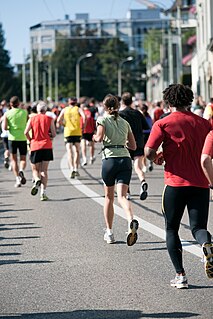
A paceband is a wristband, sometimes made of a strip of waterproof paper, that lists expected split times for a running race. When used in conjunction with a stopwatch, a paceband can assist athletes in maintaining a steady pace throughout the race. This is the most efficient racing pace from a cardiovascular and muscle energy perspective. Erratic running speeds, particularly the urge to sprint early in a race while feeling fresh, consume energy inefficiently. A glance at the paceband and stopwatch as each distance marker is passed allows the athlete to quickly determine if they are running too fast for their targeted finishing time or too slowly and adjust accordingly.
Wristbands are encircling strips worn on the wrist or lower forearm. The term can be used to refer to a bracelet-like band, similar to that of a wristwatch, to the cuff or other part of a sleeve that covers the wrist, or decorative or functional bands worn on the wrist for many different reasons. Wristbands are often worn and used similarly to event passes such as lanyards to information or allow people entry to events. These wristbands are made from loops of plastic that are placed around the wrist and are used for identification purposes.
Waterproof paper is a type of paper that is good for outdoor, marine, field use and general wet environments. Often designed especially for printing topographic maps. It is normally durable and tear-resistant.
In sport, racing is a competition of speed, against an objective criterion, usually a clock or to a specific point. The competitors in a race try to complete a given task in the shortest amount of time. Typically this involves traversing some distance, but it can be any other task involving speed to reach a specific goal.
Pre-printed versions for a variety of target finishing times can often be obtained before endurance races such as marathons, or commercially. Many websites exist that allow the free creation of customised pacebands for different distances and target finishing times that can be printed on the visitor's own computer.
Long-distance running, or endurance running, is a form of continuous running over distances of at least 3 kilometres (1.8 miles). Physiologically, it is largely aerobic in nature and requires stamina as well as mental strength.
The marathon is a long-distance race with an official distance of 42.195 kilometres, usually run as a road race. The event was instituted in commemoration of the fabled run of the Greek soldier Pheidippides, a messenger from the Battle of Marathon to Athens, who reported the victory. The marathon can be completed by running or with a run/walk strategy. There are also wheelchair divisions.
A website or web site is a collection of related network web resources, such as web pages, multimedia content, which are typically identified with a common domain name, and published on at least one web server. Notable examples are wikipedia.org, google.com, and amazon.com.
Paavo Johannes Nurmi was a Finnish middle-distance and long-distance runner. He was called the "Flying Finn" or the "Phantom Finn", as he dominated distance running in the early 20th century. Nurmi set 22 official world records at distances between 1500 metres and 20 kilometres, and won nine gold and three silver medals in his twelve events in the Olympic Games. At his peak, Nurmi was undefeated for 121 races at distances from 800 m upwards. Throughout his 14-year career, he remained unbeaten in cross country events and the 10,000 m.
Athletics is a collection of sporting events that involve competitive running, jumping, throwing, and walking. The most common types of athletics competitions are track and field, road running, cross country running, and race walking.
The Boston Marathon is an annual marathon race hosted by several cities in greater Boston in eastern Massachusetts, United States. It is always held on Patriots' Day, the third Monday of April. Begun in 1897, the event was inspired by the success of the first marathon competition in the 1896 Summer Olympics. The Boston Marathon is the world's oldest annual marathon and ranks as one of the world's best-known road racing events. It is one of six World Marathon Majors. Its course runs from Hopkinton in southern Middlesex County to Copley Square in Boston.
Joan Benoit Samuelson is an American Senior Grand Masters marathon runner who was the first-ever women's Olympic Games marathon champion, winning the Gold medal at the 1984 Summer Olympics in Los Angeles. She held the fastest time for an American woman at the Chicago Marathon for 32 years after winning the race in 1985. Her time at the Boston Marathon was the fastest time by an American woman at that race for 28 years. She was inducted into the Maine Women's Hall of Fame in 2000.
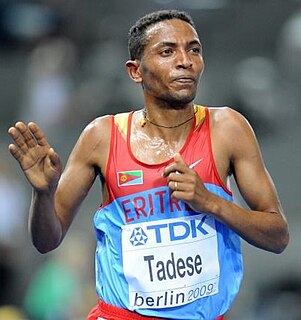
Zersenay Tadese is an Eritrean long-distance track and road running athlete. He held the men's half marathon world record from 2010 to 2018. His bronze medal in the 10,000 metres at the 2004 Athens Olympics made him the first ever Eritrean Olympic medallist, and his 20-km title at the 2006 IAAF World Road Running Championships also made him the country's first athlete to win at a world championship event. He does not use a sprint finish to win races; his strategy relies on a combination of efficient running and fast pace setting.
Fartlek, which means "speed play" in Swedish, is continuous training with interval training. Fartlek runs are a very simple form of a long distance run. Fartlek training “is simply defined as periods of fast running intermixed with periods of slower running." For some people, this could be a mix of jogging and sprinting, but for beginners it could be walking with jogging sections added in when possible. A simple example of what a runner would do during a fartlek run is “sprint all out from one light pole to the next, jog to the corner, give a medium effort for a couple of blocks, jog between four light poles and sprint to a stop sign, and so on, for a set total time or distance." The variable intensity and continuous nature of the exercise places stress on both the aerobic and anaerobic systems. It differs from traditional interval training in that it is unstructured; intensity and/or speed varies, as the athlete wishes. Fartlek training is generally associated with running, but can include almost any kind of exercise.
Arthur Leslie Lydiard was a New Zealand runner and athletics coach. He has been lauded as one of the outstanding athletics coaches of all time and is credited with popularising the sport of running and making it commonplace across the sporting world. His training methods are based on a strong endurance base and periodisation.
A pacemaker or pacesetter, sometimes informally called a rabbit, is a runner who leads a middle- or long distance running event for the first section to ensure a fast time and avoid excessive tactical racing. Pacemakers are frequently employed by race organisers for world record attempts with specific instructions for lap times. Some athletes have essentially become professional pacemakers. A competitor who chooses the tactic of leading in order to win is called a front-runner rather than a pacemaker.
Fatuma Roba is an Ethiopian long distance runner, best known for being the first African woman to win a gold medal in the women's Olympic marathon race at the Atlanta 1996 Summer Olympics and for winning three successive Boston Marathons.
The men's marathon race of the 1908 Summer Olympics took place in London on 24 July 1908. Johnny Hayes won after Dorando Pietri was disqualified for having received assistance before the finish line. For the first time in an Olympic marathon, the distance was 26 mi 385 yd (42.195 km), which would become the standard distance in 1921. 75 competitors entered the race, of whom 55 from 16 nations started, with 27 from 11 nations finishing.
Ted Corbitt was an American long-distance runner and an official of running organizations. Corbitt is often called "the father of long distance running." He was an ultramarathon pioneer, helping to revive interest in the sport in the United States in the 1960s and 1970s. New York Times columnist Robert Lipsyte called Corbitt a "spiritual elder of the modern running clan". In a Runner's World feature honoring lifetime achievement, writer Gail Kislevitz called Corbitt a "symbol of durability and longevity".
The Association of International Marathons and Distance Races, also known as AIMS, is an association of the organisers of long-distance road running races. It was founded in 1982 at a meeting in London of marathon race directors. Its membership was extended in 1986 to include all road races. In June 2016, over 400 race organisations were members.
Lawrence Joseph "Larry" Brignolia, sometimes Brignoli, was an American long-distance runner and sculler of Italian descent. He won the 1899 Boston Marathon. A 161-pound blacksmith, he is the heaviest person ever to claim victory in the event. He is also the only person to have finished all of the first three Boston Marathons, and one of two runners who participated in all of the first four marathons.
The sports under the umbrella of athletics, particularly track and field, use a variety of statistics. In order to report that information efficiently, numerous abbreviations have grown to be common in the sport.
A negative split is a racing strategy that involves completing the second half of a race faster than the first half. It is defined by the intentional setting of a slower initial pace, followed by a gradual or sudden increase of speed towards the end of the race. Alternate strategies include even splitting or sit and kick. Conversely, the act of completing the first half of a race faster than the second half is known as a positive split.
Kieren D’Souza is an Indian ultramarathon runner and endurance athlete. In 2016, he became the first and, as of October 2016, the only Indian to qualify for and finish the Spartathlon, a 246 kilometre footrace from Athens to Sparta held annually in Greece. Kieren, then aged 23, completed the race in 33 hours, 2 minutes and 25 seconds, standing 85th among 370 participants. Till 2016, only 29 athletes under the age of 25 had completed the race that has been held annually since 1983.
The physiology of marathons are typically associated with high demands on a marathon runner's the cardiovascular system and their locomotor system. The Marathon was conceived centuries ago and as of recent has been gaining popularity among many populations around the world. The, now, 42.195 km distance is a physical challenge that entails distinct features of an individual's energy metabolism. In order to understand why marathon runners finish at different times, it is important to understand what physiological characteristics of marathon runners consistently present themselves.
This page is based on this Wikipedia article Text is available under the CC BY-SA 4.0 license; additional terms may apply. Images, videos and audio are available under their respective licenses.