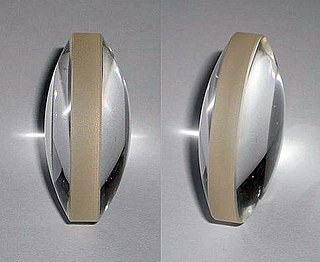
A lens is a transmissive optical device that focuses or disperses a light beam by means of refraction. A simple lens consists of a single piece of transparent material, while a compound lens consists of several simple lenses (elements), usually arranged along a common axis. Lenses are made from materials such as glass or plastic, and are ground and polished or molded to a desired shape. A lens can focus light to form an image, unlike a prism, which refracts light without focusing. Devices that similarly focus or disperse waves and radiation other than visible light are also called lenses, such as microwave lenses, electron lenses, acoustic lenses, or explosive lenses.

Plano is a city in the U.S. state of Texas, located approximately twenty miles north of downtown Dallas. The city of Plano is a part of the Dallas-Fort Worth metropolitan area. Plano lies mostly within Collin County, but includes a small portion that extends into Denton County.

Amanita pantherina, also known as the panther cap and false blusher due to its similarity to the true blusher (Amanita rubescens), is a species of fungus found in Europe and Western Asia.

A Klieg light is an intense carbon arc lamp especially used in filmmaking. It is named after inventor John Kliegl and his brother Anton Kliegl. Klieg lights usually have a Fresnel lens with a spherical reflector or an ellipsoidal reflector with a lens train containing two plano-convex lenses or a single step lens.

Ellipsoidal reflector light is the name for a type of stage lighting instrument, named for the ellipsoidal reflector used to collect and direct the light through a barrel that contains a lens or lens train. The optics of an ERS instrument are roughly similar to those of a 35 mm slide projector. There are many types of ERS that are designed for the myriad applications found in the entertainment industry. ERS instruments come in all shapes and sizes. Each particular model of ERS has its own set of characteristics. Generally, ERS instruments are the most varied and utilized type of stage lighting instrument. ERS may also be referred to as Profile Spotlights because the beam can be shaped to the profile of an object. Ellipsoidal reflectors are used for their strong, well-defined light and their versatility. Leko and Source Four are brand names which are often, but inaccurately, used to refer to any sort of ellipsoidal.

Plano Independent School District is a public school district in southwestern Collin County, Texas, based in Plano. Plano ISD serves about 100 square miles (260 km2) of land, with 66 square miles (170 km2) of it within the City of Plano. The district also takes students from northern portions of Dallas and Richardson, and portions of Allen, Carrollton, Garland, Lucas, Murphy, Parker, and Wylie.

Plano Senior High School is a public secondary school in Plano, Texas, serving students in grades 11–12. The school is part of the Plano Independent School District, with admission based primarily on the locations of students' homes. Plano is a two-time Blue Ribbon School and a Texas Exemplary School.

Plano West Senior High School is a public high school in Plano, Texas serving high school juniors and seniors. The school is part of the Plano Independent School District, and enrolls students based on the locations of students' homes. Students at Plano West attended one of two high schools: Jasper or Shepton. Plano West is accredited by the Texas Education Agency, which designates the school as "Recognized." The school colors are royal blue, black, and white, and the mascot is the wolf. The school is ranked as 22nd in the nation, and as the #1 comprehensive high school in the State of Texas, according to Newsweek's 2016 list of best public high schools.

A dome magnifier is a dome-shaped magnifying device made of glass or acrylic plastic, used to enlarge words on a page or computer screen. They are plano-convex lenses: the flat (planar) surface is placed on the object to be magnified, and the convex (dome) surface provides the enlargement. They usually provide between 1.8× and 6× magnification. Dome magnifiers are often used by the visually impaired. They are good for reading maps or basic text and their inherent 180° design naturally amplifies illumination from ambient side-light. They are suitable for people with tremors or impaired motor skills, because they are held in contact with the page during use.
Amanita altipes, also called the yellow long-stem amanita, is a species of agaric fungus found on soil in coniferous and broadleaved woodland in southwestern China up to an altitude of 4,000 metres (13,000 ft). The specific epithet altipes means "referring to the long stipe", and it suits the species as it has a longer stipe compared to its relatives.

Amanita arocheae, also known as the Latin American death cap, is a mushroom of the large genus Amanita, which occurs in Mexico, Central America and South America. Deadly poisonous, it is a member of section Phalloideae and related to the death cap A. phalloides.

Psilocybe fimetaria is a psilocybin mushroom, having psilocybin and psilocin as main active compounds.

Precision glass moulding is a replicative process that allows the production of high precision optical components from glass without grinding and polishing. The process is also known as ultra-precision glass pressing. It is used to manufacture precision glass lenses for consumer products such as digital cameras, and high-end products like medical systems. The main advantage over mechanical lens production is that complex lens geometries such as aspheres can be produced cost-efficiently.
Plano-convex ingots are lumps of metal with a flat or slightly concave top and a convex base. They are sometimes, misleadingly, referred to as bun ingots which imply the opposite orientation of concavity. They are most often made of copper although plano-convex ingots of other materials such as copper alloy, lead and tin are also known. Plano convex ingots are found across a wide chronological and geographical range with the first examples known from the Near East during the 3rd and 2nd Millennia BC. By the end of the Bronze Age they were found throughout Europe and in Western and South Asia and similar ingot forms continue in use during later Roman and Medieval periods.
A condenser is an optical lens which renders a divergent beam from a point source into a parallel or converging beam to illuminate an object.

Amanita nehuta, also called Maori Dust Amanita, is a species of fungus in the Amanitaceae family. It was first described by New Zealand mycologist Geoff Ridley in 1991. It occurs in New Zealand in large number. It has only a dark ring rather than a universal veil and white spores. It is found under leptospermum and Nothofagus. It grows on ground usually in late summer. Its height is 110 mm and width is 100 mm.
Hell Gap complex is a Plano culture from 10,060 to 9,600 before present. It is named after the Hell Gap archaeological site, in Goshen County, Wyoming.
Rosalina is a genus of foraminifera included in the rotaliid family Rosalinidae.

Pecten excavatus is a species of scallop, marine bivalve molluscs in the taxonomic family Pectinidae.


