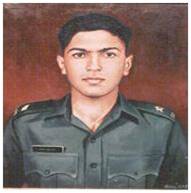
Second Lieutenant Arun Khetarpal, PVC born in Pune, Maharashtra, was an officer of the Indian Army and a posthumous recipient of the Param Vir Chakra, India's highest military decoration for valour in face of the enemy. He was killed in action in the Battle of Basantar in the Battlefield of Shakargarh during the Indo-Pakistan War of 1971 where his actions earned him his honour.

Ranna was one of the earliest and arguably one of the greatest poets of the Kannada language. His style of writing is often compared to that of Adikavi Pampa who wrote in the early 10th century. Together, Ranna, Adikavi Pampa and Sri Ponna are called "three gems of ancient Kannada literature".
Pune is a district in the state of Maharashtra, India. Pune City Central is the District Headquarters. The district's population was 9,426,959 in the 2011 census, the fourth-most-populous of India's 640 districts. Its urban population is 58.08 percent of its total population; the population of the Pune urban area is over five million.
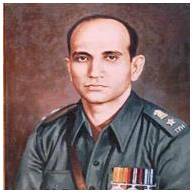
Lieutenant Colonel Ardeshir Burzorji Tarapore, PVC, was an officer in the Indian Army and a recipient of the Param Vir Chakra, India's highest award for bravery. After completing his schooling in Pune, Tarapore joined the Hyderabad Army, and was commissioned in January 1942. Initially he joined the infantry, but was later transferred to an armoured regiment, the 1st Hyderabad Imperial Service Lancers. During World War II Tarapore saw action in the Middle East.
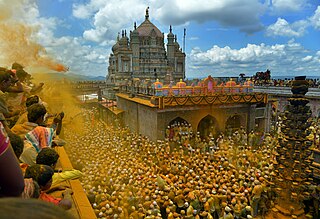
Jejuri is a city and a municipal council in Pune district in the Indian state of Maharashtra. It is famous for the main temple of Lord Khandoba. It is a famous temple town being the family deity of many houses in Maharashtra and Karnataka. Its economy is centered on businesses catering to the numerous devotees coming to worship the Khandoba Temple there. Recently the increase in property rates and the planning of an international airport near the town has seen a spurt of development happening there.
Jaya Bharata Jananiya Tanujate is a Kannada poem, which was composed by the Indian national poet Kuvempu. The poem was officially declared the state song of the Indian state of Karnataka on January 6, 2004.

Rashtrakuta literature is the body of work created during the rule of the Rastrakutas of Manyakheta, a dynasty that ruled the southern and central parts of the Deccan, India between the 8th and 10th centuries. The period of their rule was an important time in the history of South Indian literature in general and Kannada literature in particular. This era was practically the end of classical Prakrit and Sanskrit writings when a whole wealth of topics were available to be written in Kannada. Some of Kannada's most famous poets graced the courts of the Rashtrakuta kings. Court poets and royalty created eminent works in Kannada and Sanskrit, that spanned such literary forms as prose, poetry, rhetoric, epics and grammar. Famous scholars even wrote on secular subjects such as mathematics. Rashtrakuta inscriptions were also written in expressive and poetic Kannada and Sanskrit, rather than plain documentary prose.

Deccan College Post-Graduate and Research Institute also referred to as Deccan College is a post-graduate institute of Archeology, Linguistics and Sanskrit & Lexicography Pune, India.
Pune is the 9th most populous city in India and the second-largest in the state of Maharashtra, after the state capital Mumbai. The history of the city is closely related to the rise of the Maratha empire from 17th–18th century. In the 18th century, Pune became the political centre of the Indian subcontinent, as the seat of the Peshwas, who were the prime ministers of the Maratha Empire.

The Bombay Army was the army of the Bombay Presidency, one of the three presidencies of British India within the British Empire.
Asaga was a 9th-century Digambara Jain poet who wrote in Sanskrit and Kannada language. He is most known for his extant work in Sanskrit, the Vardhaman Charitra. This epic poem which runs into eighteen cantos was written in 853 CE. It is the earliest available Sanskrit biography of the last tirthankara of Jainism, Mahavira. In all, he authored at least eight works in Sanskrit. In Kannada, none of his writings, including the Karnataka Kumarasambhava Kavya that have been referenced by latter day poets have survived.

MLR Karthikeyan is an Indian playback singer who has lent his voice in Tamil, Telugu, and Kannada films.
The Secunderabad Cavalry Brigade was a cavalry brigade of the British Indian Army formed in 1907 as a result of the Kitchener Reforms. It was mobilized as 9th (Secunderabad) Cavalry Brigade at the outbreak of the First World War and departed for France. It served on the Western Front as part of the 1st and 2nd Indian Cavalry Divisions until it was broken up in March 1918.
6TH LANCERS, part of the Armoured Corps of the Indian Army, was raised on 1 February 1984 at Nabha, Punjab as 6 Armoured Regiment.
The 6th Poona Divisional Area was an infantry division of the British Indian Army that formed part of the Indian Army during the First World War. It was formed in October 1914 to replace the original 6th (Poona) Division that had been mobilized in September 1914 for service in Mesopotamia. It was renamed as Poona Division in June 1917 and remained in India throughout the war. The division was redesignated as Poona District in 1920.
This page is based on this
Wikipedia article Text is available under the
CC BY-SA 4.0 license; additional terms may apply.
Images, videos and audio are available under their respective licenses.