
Line 3 is a subway line serving Milan, Italy. The line is part of the Milan Metro and is operated by ATM. Construction began in 1981 in order to be ready for the 1990 Football World Cup. It is also called the Yellow Line as it is identified by yellow signage.

Torino Porta Susa is a railway station in Turin, northern Italy; it is the second busiest mainline station in the city, after Torino Porta Nuova. It is located in Corso Inghilterra.

Torino Porta Nuova railway station is the main railway station of Turin, northern Italy. It is the third busiest station in Italy for passenger flow after Rome Termini and Milan Central, with about 192,000 journeys per day and 70 million travellers a year and a total of about 350 trains per day. Porta Nuova is a terminal station, with trains arriving perpendicularly to the facade. The station is located in corso Vittorio Emanuele II, right in front of piazza Carlo Felice.

Milano Porta Garibaldi is a major railway station in the Italian city of Milan, located just to the north of the neighbourhood known as Porta Garibaldi. Porta Garibaldi is the city's main station for commuter traffic with 25 million passengers annually, although it is second to Centrale station considering total passenger traffic. The station is located on Piazza Sigmund Freud.

Missori is a station of Milan Metro, belonging to Line 3. The station was opened in 1990, with the opening of the line, being part of the original trunk Porta Romana - Centrale.
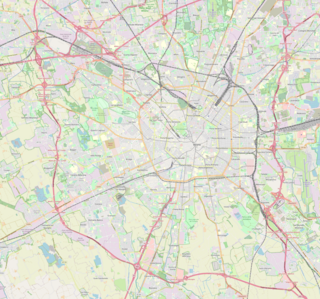
Crocetta is a station of Milan Metro, belonging to Line 3. The station was opened in 1990, with the opening of the line, being part of the original trunk Porta Romana - Centrale.

Porta Venezia is an underground station of Line 1 of Milan Metro. It opened in 1964.
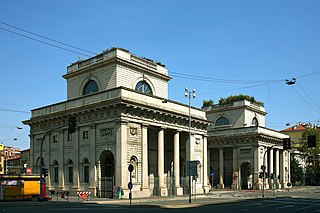
Porta Venezia is one of the historical gates of the city of Milan, Italy. In its present form, the gate dates back to the 19th century; nevertheless, its origins can be traced back to the Medieval and even the Roman walls of the city.
Vigentino is a district ("quartiere") of Milan, Italy, part of the Zone 5 administrative division, located south of the city centre. Before 1923, Vigentino was an autonomous, rural comune. By the mid 20th century, agricultural activities were dismissed, and the area was largely urbanized, with the construction of large apartment blocks.

Chiaravalle is a district (quartiere) of Milan, Italy, part of the Zone 5 administrative division of the city. It is located in the periphery south of the city centre, within the Parco Agricolo Sud Milano nature reserve.

Porta Genova is a neighborhood ("quartiere") of Milan, Italy, located within the Zone 6 administrative division. The name "Porta Genova" means "Genoa gate"; the district is named after a city gate of the old Spanish Walls of Milan, namely that leading to Genoa, that used to be in what is now Piazza Cantore. The only remnants of the old gate are the small buildings that used to house the customs offices, which replaced the Spanish gate in the 19th Century.

Lodi T.I.B.B. is a metro station in Milan, Italy on Line 3 of the Milan Metro. The station is located in Piazzale Lodi and is partially named after the company Tecnomasio Italiano Brown Boveri (T.I.B.B.) which built underground trains for years. This is an underground station with 2 tracks in a single barrel.
The city Milan, Italy, has had three different systems of defending walls. The oldest, Roman walls were developed in two stages, the first in the Republican and the second in the Imperial era. The second wall system was realized in the Middle Ages, after the destruction of the city by Frederick I Barbarossa. Finally, the latest wall system was built by the Spanish rulers. While very little remains of these walls, their structure is clearly reflected in the urbanistic layout of the city. In particular, modern Milan has two roughly circular rings of streets, namely the "Cerchia dei Navigli" and the "Cerchia dei Bastioni", which essentially correspond to the Medieval and Spanish walls, respectively.

The Milan suburban railway service is a commuter rail system serving the metropolitan area of Milan, Italy.
The system comprises 12 lines serving 125 stations, for a total length of 403 km. There are 415 trains per day with a daily ridership of about 230,000.

Palazzo Annoni is a 17th-century Baroque building in Milan, Italy. It is located at nr. 6 of Corso di Porta Romana.

Porta Genova is a station on the Line 2 of Milan Metro.

Milano Porta Romana is a railway station in Milan, Italy.

The Zone 4 of Milan is one of the 9 administrative zones of Milan, Italy. It lies in the south-eastern area of the city.


