
Pyramus and Thisbē are a pair of ill-fated lovers whose story forms part of Ovid's Metamorphoses. The story has since been retold by many authors.

A mechanical is any of six characters in A Midsummer Night's Dream who perform the play-within-a-play Pyramus and Thisbe. Named for their occupations as skilled manual laborers, they are a group of amateur and mostly incompetent actors from around Athens, looking to make names for themselves by having their production chosen among several acts as the courtly entertainment for the royal wedding party of Theseus and Hippolyta.

Mopsuestia is an ancient city in Cilicia Campestris on the Pyramus River located approximately 20 km (12 mi) east of ancient Antiochia in Cilicia. From the city's harbour the river is navigable to the Mediterranean Sea, a distance of over 40 km (24 mi).
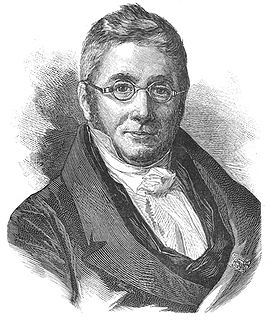
Augustin Pyramus de Candolle also spelled Augustin Pyrame de Candolle was a Swiss botanist. René Louiche Desfontaines launched de Candolle's botanical career by recommending him at an herbarium. Within a couple of years de Candolle had established a new genus, and he went on to document hundreds of plant families and create a new natural plant classification system. Although de Candolle's main focus was botany, he also contributed to related fields such as phytogeography, agronomy, paleontology, medical botany, and economic botany.
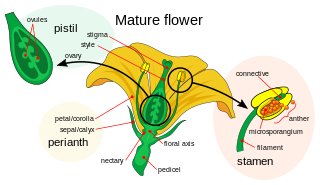
A tepal is one of the outer parts of a flower. The term is used when these parts cannot easily be classified as either sepals or petals. This may be because the parts of the perianth are undifferentiated, as in Magnolia, or because, although it is possible to distinguish an outer whorl of sepals from an inner whorl of petals, the sepals and petals have similar appearance to one another. The term was first proposed by Augustin Pyramus de Candolle in 1827 and was constructed by analogy with the terms "petal" and "sepal".

The Shropshire & Montgomeryshire Light Railway was a railway running from Shrewsbury, England to Llanymynech, Wales, with a branch to Criggion. The line was taken over by the War Department in 1941, and extensively reconstructed to serve Central Ammunition Depot Nesscliffe. It was finally closed in 1960.

Cataonia was one of the divisions of ancient Cappadocia.

Tom Snout is a character in William Shakespeare's A Midsummer Night's Dream. He is a tinker, and one of the "mechanicals" of Athens, amateur players in Pyramus and Thisbe, a play within the play.
Antiochia ad Pyramum was an ancient coastal city of Cilicia, on the Pyramus river, in Anatolia. The location of the city is on the Karataş Peninsula, Adana Province, Turkey, a few km from the city of Karataş. The course of the Pyramus has changed markedly since ancient times and the location of the ruins is no longer adjacent to the river, but decidedly west of its present course. The formerly important ancient site of Mallus lies a few km inland from Antiochia ad Pyranum along the former course of the Pyramus.
Mallus was an ancient city of Cilicia Campestris lying near the mouth of the Pyramus river, in Anatolia. In ancient times, the city was situated at the mouth of the Pyramus, on a hill opposite Magarsus which served as its port. The district was called from it, Mallotis. The location of the site is currently inland a few km from the Mediterranean coast on an elevation in the Karataş Peninsula, Adana Province, Turkey, a few km from the city of Karataş.

The Ceyhan River is a river in Anatolia in the south of Turkey.
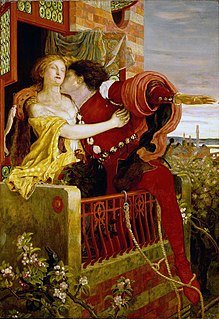
Romeo Montague is the male protagonist of William Shakespeare's tragedy, The Tragedy of Romeo and Juliet. The son of Lord Montague and his wife, Lady Montague, he secretly loves and marries Juliet, a member of the rival House of Capulet, through a priest named Friar Laurence. Forced into exile after slaying Juliet's cousin, Tybalt, in a duel, Romeo commits suicide upon hearing falsely of Juliet's death.

Chrysoritis, commonly called opals or coppers, is a genus of butterflies in the family Lycaenidae found mainly in southern Africa and particularly South Africa.
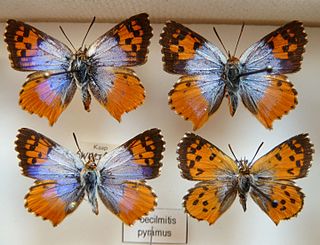
Chrysoritis pyramus, the Pyramus opal, is a species of butterfly in the family Lycaenidae. It is endemic to South Africa, where it is found on the northern slopes of the Swartberg, the Kammanassie Mountains and the Langeberg in the Western Cape.
Pyramus and Thisbe is a "mock opera" by the German-born]composer John Frederick Lampe on the story of Pyramus and Thisbe. It was first performed at Covent Garden Theatre, London, on 25 January 1745. The anonymous libretto is based on Richard Leveridge's The Comickal Masque of Pyramus and Thisbe (1716), itself inspired by the "play within a play" in act 5 of William Shakespeare's A Midsummer Night's Dream.

HMS Pyramus was a Pelorus-class protected cruiser of the Royal Navy. There were eleven ""Third class"" protected cruisers in the class, which was designed by Sir William White. While well armed for their size, they were primarily workhorses for the overseas fleet on "police" duties and did not serve with the main battlefleet.
Vitis shuttleworthii is a North American liana in the grape family commonly known as the caloosa grape. It is native to south and central Florida, with isolated populations in southern Alabama.
Misis Bridge is a Roman bridge in Adana Province, Turkey.

