This page is based on this
Wikipedia article Text is available under the
CC BY-SA 4.0 license; additional terms may apply.
Images, videos and audio are available under their respective licenses.

Lobsang Rampa is the pen name of an author who wrote books with paranormal and occult themes. His best known work is The Third Eye, published in Britain in 1956.

Estcourt is a town in the uThukela District of KwaZulu-Natal Province, South Africa. The main economic activity is farming with large bacon and processed food factories situated around the town. The N3 freeway passes close to the town, linking it to the rest of South Africa.
Cadence rampa or simply kadans, is a dance music and modern méringue popularized in the Caribbean by the virtuoso Haitian sax player Webert Sicot in the early 1960s. Cadence rampa was one of the sources of cadence-lypso.

The Natal Carbineers Regiment is an infantry unit of the South African Army. As a reserve unit, it has a status roughly equivalent to that of a British Army Reserve or United States Army National Guard unit.

Augusto Severo International Airport, formerly called Parnamirim Airport, was the airport that served Natal, Brazil, located in the adjoining municipality of Parnamirim.

The Natal Mounted Rifles is an armoured regiment of the South African Army. As a reserve unit, it has a status roughly equivalent to that of a British Army Reserve or United States Army National Guard unit. It is part of the South African Army Armour Formation and is based in the city of Durban.

The Umvoti Mounted Rifles is an armoured regiment of the South African Army. As a reserve unit, it has a status roughly equivalent to that of a British Army Reserve or United States Army National Guard unit. It is part of the South African Army Armour Formation and is based in the town of Pinetown.

The Natal Field Artillery is an artillery regiment of the South African Army. As a reserve unit, it has a status roughly equivalent to that of a British Army Reserve or United States Army National Guard unit. It is part of the South African Army Artillery Formation.

HMS Natal was a Warrior-class armoured cruiser built for the Royal Navy in the first decade of the 20th century. She escorted the royal yacht in 1911–1912 for the newly crowned King George V's trip to India to attend the Delhi Durbar. During World War I the ship was assigned to the 2nd Cruiser Squadron of the Grand Fleet, but did not participate in any battles. Natal was sunk by an internal explosion near Cromarty on 30 December 1915 with the loss of at least 390 crewmen and civilians. Most of her wreck was slowly salvaged over the decades until the remnants were demolished in the 1970s so they were no longer a hazard to navigation. The remains of her wreck are designated as a protected place under the Protection of Military Remains Act 1986 as a war grave.

The QF 6-inch 40 calibre naval gun (Quick-Firing) was used by many United Kingdom-built warships around the end of the 19th century and the start of the 20th century.
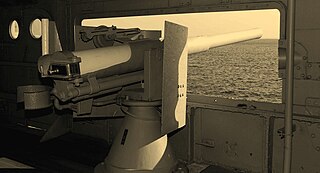
The QF 12-pounder 12-cwt gun was a common, versatile 3-inch (76.2 mm) calibre naval gun introduced in 1894 and used until the middle of the 20th century. It was produced by Armstrong Whitworth, Elswick and used on Royal Navy warships, exported to allied countries, and used for land service. In British service "12-pounder" was the rounded value of the projectile weight, and "12 cwt (hundredweight)" was the weight of the barrel and breech, to differentiate it from other "12-pounder" guns.
The 2nd South African Infantry Brigade was an infantry brigade of the army of the Union of South Africa during World War II. The Brigade formed part of the South African 1st Infantry Division and was formed on 13 August 1940. It served in East Africa and the Western Desert and was disbanded on 1 January 1943.
No. 259 Squadron RAF was a Royal Air Force Squadron formed in Africa as a reconnaissance and anti-submarine unit in World War II.

Michaelhouse is a full boarding senior school for boys founded in 1896. It is located in the Balgowan valley in the Midlands of KwaZulu-Natal, South Africa.

La Rampa is a street in the Vedado district of Havana, Cuba.

HMS Ascension (K502) was a Colony-class frigate of the United Kingdom that served in the Royal Navy during World War II. She originally was ordered by the United States Navy as the Tacoma-class frigate USS Hargood (PF-74) and was transferred to the Royal Navy prior to completion.

The South African Railways NG 0-4-0T of 1899 was a narrow-gauge steam locomotive from the pre-Union era in Transvaal and Natal.
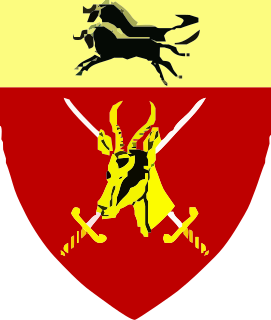
Natal Command was a Command of the South African Army. It was headquartered in Durban, South Africa. By the 1980s, it was responsible for the security of the region, forming the primary level of command for military operations in support of the Police. It also provided logistic, administrative and service support to units and formations operating in its area of responsibility.
The Potenji River Conference, also known as the Natal Conference, was a meeting that took place on January 28 and 29, 1943 between the President of Brazil, Getúlio Vargas and the President of the United States, Franklin Delano Roosevelt. On his way back from the Casablanca Conference, the U.S. president paid a visit to the Brazilian president and inspected some of the military installations that were sending aircraft and equipment to the fronts in Africa and Asia. The visit also involved discussions of the ongoing support and role of Brazil in World War II. This conference between the presidents of the two countries took place aboard the USS Humboldt in the Potenji River harbor in Natal, Rio Grande do Norte and defined the agreements that led to the creation of the Brazilian Expeditionary Force.


