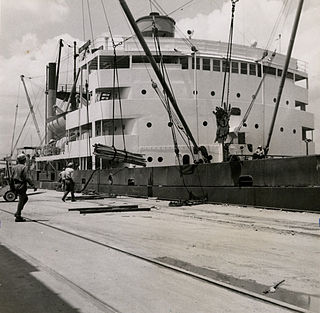
SS Iberville may refer to one of three Type C2-S-E1 ships built by Gulf Shipbuilding for the United States Maritime Commission:
Type C2 ships were designed by the United States Maritime Commission (MARCOM) in 1937–38. They were all-purpose cargo ships with five holds, and U.S. shipyards built 173 of them from 1939 to 1945. Compared to ships built before 1939, the C2s were remarkable for their speed and fuel economy. Their design speed was 15.5 knots (28.7 km/h), but some could make 19 knots (35 km/h) on occasion. The first C2s were 459 feet (140 m) long, 63 feet (19 m) broad, and 40 feet (12 m) deep, with a 25-foot (8 m) draft. Later ships varied somewhat in size.
The United States Maritime Commission (MARCOM) was an independent executive agency of the U.S. federal government that was created by the Merchant Marine Act of 1936, passed by Congress on June 29, 1936, and replaced the United States Shipping Board which had existed since World War I. It was intended to formulate a merchant shipbuilding program to design and build five hundred modern merchant cargo ships to replace the World War I vintage vessels that comprised the bulk of the United States Merchant Marine, and to administer a subsidy system authorized by the Act to offset the cost differential between building in the U.S. and operating ships under the American flag. It also formed the United States Maritime Service for the training of seagoing ship's officers to man the new fleet.
- SS Iberville (1942) (MC hull number 474), transferred to the United States Navy as the lead ship of her class of attack transports, USS Sumter (APA-52); sold for commercial use in 1947; converted to container ship in 1957; scrapped in 1978
- SS Iberville (1943) (MC hull number 481), transferred to the United States Navy as the lead ship of her class of stores ships, USS Hyades (AF-28); transferred to the National Defense Reserve Fleet in 1976; disposed of in 1983
- SS Iberville (1945) (MC hull number 1611), scrapped in 1972

The United States Navy (USN) is the naval warfare service branch of the United States Armed Forces and one of the seven uniformed services of the United States. It is the largest and most capable navy in the world, with the highest combined battle fleet tonnage and the world's largest aircraft carrier fleet, with eleven in service, and two new carriers under construction. With 319,421 personnel on active duty and 99,616 in the Ready Reserve, the Navy is the third largest of the service branches. It has 282 deployable combat vessels and more than 3,700 operational aircraft as of March 2018, making it the second largest and second most powerful air force in the world.
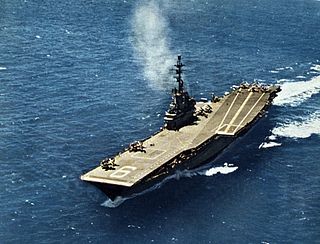
The lead ship, name ship, or class leader is the first of a series or class of ships all constructed according to the same general design. The term is applicable to military ships and larger civilian craft.

Attack transport is a United States Navy ship classification for a variant of ocean-going troopship adapted to transporting invasion forces ashore. Unlike standard troopships – often drafted from the merchant fleet – that rely on either a quay or tenders, attack transports carry their own fleet of landing craft.
  | This article includes a list of ships with the same or similar names. If an internal link for a specific ship led you here, you may wish to change the link to point directly to the intended ship article, if one exists. |