Related Research Articles

Llanelli is a market town and the largest community in Carmarthenshire and the preserved county of Dyfed, Wales. It is located on the Loughor estuary 10.5 miles (16.9 km) north-west of Swansea and 12 miles (19 km) south-east of the county town, Carmarthen. The town had a population of 25,168 in 2011, estimated in 2019 at 26,225. The local authority was Llanelli Borough Council when the county of Dyfed existed, but it has been under Carmarthenshire County Council since 1996.

Llangennech is a village and community in the area of Llanelli, Carmarthenshire, Wales, which covers an area of 1,222 hectares (4.72 sq mi).
This article is a timeline of Llanelli history. For a full article on the town, see Llanelli.

The Reverend David Rees was a Welsh Congregational minister of Capel Als chapel Llanelli, Carmarthenshire, and an editor of a radical Welsh language Nonconformist periodical titled Y Diwygiwr. Known as 'Y Cynhyrfwr', he held radical political views and opposed the relationship between the Established Church and the state.
This is a list of High Sheriffs of Carmarthenshire. Carmarthenshire was originally created by the Statute of Rhuddlan in 1284. It became an administrative county in 1889 with a county council following the Local Government Act 1888. Under the Local Government Act 1972, the administrative county of Carmarthenshire was abolished on 1 April 1974 and the area of Carmarthenshire became three districts within the new county of Dyfed : Carmarthen, Dinefwr and Llanelli. Under the Local Government (Wales) Act 1994, Dyfed was abolished on 1 April 1996 and the three districts united to form a unitary authority which had the same boundaries as the original Carmarthenshire but remaining in the shrievalty of Dyfed.

Howell Elvet Lewis, widely known by his bardic name Elfed, was a Welsh Congregational minister, hymn-writer, and devotional poet, who served as Archdruid of the National Eisteddfod of Wales from 1924 to 1928.

Siloa Chapel was the largest of the Welsh Independent, or Congregationalist, chapels in Aberdare. Services are held in the Welsh language. Established in 1844, Siloa is one of the few Welsh-language chapels in the locality to remain open today. Siloa was notable for its long-serving ministers and in over a century there were only three pastorates, namely those of David Price (1843–1878), D. Silyn Evans (1880–1930) and R. Ifor Parry (1933–1964).
Gwawr, Aberaman was a Baptist chapel in Regent Street, Aberaman, near Aberdare, South Wales, formed as a branch of Calfaria, Aberdare
Seion, Cwmaman is a Welsh Baptist church, originally established in 1859. The chapel closed in 2013 but the church still meets at another location in the village.

Ebenezer, Trecynon was an Independent (Congregationalist) chapel in Ebenezer Street, Trecynon, Aberdare, Wales. It was one of the earliest Independent chapels in the Cynon Valley and remained an active place of worship until 2009.

Thomas Thomas was a Welsh church minister and chapel architect, also known as Thomas Glandŵr. He is described as "the first national architect of Wales" and the "unchallenged master of chapel architecture in Wales in the 1860s".

Capel Heol Dŵr was a Calvinistic Methodist chapel in the town of Carmarthen, Carmarthenshire, Wales. The building dates from 1831 and is located at Water St, Carmarthen. It was designated as a Grade II listed building on 19 May 1981.
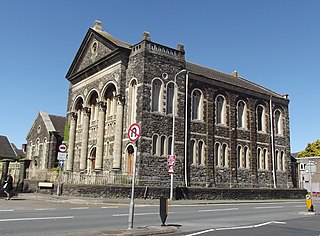
Tabernacle Chapel is an Independent (Congregational) chapel in the town of Llanelli, Carmarthenshire, Wales. It was built in 1872 and is located at 17 Cowell Street. It is a Grade II* listed building.

Bethel Baptist Chapel is a Baptist chapel in the town of Llanelli, Carmarthenshire, Wales. It was built in 1840 and is located on Copperworks Road. It had a larger seating capacity than most Llanelli chapels and in 1905 could seat 850 persons.

Capel Als is an Independent (Congregational) chapel in Llanelli, Carmarthenshire, Wales, It is regarded as one of the most significant religious buildings in Wales. Folk tradition suggested that the name refers to a woman named Als, which along with Alys is the Welsh equivalent of the English name Alice, whose cottage stood where the chapel was built. Another theory contends that the Welsh word als translates as rock, and there is a rock-face behind the chapel. However, there is no word "als" in Welsh meaning rock, and so this latter explanation may be safely disregarded.

Thomas Johns was a Welsh Independent (Congregationalist) minister, best known for his pastorate at Capel Als, Llanelli, one of the largest chapels in Wales, from 1869 until his death in 1914.
Daniel John Davies was a Welsh Independent (Congregationalist) minister and Welsh language poet. He published under the name 'D.J. Davies' and was also well known as 'Davies Capel Als'.
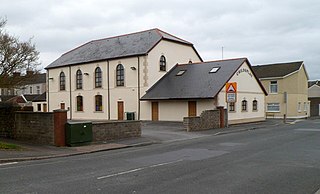
Soar Welsh Independent Chapel was an Independent (Congregationalist) chapel in Marsh Street, Llanelli, Carmarthenshire, Wales. Services at Soar were conducted in the Welsh language.

Ebenezer was an Independent (Congregationalist) chapel in Inkerman Street, Llanelli, Carmarthenshire, Wales. Services at Ebenezer were conducted in the Welsh language.
Lloyd Street, Llanelli was an Independent (Congregationalist) chapel in Lloyd Street, Llanelli, Carmarthenshire. Services at Lloyd Street were conducted in the Welsh language.
References
- ↑ Edwards 2009, pp. 89–91.
- 1 2 Edwards 2009, p. 97.
- ↑ Edwards 2009, pp. 97–8.
- 1 2 3 Edwards 2009, p. 98.
- ↑ "Siloah Independent Chapel, Glanmor Rd. And Copperworks Rd., Seaside, Llanelli;siloa (6427)". Coflein. RCAHMW . Retrieved 1 October 2021.
- ↑ Edwards 2009, p. 100.
- ↑ "Mr Puxley at Llanelly". Welshman. 18 September 1868. p. 6. Retrieved 30 September 2019.
- ↑ Edwards 2009, p. 102.
- ↑ Edwards 2009, p. 101.
- ↑ Edwards 2009, p. 103.
- ↑ "Nonconformity in Wales. Handsome Collections at Llanelly". South Wales Daily News. 25 May 1891. p. 4. Retrieved 1 October 2019.
- ↑ "Late Rev. Elias Davies. Impressive Funeral at Llanelly". Cardiff Times. 23 May 1908. p. 9. Retrieved 26 September 2019.
- ↑ Edwards 2009, pp. 104–8.
- ↑ Edwards 2009, p. 108.