The Hypertext Transfer Protocol (HTTP) is an application protocol for distributed, collaborative, hypermedia information systems. HTTP is the foundation of data communication for the World Wide Web, where hypertext documents include hyperlinks to other resources that the user can easily access, for example by a mouse click or by tapping the screen. HTTP was developed to facilitate hypertext and the World Wide Web.
An Internet Protocol address is a numerical label assigned to each device connected to a computer network that uses the Internet Protocol for communication.
An IP address serves two principal functions: host or network interface identification and location addressing.
The Internet Protocol (IP) is the principal communications protocol in the Internet protocol suite for relaying datagrams across network boundaries. Its routing function enables internetworking, and essentially establishes the Internet.
The Internet protocol suite is the conceptual model and set of communications protocols used in the Internet and similar computer networks. It is commonly known as TCP/IP because the foundational protocols in the suite are the Transmission Control Protocol (TCP) and the Internet Protocol (IP). It is occasionally known as the Department of Defense (DoD) model because the development of the networking method was funded by the United States Department of Defense through DARPA.
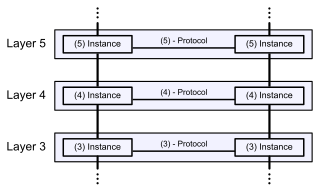
The Open Systems Interconnection model is a conceptual model that characterizes and standardizes the communication functions of a telecommunication or computing system without regard to its underlying internal structure and technology. Its goal is the interoperability of diverse communication systems with standard protocols. The model partitions a communication system into abstraction layers. The original version of the model defined seven layers.
The Session Initiation Protocol (SIP) is a signaling protocol used for initiating, maintaining, and terminating real-time sessions that include voice, video and messaging applications. SIP is used for signaling and controlling multimedia communication sessions in applications of Internet telephony for voice and video calls, in private IP telephone systems, in instant messaging over Internet Protocol (IP) networks as well as mobile phone calling over LTE (VoLTE).
SOAP is a messaging protocol specification for exchanging structured information in the implementation of web services in computer networks. Its purpose is to provide extensibility, neutrality and independence. It uses XML Information Set for its message format, and relies on application layer protocols, most often Hypertext Transfer Protocol (HTTP) or Simple Mail Transfer Protocol (SMTP), for message negotiation and transmission.
In computer networking, the User Datagram Protocol (UDP) is one of the core members of the Internet protocol suite. The protocol was designed by David P. Reed in 1980 and formally defined in RFC 768. With UDP, computer applications can send messages, in this case referred to as datagrams, to other hosts on an Internet Protocol (IP) network. Prior communications are not required in order to set up communication channels or data paths.
The File Transfer Protocol (FTP) is a standard network protocol used for the transfer of computer files between a client and server on a computer network.

A virtual private network (VPN) extends a private network across a public network, and enables users to send and receive data across shared or public networks as if their computing devices were directly connected to the private network. Applications running across a VPN may therefore benefit from the functionality, security, and management of the private network.
An application layer is an abstraction layer that specifies the shared communications protocols and interface methods used by hosts in a communications network. The application layer abstraction is used in both of the standard models of computer networking: the Internet Protocol Suite (TCP/IP) and the OSI model. Although both models use the same term for their respective highest level layer, the detailed definitions and purposes are different.

Philip-Jon Haarsma, more commonly known as PJ Haarsma, is a Canadian born producer and science fiction author best known for his creation of the Rings of Orbis universe, which encompasses The Softwire series of books. Haarsma created a free, online role-playing game, also called the Rings of Orbis, set in the same universe. Both the book-series and the game target young, often reluctant readers in an attempt to encourage them by rewarding them for reading.
An IPv6 transition mechanism is a technology that facilitates the transitioning of the Internet from the Internet Protocol version 4 (IPv4) infrastructure in use since 1983 to the successor addressing and routing system of Internet Protocol Version 6 (IPv6). As IPv4 and IPv6 networks are not directly interoperable, transition technologies are designed to permit hosts on either network type to communicate with any other host.

The Protocols of the Elders of Zion or The Protocols of the Meetings of the Learned Elders of Zion is an antisemitic fabricated text purporting to describe a Jewish plan for global domination. The hoax, which was shown to be plagiarized from several earlier sources, some not antisemitic in nature, was first published in Russia in 1903, translated into multiple languages, and disseminated internationally in the early part of the 20th century. According to the claims made by some of its publishers, the Protocols are the minutes of a late 19th-century meeting where Jewish leaders discussed their goal of global Jewish hegemony by subverting the morals of Gentiles, and by controlling the press and the world's economies.
In telecommunication, a communication protocol is a system of rules that allow two or more entities of a communications system to transmit information via any kind of variation of a physical quantity. The protocol defines the rules, syntax, semantics and synchronization of communication and possible error recovery methods. Protocols may be implemented by hardware, software, or a combination of both.
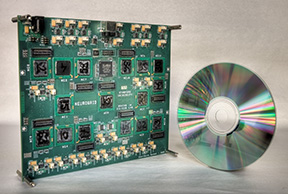
Neurogrid is a piece of computer hardware that is designed specifically for simulation of biological brains. It uses analog computation to emulate ion channel activity, and digital communication to softwire structured connectivity patterns. Neurogrid simulates one million neurons and six billion synapses in real time. The neurons spike at a rate of ten times a second. In terms of number of simulated neurons, it rivals simulations done by the Blue Brain Project. However, by running the simulation of whole neurons, instead of simulation on molecular level, it needs only one millionth of Blue Brain's power. The entire board consumes less than two watts of electrical energy.
IPv4 Residual Deployment (4rd) is an IPv6 transition mechanism for Internet service providers for deployment of Internet Protocol version 6 (IPv6), while maintaining IPv4 service to customers. The protocol and sample applications are specified in RFC 7600.
Mapping of Address and Port (MAP) is a proposal which combines A+P port address translation with the tunneling of legacy IPv4 protocol packets over an ISP's internal IPv6 network.

