St Mary's Church is an Anglican parish church in the village of Newbold Astbury, Cheshire, England. It is recorded in the National Heritage List for England as a designated Grade I listed building, and its architecture has been praised by a number of writers.

St Andrew's Church stands near the village of Aikton, Cumbria, England. It is an active Anglican parish church in the deanery of Carlisle, the archdeaconry of Carlisle, and the diocese of Carlisle. Its benefice is united with those of St Michael, Burgh by Sands, St Mary, Kirkandrews-on-Eden with Beaumont, and St Peter, Kirkbampton. The church is recorded in the National Heritage List for England as a designated Grade I listed building.

St Andrew's Church is a redundant Anglican church at the south end of the village of East Heslerton, North Yorkshire, England. It is recorded in the National Heritage List for England as a designated Grade I listed building and is under the care of the Churches Conservation Trust.

St Nicholas Church is a historic church in Westgate Street in the city of Gloucester, England, under the care of The Churches Conservation Trust. It is recorded in the National Heritage List for England as a designated Grade I listed building. Its truncated spire is a landmark in the city centre.
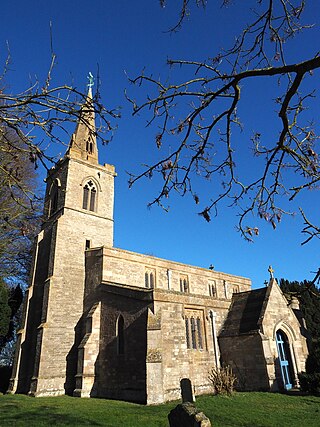
St Andrew's Church is a redundant Anglican church in the hamlet of Steeple Gidding, about 10 miles (16 km) northwest of Huntingdon, Cambridgeshire, England. It is recorded in the National Heritage List for England as a designated Grade II* listed building, and is under the care of the Churches Conservation Trust.
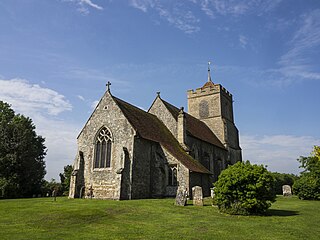
St Andrew's Church is a redundant Anglican church in the village of Buckland, Hertfordshire, England. It is recorded in the National Heritage List for England as a designated Grade II* listed building, and is under the care of the Churches Conservation Trust. The church stands at the highest point in the village to the east of Ermine Street, now the A10 road, between Royston and Buntingford.

Old St Peter and St Paul's Church is a former Anglican church near the village of Albury, Surrey, England in the care of The Churches Conservation Trust. It is recorded in the National Heritage List for England as a designated Grade I listed building. The church stands in Albury Park, to the northwest of Albury Hall, and between the villages of Albury and Shere.

St Michael's Church is in the village of Grimsargh, Lancashire, England. It is an active Anglican parish church in the deanery of Grimsargh, the archdeaconry of Preston, and the diocese of Blackburn. The church is recorded in the National Heritage List for England as a designated Grade II listed building.

Christ Church is in Wyresdale Road, Lancaster, Lancashire, England. It is an active Anglican parish church in the deanery of Lancaster and Morecambe, the archdeaconry of Lancaster, and the diocese of Blackburn. The church is recorded in the National Heritage List for England as a designated Grade II listed building.

St Michael's Church is in Giantswood Lane, Hulme Walfield, Cheshire, England. It is an active Anglican parish church in the deanery of Congleton, the archdeaconry of Macclesfield, and the diocese of Chester. The church is recorded in the National Heritage List for England as a designated Grade II listed building. The authors of the Buildings of England series comment that it is "an attractive building, and one for which money must have been spent generously".

St Michael's Church is in Church Lane, Aughton, Lancashire, England. It is an active Anglican parish church in the deanery of Ormskirk, the archdeaconry of Wigan & West Lancashire, and the diocese of Liverpool. Its benefice is united with that of Holy Trinity, Bickerstaffe. The church is recorded in the National Heritage List for England as a designated Grade I listed building.

St Peter's and St Paul's Church is a parish church in Headcorn, Kent dedicated to saints Peter and Paul. It was begun in the 13th century. The church is a Grade I listed building.

All Saints is a parish church in Ulcombe, Kent. It was begun in the 12th century and is a Grade I listed building.

St Peter's and St Paul's Church is a parish church in Yalding, Kent, dedicated to saints Peter and Paul. It was begun in the 13th century and is a Grade I listed building.

Christ Church is in King's Road, Higher Bebington, Wirral, Merseyside, England. It is an active Anglican parish church in the deanery of Wirral, North, the archdeaconry of Chester, and the diocese of Chester. The church is recorded in the National Heritage List for England as a designated Grade II listed building.
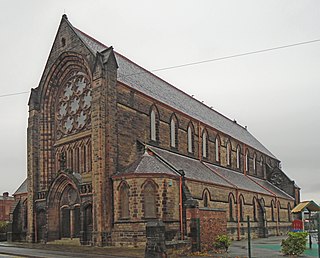
The Church of Our Lady Star of the Sea is in Wheatland Lane, Seacombe, Wallasey, Wirral, Merseyside, England. It is an active Roman Catholic parish church in the diocese of Shrewsbury, and its parish is combined with that of St Joseph, Wallasey. The church is recorded in the National Heritage List for England as a designated Grade II listed building.

St Alban's Church, is in Mill Lane, Liscard, Wallasey, Wirral, Merseyside, England. It is an active Roman Catholic church in the diocese of Shrewsbury. The church is recorded in the National Heritage List for England as a designated Grade II listed building.
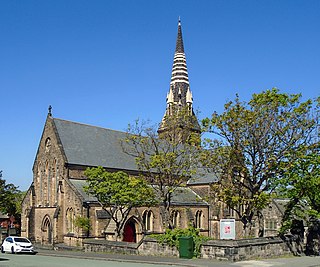
St James' Church is in Victoria Road, New Brighton, Wirral, Merseyside, England. It is an active Anglican parish church in the deanery of Wallasey, the archdeaconry of Chester and the diocese of Chester. Its benefice is united with that of Emmanuel, New Brighton. The church is recorded in the National Heritage List for England as a designated Grade II listed building.

St Luke's Church is a redundant Anglican parish church in St Luke's Place, Preston, Lancashire, England. The church is recorded in the National Heritage List for England as a designated Grade II listed building.

St. Mary's Church, Presbytery and Convent are in Back Lane, Little Crosby, Sefton, Merseyside, England. The church is an active Roman Catholic parish church in the diocese of Liverpool which was built in 1845–47. The presbytery and convent were both built in the 18th century, and altered in the 19th century. The convent originated as a chapel, and has since been converted into a private dwelling. Both the church and the former convent with its attached presbytery are recorded in the National Heritage List for England as designated Grade II listed buildings.