
Ruokolahti is a municipality of Finland, situated in south-eastern Finland, in the region of South Karelia. Neighbouring municipalities are Imatra, Lappeenranta, Taipalsaari, Puumala, Sulkava, Punkaharju, Parikkala and Rautjärvi. Ruokolahti covers an area of 1,219.85 square kilometres (470.99 sq mi) of which 23% is water.
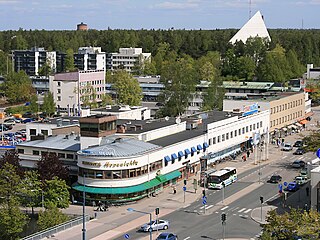
Hyvinkää is a city and municipality of Finland. It is located in the Uusimaa region, approximately 50 kilometres (30 mi) north of the capital Helsinki. The city was chartered in 1960. The population of Hyvinkää is 46,892. Its neighboring municipalities are Riihimäki and Hausjärvi in the north, Mäntsälä in the east, Tuusula and Nurmijärvi in the south, and Vihti and Loppi in the west.
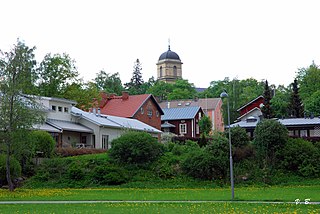
Vihti is a municipality located in the Uusimaa region of province of Southern Finland, approximately 50 kilometres (30 mi) northwest of the capital city Helsinki. The municipality has a population of 28,866 and covers an area of 567.06 square kilometres (218.94 sq mi) of which 45.02 km2 (17.38 sq mi) is water. The population density is 55.3 inhabitants per square kilometre (143/sq mi). Its seat is Nummela, which is the most populated urban area in the municipality.
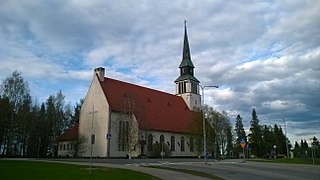
Kemijärvi is a town and municipality of Finland. It is located in Eastern Lapland sub-region.

Keminmaa is a municipality of Finland.

Eurostat is a Directorate-General of the European Commission located in the Kirchberg quarter of Luxembourg City, Luxembourg. Eurostat's main responsibilities are to provide statistical information to the institutions of the European Union (EU) and to promote the harmonisation of statistical methods across its member states and candidates for accession as well as EFTA countries. The organisations in the different countries that cooperate with Eurostat are summarised under the concept of the European Statistical System.

Laitila is a town and a municipality of Finland. It is located in the Southwest Finland region, and it is 59 kilometres (37 mi) from Laitila to Turku. The municipality has a population of 8,439 (30 September 2023) and covers an area of 545.32 square kilometres (210.55 sq mi) of which 13.65 km2 (5.27 sq mi) is water. The population density is 15.87 inhabitants per square kilometre (41.1/sq mi). The municipality is monolingually Finnish.

Savukoski is a municipality of Finland.

The National Institute of Statistics and Censuses is an Argentine decentralized public body that operates within the Ministry of Economy, which exercises the direction of all official statistical activities carried out in the country.

The Philippine Statistics Authority is the central statistical authority of the Philippine government that collects, compiles, analyzes and publishes statistical information on economic, social, demographic, political affairs and general affairs of the people of the Philippines and enforces the civil registration functions in the country.
Statistics Denmark is a Danish governmental organization under the Ministry of the Interior and Housing, reporting to the Minister of Economic and Internal Affairs. The organization is responsible for creating statistics on the Danish society, including employment statistics, trade balance, and demographics.

Tampereen Pallo-Veikot (TPV) is a Finnish football club, based in Tampere. The club plays in the Kakkonen, the third highest level of football in Finland. It is the second largest football club in the Pirkanmaa region in terms of active members, with 1,600 members in 2005.

Statistics Indonesia, is a non-departmental government institute of Indonesia that is responsible for conducting statistical surveys. Its main customer is the government, but statistical data is also available to the public. Annual surveys cover areas including national and provincial socio-economics, manufacturing establishments, population and the labour force.
Statistics Austria, known locally as Statistik Austria, is the official name of Austria's Federal Statistical Office, the country's agency for collecting and publishing official statistics related to Austria.
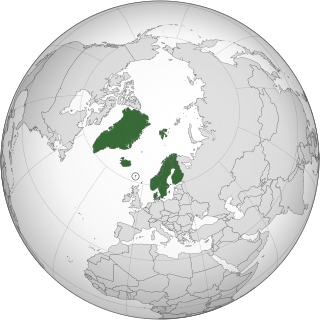
The Nordic countries are a geographical and cultural region in Northern Europe and the North Atlantic. It includes the sovereign states of Denmark, Finland, Iceland, Norway and Sweden; the autonomous territories of the Faroe Islands and Greenland; and the autonomous region of Åland.

The State Data Agency of Lithuania, known as the Department of Statistics of Lithuania, officially the Department of Statistics to the Government of the Republic of Lithuania, until 2023, is an institution in Lithuania which is responsible for collecting, processing, presenting and analysing statistics concerning the topics economy, society and environment, and governance regarding the state data. It is subordinate directly to the Government of Lithuania. The agency also supplies data to Eurostat.
Erik Olof Törnqvist was a Finnish civil servant and diplomat.

The Skolt of the Year Award is an annual award founded in 2007. It is awarded to people, groups, organizations, and institutions individually or collectively in recognition of their outstanding linguistic and cultural contributions for the good of the Skolt community. In spite of its name, it is not a requirement that the recipient be a Skolt. The award is administered and voted on by the Skolt Sámi Language and Culture Association Saaʹmi Nueʹtt and the Skolt community council.

The General Authority for Statistics (GASTAT) is a government agency in Saudi Arabia responsible for the implementation of statistical works including the conducting of national surveys.
An urban area in the Nordic countries, with the exception of Iceland, is defined as a distinct statistical concept used to differentiate population clusters independent of municipal borders. The population is measured on a national level, independently by each country's statistical bureau. Statistics Sweden uses the term tätort, Statistics Finland also uses tätort in Swedish and taajama in Finnish, Statistics Denmark uses byområde (city), while Statistics Norway uses tettsted.


