GNU Hurd is the multiserver microkernel written as part of GNU. It has been under development since 1990 by the GNU Project of the Free Software Foundation, designed as a replacement for the Unix kernel, and released as free software under the GNU General Public License. While the Linux kernel soon proved to be a more viable solution, development of GNU Hurd continued, albeit at a slow pace.
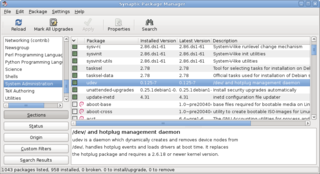
A package manager or package-management system is a collection of software tools that automates the process of installing, upgrading, configuring, and removing computer programs for a computer's operating system in a consistent manner.

The GNU Project is a free-software, mass-collaboration project, first announced on September 27, 1983 by Richard Stallman at MIT. Its aim is to give computer users freedom and control in their use of their computers and computing devices, by collaboratively developing and providing software that is based on the following freedom rights: users are free to run the software, share it, study it, and modify it. GNU software guarantees these freedom-rights legally, and is therefore free software; the use of the word "free" always being taken to refer to freedom.
Technical variations of Linux distributions include support for different hardware devices and systems or software package configurations. Organizational differences may be motivated by historical reasons. Other criteria include security, including how quickly security upgrades are available; ease of package management; and number of packages available.

GNU Ubiquitous Intelligent Language for Extensions is the preferred extension language system for the GNU Project, which features an implementation of the programming language Scheme. Its first version was released in 1993. In addition to large parts of Scheme standards, Guile Scheme includes modularized extensions for many different programming tasks.
ThreadX, developed and marketed by Express Logic of San Diego, California, United States, is a highly deterministic, embedded real-time operating system (RTOS) written mostly in the C. Express Logic was purchased for an undisclosed sum by Microsoft on April 18, 2019.
In computing, mechanisms and techniques for managing services often differ by operating system. Examples of operating system service management are:
GNU variants are operating systems based upon the GNU operating system. According to the GNU project and others, these also include most operating systems using the Linux kernel and a few others using BSD-based kernels.
Nix is a cross-platform package management system. Differing from traditional package managers, Nix utilizes a purely functional deployment model where software is installed into unique directories generated through cryptographic hashes. Dependencies from each software are included within each hash, solving the problem of dependency hell. This novel approach to package management promises to generate more reliable, reproducible, and portable packages.

Linux-libre is an operating system kernel and a GNU package.
NixOS is a Linux distribution built on top of the Nix package manager. It uses declarative configuration and allows reliable system upgrades. Two main branches are offered: current Stable release and Unstable following latest development.
Software categories are groups of software. They allow software to be understood in terms of those categories instead of the particularities of each package. Different classification schemes consider different aspects of software.

GNU Gnubik or GNUbik is a puzzle game – a software implementation of the Rubik's Cube. It is cross platform and is included in all major operating systems including Debian, openSUSE, GuixSD, Red Hat and Ubuntu.

Uruk GNU/Linux-libre is a Trisquel-based GNU system. The name Uruk is an Iraqi city that states its Iraqi origin. Uruk GNU/Linux 1.0 was released on 13 April 2016 and it ships with the most common software for popular tasks.
This page is based on this
Wikipedia article Text is available under the
CC BY-SA 4.0 license; additional terms may apply.
Images, videos and audio are available under their respective licenses.