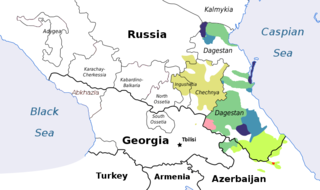
The Northeast Caucasian languages, or Nakh-Daghestanian languages, are a language family spoken in the Russian republics of Dagestan, Chechnya and Ingushetia and in northern Azerbaijan as well as in diaspora populations in Western Europe, Turkey and the Middle East. They are occasionally called North Caspian, as opposed to North Pontic for the Northwest Caucasian languages.

Makhachkala is the capital city of the Republic of Dagestan, Russia. It is located on the western shore of the Caspian Sea and is home to the Makhachkala Grand Mosque, one of Russia's largest. As of the 2010 Census, the city had a population of 572,076, making it the largest in the North Caucasus Federal District. The city has an ethnic plurality, with the Avars and Kumyks being the largest groups.

Lezgins are a Northeast Caucasian ethnic group native predominantly to southern Dagestan and northeastern Azerbaijan and who speak the Lezgian language.

Dagestan, officially the Republic of Dagestan, is a federal subject of Russia, located in the North Caucasus region. Its capital and largest city is Makhachkala, centrally located on the Caspian Sea coast.

The peoples of the Caucasus are diverse comprising more than 50 ethnic groups throughout the Caucasus region.
Azerbaijanis in Russia or Russian Azerbaijanis are Azerbaijani people in the Russian Federation, and are Russian citizens or permanent residents of ethnic Azerbaijani background.
Aside from the large Azeri community native to Russia's Dagestan Republic, the majority of Azeris in Russia are fairly recent immigrants. Azeris started settling in Russia around the late nineteenth century, but their migration intensified after World War II, and especially after the collapse of the Soviet Union in 1991. According to the 2010 All-Russian Population Census, there are 603,070 Azeris residing in Russia, however the actual numbers may be much higher due to the arrival of guest workers in the post-Soviet era. The estimated total Azeri population of Russia as of 2002 might have reached as many as 3,000,000 people, with more than one and half million of them living in Moscow, though in the following decade there was a tendency for many Azeris to move back to Azerbaijan. The majority of post-1991 ethnic Azeri migrants have come to Russia from rural Azerbaijan, Georgia and Armenia. Today most provinces of Russia have more or less significant Azeri communities, the biggest ones, according to official numbers, residing in Dagestan, Moscow, Khanty–Mansi, Krasnoyarsk, Rostov-on-the-Don, Saratov, Sverdlovsk, Samara, Stavropol, etc.

The khanates of the Caucasus, or Azerbaijani khanates or Persian khanates, or Iranian khanates, were various provinces and principalities established by Persia (Iran) on their territories in the Caucasus from the late Safavid to the Qajar dynasty. The Khanates were mostly ruled by Khans of Turkic (Azeri) origin and were vassals and subjects of the Iranian shah (King). Persia permanently lost a part of these khanates to Russia as a result of the Russo-Persian Wars in the course of the 19th century, while the others were absorbed into Persia.
The Lezgic languages are one of seven branches of the Northeast Caucasian language family. Lezgian and Tabasaran are literary languages.

Shaykh Haydar or Sheikh Haydar was the successor of his father as leader of the Safaviyya from 1460-1488. Haydar maintained the policies and political ambitions initiated by his father. Under Sheikh Haydar, the Safaviyya became crystallized as a political movement with an increasingly extremist heterodox Twelver Shi'i coloring and Haydar was viewed as a divine figure by his followers. Shaykh Haydar was responsible for instructing his followers to adopt the scarlet headgear of 12 gores commemorating The Twelve Imams, which led to them being designated by the Turkish term Qizilbash "Red Head".
Lakia is an ancient ethnic region within the state of Dagestan. Its historical capital is Kumukh, one of the ancient cultural and religious centres of Lakia. The people of Lakia are self-designated as Laks and their native language is Lak.
Historically, Dagestan consisted of a federation of mountainous principalities in the eastern part of the North Caucasus.
Located at the crossroads of world civilizations of north and south, Dagestan was the scene of clashes of interests of many states and until the early 19th century most notably that of between Persia (Iran) and Imperial Russia.
Fatali Khan of Quba or Fath Ali-Khan of Quba – was a khan of the Quba Khanate (1758–1789).
Karim Huseyn oglu Mammadbeyov was a Soviet Dagestani politician, social activist and revolutionary who participated in the Bolshevik movement in Dagestan and served in various government positions from 1921 to 1937.

The Derbent Khanate was a Caucasian khanate that was established in Afsharid Iran. It corresponded to southern Dagestan and its center was at Derbent. It included the northern clans of Lezgian people.
The Tabasaran Principality or Principality of Tabasaran was an independent monarchic state in southern Dagestan, existing from 1642 until the later 19th century. It emerged as one of many smaller states from the disintegration of the Shamkhalate of Gazikumukh in 1642. It was located in the Samur river valley, roughly coinciding with the region in which the Tabasaran people still reside today. Its location close to the main road between Derbent and Shirvan gave it some strategic importance.
The Withdrawal through Andalal by the Persian army under Nader Shah took place after he broke off the siege of the last Lezgian fortress in order to return to Derbent for winter quarters. His withdrawal came under heavy raids by the Lezgians. However, there is no mention of any pitched battle around Andalal, or anywhere else during the withdrawal, in any of the primary or secondary material in the established historiography of Nader's Campaigns.

The national emblem of the Dagestan Autonomous Soviet Socialist Republic was adopted in 1937 by the government of the Dagestan Autonomous Soviet Socialist Republic. The emblem is identical to the emblem of the Russian Soviet Federative Socialist Republic.