The Baroque is a highly ornate and often extravagant style of architecture, music, painting, sculpture and other arts that flourished in Europe from the early 17th until the mid-18th century. It followed the Renaissance style and preceded the Rococo and Neoclassical styles. It was encouraged by the Catholic Church as a means to counter the simplicity and austerity of Protestant architecture, art and music, though Lutheran Baroque art developed in parts of Europe as well. The Baroque style used contrast, movement, exuberant detail, deep colour, grandeur and surprise to achieve a sense of awe. The style began at the start of the 17th century in Rome, then spread rapidly to France, northern Italy, Spain and Portugal, then to Austria and southern Germany. By the 1730s, it had evolved into an even more flamboyant style, called rocaille or Rococo, which appeared in France and central Europe until the mid to late 18th century.
The French organ school formed in the first half of the 17th century. It progressed from the strict polyphonic music of Jean Titelouze to a unique, richly ornamented style with its own characteristic forms that made full use of the French classical organ. Instrumental in establishing this style were Louis Couperin, who experimented with structure, registration and melodic lines, expanding the traditional polyphonic forms, and Guillaume-Gabriel Nivers (1632–1714), who established the distinct forms and styles of what was to become the French organ tradition.

The oboe da caccia, also sometimes referred to as an oboe da silva, is a double reed woodwind instrument in the oboe family, pitched a fifth below the oboe and used primarily in the Baroque period of European classical music. It has a curved tube, and in the case of instruments by Eichentopf, a brass bell, unusual for an oboe.

Pierre Dumage was a French Baroque organist and composer. His first music teacher was most likely his father, organist of the Beauvais Cathedral. At some point during his youth Dumage moved to Paris and studied under Louis Marchand. He also befriended Nicolas Lebègue, who in 1703 procured for Dumage a position of organist of the Saint-Quentin collegiate church. In 1710 Dumage was appointed titular organist of the Laon Cathedral. Due to strained relations with his superiors in the cathedral chapter, Dumage left on 30 March 1719, at the age of 45, and became a civil servant. He apparently neither played nor composed music professionally until his death.
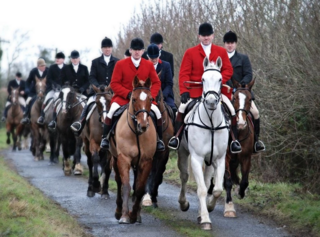
Tally-ho is a very old traditional cry made by the huntsman to tell others the quarry has been sighted. It may also be used with directions, including "away" and "back".
Jean-Adam Guilain was a German organist and harpsichordist who was mostly active in Paris during the first half of the eighteenth century.
The haute-contre is a rare type of high tenor voice, predominant in French Baroque and Classical opera until the latter part of the eighteenth century.
Don Quichotte chez la Duchesse is a "comic ballet" by the French baroque composer Joseph Bodin de Boismortier. Although it is described as a ballet, it is sung throughout with a libretto by Charles Simon Favart.

Saint-Nicolas-de-la-Taille is a commune in the Seine-Maritime department in the Normandy region in northern France.

The Braques français are hunting dogs, from a very old type of gun dog used for pointing the location of game birds for a hunter. There are two breeds of Braque français, both from the south of France, the Braque français, type Gascogne and the Braque français, type Pyrénées They are popular hunting dogs in France, but are seldom seen elsewhere.
Alcine is an opera by the French composer André Campra. It takes the form of a tragédie en musique in a prologue and five acts. The libretto, by Antoine Danchet, is based on Cantos IV, VI and VII of Ariosto's epic poem Orlando furioso and tells of the love of the enchantress Alcine (Alcina) for the paladin Astolphe (Astolfo).
Iphigénie en Tauride is an opera by the French composers Henri Desmarets and André Campra. It takes the form of a tragédie en musique in a prologue and five acts. The libretto is by Joseph-François Duché de Vancy with additions by Antoine Danchet. Desmarets had begun work on the opera around 1696 but abandoned it when he was forced to go into exile in 1699. Campra and his regular librettist Danchet took up the piece and wrote the prologue, most of Act Five, two arias in Act One, an aria for Acts Two and Three, and two arias for the fourth act. The plot is ultimately based on Euripides' tragedy Iphigeneia in Tauris.

Baroque music is a period or style of Western art music composed from approximately 1600 to 1750. This era followed the Renaissance music era, and was followed in turn by the Classical era. Baroque music forms a major portion of the "classical music" canon, and is now widely studied, performed, and listened to. Key composers of the Baroque era include Johann Sebastian Bach, Antonio Vivaldi, George Frideric Handel, Claudio Monteverdi, Domenico Scarlatti, Alessandro Scarlatti, Henry Purcell, Georg Philipp Telemann, Jean-Baptiste Lully, Jean-Philippe Rameau, Marc-Antoine Charpentier, Arcangelo Corelli, Tomaso Albinoni, François Couperin, Giuseppe Tartini, Heinrich Schütz, Giovanni Battista Pergolesi, Dieterich Buxtehude, and Johann Pachelbel.
Joseph Michel (1679–1736) was an 18th-century French baroque chorister, composer and music teacher of the Sainte Chapelle of Dijon, demolished in 1802. A contemporary of Jean-Philippe Rameau, his reputation extended far beyond the boundaries of the city of Versailles and Burgundy.

The history of the wine press and of pressing is nearly as old as the history of wine itself with the remains of wine presses providing some of the longest-serving evidence of organised viticulture and winemaking in the ancient world. The earliest wine press was probably the human foot or hand, crushing and squeezing grapes into a bag or container where the contents would ferment.
Ich habe meine Zuversicht, BWV 188, is a church cantata by Johann Sebastian Bach. He composed the cantata in Leipzig for the 21st Sunday after Trinity and probably first performed it on 17 October 1728.