Related Research Articles

Hans Holbein the Younger was a German-Swiss painter and printmaker who worked in a Northern Renaissance style, and is considered one of the greatest portraitists of the 16th century. He also produced religious art, satire, and Reformation propaganda, and he made a significant contribution to the history of book design. He is called "the Younger" to distinguish him from his father Hans Holbein the Elder, an accomplished painter of the Late Gothic school.

Giorgio Giulio Clovio or Juraj Julije Klović was an illuminator, miniaturist, and painter born in the Kingdom of Croatia, who was mostly active in Renaissance Italy. He is considered the greatest illuminator of the Italian High Renaissance, and arguably the last very notable artist in the long tradition of the illuminated manuscript, before some modern revivals.

The Morgan Bible, also called the Morgan Picture Bible, Crusader Bible, Shah Abbas Bible or Maciejowski Bible, is a unique medieval illuminated manuscript. It is a picture book Bible consisting of 46 surviving folios. The book consists of miniature paintings of events from the Hebrew Bible, set in the scenery and costumes of thirteenth-century France, and depicted from a Christian perspective. It is not a complete Bible, as it consists largely of illustrations of stories of kings, especially King David. The illustrations are now surrounded by text in three scripts and five languages: Latin, Persian, Arabic, Judeo-Persian, and Hebrew. The level of detail in the images and the remarkable state of preservation of the work make it particularly valuable to scholars.

A portrait miniature is a miniature portrait painting, usually executed in gouache, watercolor, or enamel. Portrait miniatures developed out of the techniques of the miniatures in illuminated manuscripts, and were popular among 16th-century elites, mainly in England and France, and spread across the rest of Europe from the middle of the 18th century, remaining highly popular until the development of daguerreotypes and photography in the mid-19th century. They were usually intimate gifts given within the family, or by hopeful males in courtship, but some rulers, such as James I of England, gave large numbers as diplomatic or political gifts. They were especially likely to be painted when a family member was going to be absent for significant periods, whether a husband or son going to war or emigrating, or a daughter getting married.
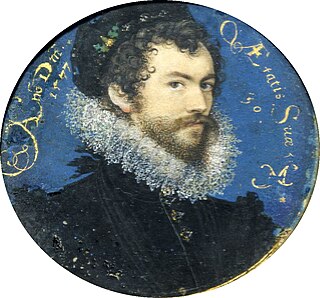
Nicholas Hilliard was an English goldsmith and limner best known for his portrait miniatures of members of the courts of Elizabeth I and James I of England. He mostly painted small oval miniatures, but also some larger cabinet miniatures, up to about 10 inches tall, and at least two famous half-length panel portraits of Elizabeth. He enjoyed continuing success as an artist, and continuing financial troubles, for forty-five years. His paintings still exemplify the visual image of Elizabethan England, very different from that of most of Europe in the late sixteenth century. Technically he was very conservative by European standards, but his paintings are superbly executed and have a freshness and charm that has ensured his continuing reputation as "the central artistic figure of the Elizabethan age, the only English painter whose work reflects, in its delicate microcosm, the world of Shakespeare's earlier plays."

François Clouet, son of Jean Clouet, was a French Renaissance miniaturist and painter, particularly known for his detailed portraits of the French ruling family.

Kamāl ud-Dīn Behzād, also known as Kamal al-din Bihzad or Kamaleddin Behzād, was a Persian painter and head of the royal ateliers in Herat and Tabriz during the late Timurid and early Safavid Periods. He is regarded as marking the highpoint of the great tradition of Islamic miniature painting. He was well known for his very prominent role as kitābdār in the Herat Academy as well as his position in the Royal Library in the city of Herat. His art is unique in that it includes the common geometric attributes of Persian painting, while also inserting his own style, such as vast empty spaces to which the subject of the painting dances around. His art includes masterful use of value and individuality of character, with one of his most famous pieces being "The Seduction of Yusuf" from Sa'di's Bustan of 1488. Behzād's fame and renown in his lifetime inspired many during, and after, his life to copy his style and works due to the wide praise they received. Due to the great number of copies and difficulty with tracing origin of works, there is a large amount of contemporary work into proper attribution.
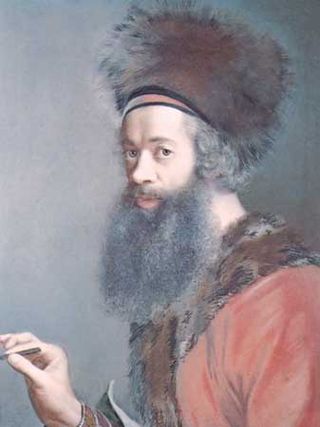
Jean-Étienne Liotard was a Genevan painter, art connoisseur and dealer. He is best known for his detailed, strikingly naturalistic portraits in pastel, and for the works from his stay in Turkey. A Huguenot of French origin and citizen of the Republic of Geneva, he was born and died in Geneva, but spent most of his career in stays in the capitals of Europe, where his portraits were much in demand. He worked in Rome, Istanbul, Paris, Vienna, London, and other cities.

Théobald Chartran was a classical French academic painter and portrait artist.

Sir Théodore Turquet de Mayerne was a Genevan-born physician who treated kings of France and England and advanced the theories of Paracelsus.

Adolfo Müller-Ury, KSG was a Swiss-born American portrait painter and impressionistic painter of roses and still life.

Alexis Simon Belle was a French portrait painter, known for his portraits of the French and Jacobite nobility. As a portrait artist, Belle's style followed that of his master François de Troy, Hyacinthe Rigaud, and Nicolas de Largillière. He was the master of the painter Jacques-André-Joseph-Camelot Aved (1702–1766).

Louis-Marie Autissier, was a French-born portrait miniature painter in the Netherlands. According to Marjorie E. Wieseman, curator of European painting, at the Cincinnati Art Museum, "Autissier's success as a miniaturist was in large measure due to his talent as a colourist and his meticulous detailing of costumes and accessory." He is considered the founder of the Belgian school of miniature painting in the nineteenth century. Among his most accomplished pupils and followers were Alexandre de Latour a (1780–1858), Louis Henri de Fontenay, and Dominique Ducaju (1802–1867) b. His works are in the collections of the Cincinnati Art Museum, the Nationalmuseum and the Royal Collection.

Abraham Constantin, a Swiss enamel painter, was born at Geneva. He became a pupil of Gérard, after whom he executed many works in enamel and on porcelain, among which may be mentioned, 'Belisarius,' 'Cupid and Psyche,' 'The Entry of Henry IV. into Paris,' and portraits of the King of Rome, Charles X, and the Emperor of Russia. He was attached to the manufactory at Sèvres, and died at Geneva.

Amalia Küssner Coudert was an American artist from Terre Haute, Indiana, who is best known for her portrait miniatures of prominent American and European figures of the late 19th and early 20th century. Subjects for her paintings include actresses Lillian Russell and Marie Tempest; wealthy socialites Caroline Schermerhorn Astor, Emily Havemeyer ; members of Britain's royal family and London society such as King Edward VII, Alice Keppel, and Consuelo Vanderbilt, the Duchess of Marlborough; as well as members of the Russian royal family, including Czar Nicholas II and his wife, Czarina Alexandra Feodorovna; and wealthy industrialists such as Cecil Rhodes.

John Alexander Gresse, was an English painter and drawing-master.
William Haines was an English engraver and painter.

The Great Mongol Shahnameh also known as the Demotte Shahnameh or Great Ilkhanid Shahnama, is an illustrated manuscript of the Shahnameh, the national epic of Greater Iran, probably dating to the 1330s. In its original form, which has not been recorded, it was probably planned to consist of about 280 folios with 190 illustrations, bound in two volumes, although it is thought it was never completed. It is the largest early book in the tradition of the Persian miniature, in which it is "the most magnificent manuscript of the fourteenth century", "supremely ambitious, almost awe-inspiring", and "has received almost universal acclaim for the emotional intensity, eclectic style, artistic mastery and grandeur of its illustrations".
Simon Jacques Rochard was a painter of portrait miniatures in France, England and Brussels in the first half of the nineteenth century.
Peter Cross(e) was an English miniature painter. He imitated and perhaps trained under Samuel Cooper, and was extensively employed by royalty and the nobility as a miniaturist during the reign of Queen Anne. He is said to have created an erroneous type of the features of Mary, Queen of Scots by renovating a portrait of her to appear more beautiful.
References
- ↑ ULAN
- ↑ George Henry Borrow Celebrated Trials, and Remarkable Cases of Criminal Jurisprudence: Volume 4 1825 Page 400 THEODORE GARDELLE .. was a native of Geneva, and having received a university education, went to Paris, where he studied miniature-painting, and havin made great proficiency in the art, returned to ...
- ↑ The Annual Register 1758 - Page 43 "Gardelle, Theodore, who was executed for the murder of mrs. Anne King; narrative of the fact for which he suffered, and some account of the character of mrs. King, as well as the murderer,
- ↑ The Gentleman's and London Magazine 1741 -- Page 145 "Some Account of Theodore Gardelle, who was lately executed for the murder of Anne King. THeodore Gardelle, a native of Geneva, was born in the year 1722. At about the age of 14, his father put him apprentice to an engraver and embosser ..."
