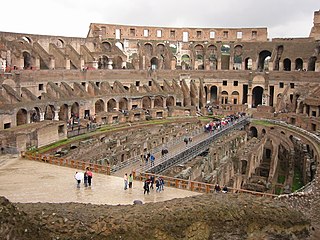
An amphitheatre or amphitheater is an open-air venue used for entertainment, performances, and sports. The term derives from the ancient Greek ἀμφιθέατρον (amphitheatron), from ἀμφί (amphi), meaning "on both sides" or "around" and θέατρον (théātron), meaning "place for viewing".

Tragedy is a form of drama based on human suffering that invokes an accompanying catharsis or pleasure in audiences. While many cultures have developed forms that provoke this paradoxical response, the term tragedy often refers to a specific tradition of drama that has played a unique and important role historically in the self-definition of Western civilisation. That tradition has been multiple and discontinuous, yet the term has often been used to invoke a powerful effect of cultural identity and historical continuity—"the Greeks and the Elizabethans, in one cultural form; Hellenes and Christians, in a common activity," as Raymond Williams puts it.

The hippodrome was an ancient Grecian stadium for horse racing and chariot racing. The name is derived from the Greek words hippos and dromos. The term is used in the modern French language and some others, with the meaning of "horse racecourse". Hence, some present-day horse racing tracks also include the word hippodrome in their names, such as the Hippodrome de Vincennes and the Central Moscow Hippodrome.
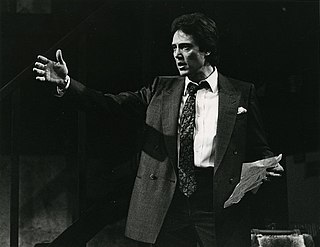
In theatre, a monologue is a speech presented by a single character, most often to express their mental thoughts aloud, though sometimes also to directly address another character or the audience. Monologues are common across the range of dramatic media, as well as in non-dramatic media such as poetry. Monologues share much in common with several other literary devices including soliloquies, apostrophes, and asides. There are, however, distinctions between each of these devices.

A proscenium is the metaphorical vertical plane of space in a theatre, usually surrounded on the top and sides by a physical proscenium arch and on the bottom by the stage floor itself, which serves as the frame into which the audience observes from a more or less unified angle the events taking place upon the stage during a theatrical performance. The concept of the fourth wall of the theatre stage space that faces the audience is essentially the same.

A Greek chorus, or simply chorus in the context of Ancient Greek tragedy, comedy, satyr plays, and modern works inspired by them, is a homogeneous, non-individualised group of performers, who comment with a collective voice on the dramatic action. The chorus consisted of between 12 and 50 players, who variously danced, sang or spoke their lines in unison and sometimes wore masks.

Epidaurus was a small city (polis) in ancient Greece, on the Argolid Peninsula at the Saronic Gulf. Two modern towns bear the name Epidavros:Palaia Epidavros and Nea Epidavros. Since 2010 they belong to the new municipality of Epidaurus, part of the regional unit of Argolis. The seat of the municipality is the town Lygourio.
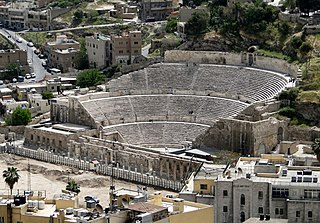
Roman theatres derive from and are part of the overall evolution of earlier Greek theatres. Indeed, much of the architectural influence on the Romans came from the Greeks, and theatre structural design was no different from other buildings. However, Roman theatres have specific differences, such as generally being built upon their own foundations instead of earthen works or a hillside and being completely enclosed on all sides.

The Theatre of Dionysus Eleuthereus is a major theatre in Athens, considered to be the world's first theatre, built at the foot of the Athenian Acropolis. Dedicated to Dionysus, the god of plays and wine, the theatre could seat as many as 17,000 people with excellent acoustics, making it an ideal location for ancient Athens' biggest theatrical celebration, the Dionysia. It was the first theatre ever built, cut into the southern cliff face of the Acropolis, and supposedly the birthplace of Greek tragedy. The remains of a restored and redesigned Roman version can still be seen at the site today. It is sometimes confused with the later, smaller, and better-preserved Odeon of Herodes Atticus, located nearby on the southwest slope of the Acropolis.
A prologue or prolog from Greek πρόλογος prologos, from πρό pro, "before" and λόγος logos, "word" is an opening to a story that establishes the context and gives background details, often some earlier story that ties into the main one, and other miscellaneous information. The Ancient Greek prólogos included the modern meaning of prologue, but was of wider significance, more like the meaning of preface. The importance, therefore, of the prologue in Greek drama was very great; it sometimes almost took the place of a romance, to which, or to an episode in which, the play itself succeeded.

Greek Theatre is a 5,870-seat music venue located in Griffith Park, Los Angeles, California. The theatre is owned by the city of Los Angeles and is operated by SMG. Designed by architects Samuel Tilden Norton, Frederick Hastings Wallisand, and the Tacoma firm Heath, Gove, & Bell, the theatre stage is modeled after a Greek temple.
The William Randolph Hearst Greek Theatre, known locally as simply the Greek Theatre, is an 8,500-seat amphitheater owned and operated by the University of California, Berkeley in Berkeley, California, USA.

Theatre of ancient Rome refers to the time period of theatrical practice and performance in Rome beginning in the 4th century B.C., following the state’s transition from Monarchy to Republic. Theatre of the era is generally separated into the genres of tragedy and comedy. Some works by Plautus, Terence, and Seneca the Younger survive to this day. Eventually, theatre would represent an important aspect of Roman society because it would come to function as the primary means through which the Roman people could express their political emotions during the republican and imperial periods of Rome.
Vassilis Photopoulos was an influential Greek painter, film director, art director and set designer.
Drama is the specific mode of fiction represented in performance: a play, opera, mime, ballet, etc, performed in a theatre, or on radio or television. Considered as a genre of poetry in general, the dramatic mode has been contrasted with the epic and the lyrical modes ever since Aristotle's Poetics —the earliest work of dramatic theory.

A play is a form of literature written by a playwright, usually consisting of dialogue and/or singing between characters, intended for theatrical performance rather than just reading. Plays are performed at a variety of levels, from Broadway, Off-Broadway, regional theater, to Community theatre, as well as university or school productions. There are rare dramatists, notably George Bernard Shaw, who have had little preference as to whether their plays were performed or read. The term "play" can refer to both the written texts of playwrights and to their complete theatrical performance.

