
Khanom Buang, known as Thai crepes in English. Kanom Bueang is an ancient Thai snack known as crispy pancakes in English. It is a popular form of street food in Thailand. These crepes resemble tacos. Khanom bueang are usually first topped or filled with meringue, followed by sweet or salty toppings such as shredded coconut, Foi Thong, or chopped scallions.
Maria Guyomar de Pina, Thao Thong Kip Ma, was a Siamese woman from Ayutthaya. She was of mixed Japanese, Portuguese and Bengali Indian ancestry and became the wife of Greek adventurer Constantine Phaulkon.

Pumpkin-coconut custard is a Southeast Asian dessert, consisting of a coconut custard steam-baked in a whole pumpkin or kabocha. It was created by Maria Guyomar de Pinha in Ayutthaya Kingdom in 17th century as an adaptation of a Portuguese egg-based dessert.
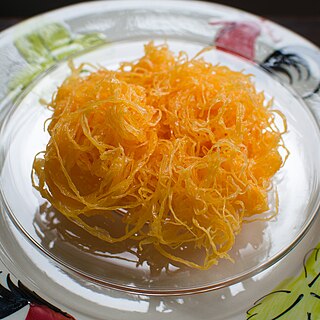
Fios de ovos is a traditional Portuguese sweet food made of eggs, drawn into thin strands and boiled in sugar syrup. They can be found in many Thai desserts; this unique dish found its way to Thailand in the 17th century. It is a traditional element in Portuguese and Brazilian cuisine, in desserts and as side dishes.
The nine auspicious Thai desserts are desserts used in Thailand for traditional ceremonies such as weddings or housewarmings because of their positive connotations.

Khanom krok or coconut-rice pancakes or mortar toasted pastry, is a traditional Thai dessert. They are prepared by mixing rice flour, sugar, and coconut milk to form a dough. Usually, khanom krok is composed of two batters, one salty and one sweet, both of which are cooked in a heating mantle—a hot indented frying pan. After heating, khanom krok is picked out of the mantle and the two half-circular doughs formed into a circular shape.

Bua loi or bua loy is a Thai dessert. It consists of rice flour rolled into small balls, and cooked in coconut milk and sugar. Some Bua loi also adds sweet egg into the recipe. It was inspired by Tangyuan, a Chinese dessert that is traditionally eaten around the Lantern festival. Bua Loi is also traditionally eaten during the Dongzhi Festival in Thailand, which is a festival for the Chinese-Thai bloodline. There are a variety of versions of Bua loi such as ones that use food coloring instead of natural color, use soy milk instead of Coconut cream, add sliced pumpkin inside the rice balls, et cetera. There are other types of Bua loi from other countries such as China, Japan, Indonesia, Myanmar, Philippines, Southern Vietnam and Malaysia. 1 cup of Bua Loy has total calories of 295.5 kilocalories, protein of 10.4 grams, carbohydrate of 6.3 grams, and fat of 25 grams.

Khanom Tokyo or Khanom Tokiao is a Thai street snack. It is a thin flat pancake filled with sweet custard cream. Some have a savory filling, like pork or sausage.

Thong yip or pinched gold egg yolks is one of the nine auspicious traditional Thai desserts. It is usually made for important occasions and ceremonies such as weddings, ordinations, and housewarmings.

Thong yot, also known as "gold egg-yolks drops", is an ancient Thai dessert and one of the nine auspicious traditional Thai desserts. Thong yot originated in Aveiro District, Portugal. Thong yot was adapted from ovos moles de aveiro, a Portuguese dessert, by Maria Guyomar de Pinha, who was appointed as a cook in the palace in the period of King Narai of Ayutthaya. Thong yot is made from egg yolks, flour and sugar.

Khanom mo kaeng is a traditional Thai dessert. It is similar to an egg custard or a kind of flan. Khanom mo kaeng is made with coconut milk, eggs, palm sugar, white sugar, salt, shallots and a bit of oil. There are different variations of khanom mo kaeng. The kind of starch that is used is usually taros, but sometimes are used hulled mung beans, lotus seeds, sweet potatoes, or other starches.

Khanom tan is a traditional Thai dessert consisting of small steamed cakes flavoured with toddy palm sugar and coconut milk, wrapped in banana leaves, and topped with grated coconut. It is most often found in the provinces where sugar palm is grown, such as Phetchaburi, Nakhon Pathom and Suphanburi.
Cha mongkut is a name of one of the traditional Thai desserts. It is similar to kalamae and is made of rice flour and glutinous flour mixed with green bean flour, and is stirred with coconut milk and sugar until it becomes sticky; it is typically sprinkled with chopped roasted peanuts on top or stuffed with melon seeds. Traditionally, they are cut into bite-size pieces and wrapped with banana leaf. Moreover, the aromatic scents of the dessert are given by fresh flowers such as Kesidang, Ylang-Ylang, Damask rose, and Jasmine with boiled water, which is used to squeeze coconut milk. Cha mongkut is easy to keep and does not need to be stored in a refrigerator.

Khao niao sangkhaya or sticky rice with custard, is a traditional Thai dessert. It is prepared with glutinous rice, topped with coconut custard and coconut milk. Khao niao sangkhaya is served warm or at room temperature. The dessert is also found in other countries in Southeast Asia, such as Indonesia, Malaysia, Singapore, and the Philippines.

Relations between Portugal and Thailand date as far as the 16th century. Portugal was the first European nation to make contact with the Ayutthaya Kingdom, in 1511. The Portuguese became dominant foreign traders, and established a presence in the capital. Portuguese traders introduced firearms as well as New-World goods from the Columbian Exchange, influencing Thai cuisine, language and culture. Although Portugal's overseas influence gradually declined from the 17th century, it maintained ties with Siam. The Portuguese Embassy in Bangkok, established in 1820, is the oldest diplomatic mission in the country. In contrast to other European powers, against whose colonial aspirations Siam struggled during the 19th century, Siam's relationship with Portugal was largely friendly. Both countries elevated their missions to embassy status in 1964, and Thailand established a resident embassy in Lisbon in 1981. Today, the two countries share a small amount of trade, tourism and cultural activities.

Kleeb lamduan or lamduan flower shortbread cookie is a Thai biscuit in the shape of lamduan flowers. It is traditionally made from one part of white sugar, two parts of flour, and lard. Kleeb Lamduan cookies are uniquely made by placing them in a container with a tian op (เทียนอบ) scented candle used for dessert making. When the container is closed the candle is extinguished and the aromatic smoke is trapped inside. Modern recipes are also often adapted from the original by using icing sugar instead of caster sugar, vegetable oil instead of lard and some bakers add a portion of salt.

Khanom farang kudi chin is a Thai-style cake that was influenced by Portuguese desserts since the Ayutthaya era, during the reign of King Narai (1633–88). Ayutthaya was a trading entrepot and had diplomatic relations with many European countries at the time, such as France, Spain, Holland and Portugal
Khanom khai pla is a type of Thai dessert. It can be considered as a rare and little known dessert.
Khanom met khanun is traditional Thai dessert dating back to the Ayutthaya period. It is made from a mixture of sweet cooked bean and coconut paste, which is dipped in blended egg yolk and then dipped in hot syrup. The dessert has a yellow-golden appearance and is a bit soft and sticky when chewed. It is one of the nine auspicious Thai desserts served in Thai wedding traditions, religious observances and as a snack.


