Southlands College, also known as Southlands Girls, is a Girls' school located in Galle, Sri Lanka, founded in 1885 by the Wesleyan Methodist missionaries. Southlands College is situated within the historical Galle fort.

St. Peter's College is a Roman Catholic boys-only primary to secondary (inclusive) school in the Bambalapitiya zone of Colombo, Sri Lanka, founded in 1922.

Sri Sumangala College, in Panadura, Sri Lanka, was founded on 3 March 1909 at Rankoth Viharaya, in memory of Ven. Weligama Sri Sumangala Thero, who played an important role in Sri Lankan Buddhism. It is one of the oldest schools in the country. It is a national school, controlled by the central government as opposed to the Provincial Council. It is one of the largest Buddhist school in Sri Lanka, with a student population of 4,000 over 13 Grades.

Sujatha Vidyalaya is a girls' school situated in Matara District, the southernmost district of Sri Lanka. Founded by the Matara Buddhists' Society as a private Buddhist institution in 1929, it is among the oldest Buddhist schools in the country. Today, the Government of Sri Lanka operates Sujatha Vidyalaya as a National School, having been part of the initial group of schools to receive this designation.

St. Anne's College, Kurunegala, is a Roman Catholic boys' school located in Kurunegala, Sri Lanka. Established by Francis Saviour in 1867. Students of St. Anne's College are known as Annites.

St. Anthony's College, Kandy is a Roman Catholic School in Kandy, Sri Lanka. The college was established in 1844 by the Franciscan missionary, Felice Zoppi. The college is under the management of the Sylvestro Benedictine congregation and falls under the Diocese of Kandy. A number of notable individuals, including presidents, ministers, and parliamentarians have graduated from the college.
Prince of Wales' College is a selective entry boys' school situated in Moratuwa, a suburb of Colombo, Sri Lanka. Prince of Wales College, Moratuwa, was founded and endowed in 1876 by Sir Charles Henry de Soysa, a famous 19th century Sri Lankan philanthropist and was named in honour of Prince Albert, Prince of Wales

Dharmapala Vidyalaya, Pannipitiya, established in 1942 on land owned by Anagarika Dharmapala, is the largest mixed school in Sri Lanka with about 8000 students and 600 academic staff. It is a public school and provides primary and secondary education.
Kokuvil Hindu College is a provincial school in Kokkuvil, Sri Lanka.

Musaeus College is a Buddhist private girls' school in Colombo, Sri Lanka. The school is named after its founding principal, Marie Musaeus Higgins from Wismar, Germany, who served as the school's principal from 1891 to 1926. Musaeus College provides primary and secondary education to more than 6,500 girls from ages 3 to 18, and is managed by a board of trustees. The school's motto is "Follow the Light".

St. Servatius' College is a boys' school located in Matara, Sri Lanka. The school was established in 1897 by recently arrived Belgian Jesuit missionaries, led by Joseph Van Reeth, first bishop of Galle and Father Augustus Standaert. St. Servatius' College is a national school, which provides primary and secondary education. This is the only school in Sri Lanka where 3 Governors of the Central Bank of Sri Lanka were educated. This is the only school in Sri Lanka that has produced national team captains in all three sports of cricket, football and volleyball.
Vavuniya Tamil Madhya Maha Vidyalayam also Known as VTMMV is a national school in Vavuniya, Sri Lanka.
Zahira College, Mawanella is a Muslim selective entry co-educational school in Mawanella, Sri Lanka. College started as a result of the educational reform that was brought along with the 1920 political reforms. The school was started as a religious school in a cadjan shed which belonged to the Hinguloya Masjidul Huda. It is currently the one of the largest Muslim educational institution in Sri Lanka with more than 4000 students studying there. The college is located in Mawanella next to Masjidul Huda. Zahira means Excellence in Arabic.
Bandaranayake Central College, Veyangoda, also known as “Veyangoda Central College (VCC)”, is a National school in Sri Lanka. The school was originally one of the three first Central Colleges established under the education reforms of late Hon. C. W. W. Kannangara, who introduced free education in Sri Lanka. Today about 3270 students are studying from grade 6 to 13 and academic staff of 175 are engaged in the teaching process.
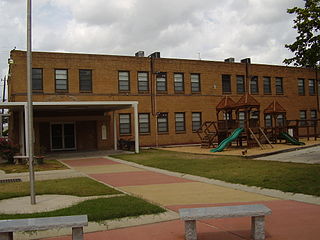
Our Lady of Guadalupe Catholic School is a Roman Catholic K-8 school in the Second Ward in the East End, Houston, Texas. It is the parish school of the Our Lady of Guadalupe Catholic Church of the Roman Catholic Archdiocese of Galveston-Houston.
Trinity College, Kandy, is an independent private school for boys in Kandy Sri Lanka. It was founded in 1872 by British Anglican missionaries of the Church Missionary Society, modelled on British Public school tradition. Trinity offers primary and secondary education, and is a leading private school in Sri Lanka managed by the Anglican Church of Ceylon.
D. S. Senanayake College is a boys' primary and secondary national school in Cinnamon Gardens, Colombo, Western Province, Sri Lanka. It was established on 10 February 1967 under the stewardship of R. I. T. Alles, and was named after the first Prime Minister of Sri Lanka, D. S. Senanayake.

Arafa Muslim Maha Vidyalaya, commonly called Arafa MMV, is a coeducational school in Udunuwara, under the administration of the Central Province, Sri Lanka in the Kandy District. The school has the classes from grade 1 to grade 13 Tamil medium. The first principal was Noor Mohammed Kalugamuwa Gelioya. In the 2019 General Examination of Advance Level exam, 15 students sat the examination and 13 got admission to the university one remarkable university admission was entry to the faculty of law

Matale Vijaya College, or (VCM) is a "Buddhist College" situated in matale city center, A9 highway main road. It is the oldest buddhist college in Matale District. Vijaya College was founded in 1886 by Henry Steel Olcott.
1."Samooha Ozli" book published on 1974 by Vidathaltheevu West Sanasamooha nillaiyam
2. The Chronicle of the Sanctuary of Our Lady of Madhu (up to 1950) with the Life and Labours of the Missionaries Connected with it by. A.J.B.Antaninus
3.Christianity in Sri Lanka under Portuguese By. Martin Quere. O.M.I


