This page is based on this
Wikipedia article Text is available under the
CC BY-SA 4.0 license; additional terms may apply.
Images, videos and audio are available under their respective licenses.

The thylacine ( THY-lə-seen, or THY-lə-syne, also ;, now extinct, was the largest known carnivorous marsupial mammal, evolving about 4 million years ago. The last known live animal was captured in 1933 in Tasmania. It is commonly known as the Tasmanian tiger because of its striped lower back, or the Tasmanian wolf because of its canid-like characteristics. It was native to continental Tasmania, New Guinea, and the Australian mainland.
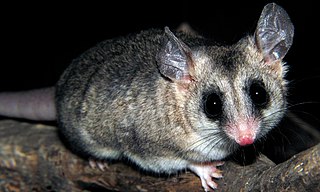
The elegant fat-tailed mouse opossum, also known as the Chilean mouse opossum, is an opossum from central Chile. The type species of Thylamys, it was first described by English naturalist George Robert Waterhouse in 1839. This medium-sized opossum is characterized by black rings around the eyes, white limbs, gray to light brown coat, lighter flanks and underbelly and a thick 12.7–14.6 centimetres (5.0–5.7 in) long tail covered with hairs. It is crepuscular and lives in nests in tree hollows or under rocks and roots. This opossum feeds mainly on arthropods and larvae apart from fruits. Litter size is typically between 11 and 13. The elegant fat-tailed opossum can occur in a variety of habitats – from cloud forests to chaparrals. The IUCN classifies the opossum as least concern.

The white-bellied fat-tailed mouse opossum is a species of opossum in the family Didelphidae. It is found in Argentina, Bolivia,
Chile and Peru.
Michael Crane is a widely published Australian poet, writer and compere of poetry events in Melbourne.

Kate Gordon is an Australian writer of young adult fiction.
Casimier Joseph Franciscus "Cas" Cremers is a computer scientist and professor of Information Security at the University of Oxford.
He is a member of the Department of Computer Science and the Cyber Security Centre as well as a Governing Body Fellow of Kellogg College.

Tamarin Prover is a computer software program for formal verification of cryptographic protocols. It has been used to verify Transport Layer Security 1.3, ISO/IEC 9798, and DNP3 Secure Authentication v5.
