
Alicante is a province of eastern Spain, in the southern part of the Valencian Community. It is the second most populated Valencian province. Likewise, the second and third biggest cities in the Valencian Community—Alicante and Elche, respectively—are located in this province.

The taifas were the independent Muslim principalities and kingdoms of the Iberian Peninsula, referred to by Muslims as al-Andalus, that emerged from the decline and fall of the Umayyad Caliphate of Córdoba between 1009 and 1031. They were a recurring feature of al-Andalus history.

Soria is a municipality and a Spanish city, located on the Douro river in the east of the autonomous community of Castile and León and capital of the province of Soria. Its population is 38,881, 43.7% of the provincial population. The municipality has a surface area of 271,77 km2, with a density of 144.97 inhabitants/km2. Situated at about 1065 metres above sea level, Soria is the second highest provincial capital in Spain.

The Kingdom of Castile was a polity in the Iberian Peninsula during the Middle Ages. It traces its origins to the 9th-century County of Castile, as an eastern frontier lordship of the Kingdom of Asturias. During the 10th century, the Castilian counts increased their autonomy, but it was not until 1065 that it was separated from León and became a kingdom in its own right. Between 1072 and 1157, it was again united with León, and after 1230, the union became permanent.

Villena is a city in Spain, in the Valencian Community. It is located at the northwest part of Alicante, and borders to the west with Castilla-La Mancha and Murcia, to the north with the province of Valencia and to the east and south with the province of Alicante. It is the capital of the comarca of the Alto Vinalopó. The municipality has an area of 345.6 km² and a population of 34,144 inhabitants as of INE 2023.

Jumilla is a town and a municipality in southeastern Spain. It is located in the north east of the Region of Murcia, close to the towns of Cieza and Yecla. According to the 2018 census, the town population was 25,547.

The Crown of Castile was a medieval polity in the Iberian Peninsula that formed in 1230 as a result of the third and definitive union of the crowns and, some decades later, the parliaments of the kingdoms of Castile and León upon the accession of the then Castilian king, Ferdinand III, to the vacant Leonese throne. It continued to exist as a separate entity after the personal union in 1469 of the crowns of Castile and Aragon with the marriage of the Catholic Monarchs up to the promulgation of the Nueva Planta decrees by Philip V in 1716.

Cabra is a municipality in Córdoba province, Andalusia, Spain and the site of former bishopric Egabro. It lies along the route between Córdoba and Málaga in the south of Spain. It is an entrance point to the Parque Natural de las Sierras Subbéticas.

Alcalá del Júcar is a Spanish municipality located in the southeastern part of the Iberian Peninsula, within the Province of Albacete, in the autonomous community of Castile-La Mancha. It has a population of 1,148 inhabitants. The town, situated 64 kilometres from Albacete, was declared Conjunto histórico in 1982.

Caudete is a municipality of Spain located in the province of Albacete, Castilla–La Mancha. It has a population of 10.163. It is part of the Altiplanicie de Almansa comarca.
The Treaty of Torrellas, signed in Torrellas on 8 August 1304, settled the question of conquest of the Kingdom of Murcia, thitherto a dependency of the Crown of Castile, by James II of Aragon. The agreement favored the Crown of Aragon, straining ties.

Ademuz is a municipality in the comarca of Rincón de Ademuz in the Valencian Community, Spain. The name in Valencian is Ademús, but the local language is Spanish, not Valencian.
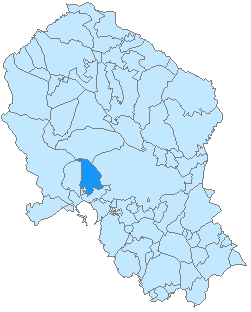
Almodóvar del Río is a small historic city located in the province of Córdoba, Spain, located in the Valle Medio del Guadalquivir Comarca. In 2022, there were 8093 inhibitants. It belongs to the judicial district of Posadas.

Sax is a municipality in the comarca of Alt Vinalopó, province of Alicante, Valencian Community.

The Region of Murcia is an autonomous community of Spain located in the southeastern part of the Iberian Peninsula, on the Mediterranean coast. The region is 11,313 km2 (4,368 sq mi) in area and had a population of 1,511,251 as at the start of 2020. About a third of its population lives in the capital, Murcia, and a seventh in the second city, Cartagena. At 2,014 m (6,608 ft), the region's highest point is Los Obispos Peak in the Massif of Revolcadores.

The Atalaya Castle is a fortress in Villena, province of Alicante, southern Spain. Located over a spur of the Sierra de la Villa, in the north-western part of the province of Alicante, it commands the former frontier between Castile and Kingdom of Aragon.

The Castle of Chinchilla is a castle located in Chinchilla de Monte-Aragón, Spain. It was declared Bien de Interés Cultural in 1931. As of right now visitors only have access to see the exterior of the castle as the interior is under construction. Visitors to the castle can see the remains of Iberian and Roman architecture.

The Battle of the Puig of 1237, also known as the Battle of the Puig de Santa Maria, the Battle of the Puig de Enesa, or the Battle of the Puig de Cepolla was a battle of the Iberian Reconquista and of the Aragonese Conquest of Valencia.

The Castle of Alarcón forms part of the fortifications built around the town of Alarcón in Cuenca, Spain. The fortress is composed of a walled enclosure, which houses the heart of the population and the castle proper, and of five exterior towers, separate and strategically placed.

The Mudéjar revolt of 1264–1266 was a rebellion by the Muslim populations (Mudéjares) in the Lower Andalusia and Murcia regions of the Crown of Castile. The rebellion was in response to Castile's policy of relocating Muslim populations from these regions and was partially instigated by Muhammad I of Granada. The rebels were aided by the independent Emirate of Granada, while the Castilians were allied with Aragon. Early in the uprising, the rebels managed to capture Murcia and Jerez, as well as several smaller towns, but were eventually defeated by the royal forces. Subsequently, Castile expelled the Muslim populations of the reconquered territories and encouraged Christians from elsewhere to settle their lands. Granada became a vassal of Castile and paid an annual tribute.


