1914 in sports describes the year's events in world sport.

Al McCoy,, born Alexander Rudolph, was a boxing World Middleweight Champion from 1914 to 1917. He had a total of 157 bouts. Of those determined officially, he won 44 with 27 by knockout, and had 6 losses, and 6 draws. Around 107 of his fights were no decision bouts.

George Chip was a Lithuanian-American boxer who was the World Middleweight Champion from 1913 to 1914 in an era of great middleweights. Chip came to be known as a heavy puncher with an impressive knockout ratio. He was the father of Major general William C. Chip, USMC.

Ted "Kid" Lewis was an English-Jewish professional boxer who twice won the World Welterweight Championship. Lewis is often ranked among the all-time greats, with ESPN ranking him 41st on their list of the 50 Greatest Boxers of All-Time and boxing historian Bert Sugar placing him 46th in his Top 100 Fighters catalogue. Statistical boxing website BoxRec ranks Lewis as the 17th best welterweight of all-time and the 7th best UK boxer ever. He is a member of the International Jewish Sports Hall of Fame, the Ring Magazine Hall of Fame, and the International Boxing Hall of Fame.
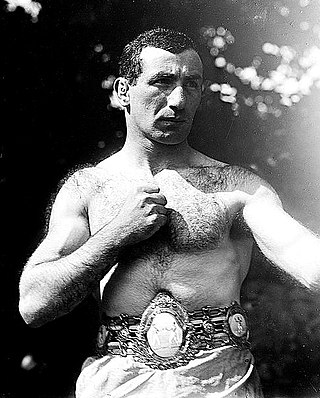
Matthew Wells was a British professional boxer in the lightweight and welterweight divisions. In 1911, he held the Lightweight Championship of Great Britain, and in 1914 he claimed the Welterweight Championship of Britain and the Welterweight Championship of the World.

Sid Smith was an English professional boxer who competed from 1907 to 1919. He was the first officially recognised BBBofC British flyweight champion, holding the title from 1912 to 1913, and was also recognized by the International Boxing Union as the world flyweight champion in 1913.

Johnny Summers was an English boxer who competed from 1901 to 1920. He was a British and British Empire (Commonwealth) welterweight champion.

Waldemar Birger Holberg was a Danish boxer. Born in Copenhagen, Denmark on May 29, 1883, he won the World Welterweight Championship on January 1, 1914, defeating Ray Bronson in Melbourne, Australia in a twenty round points decision. He was a fierce boxer with a KO percentage of 40% in the virtually complete boxing record displayed on BoxRec.

John Michael Basham was a Welsh boxer who became British and European champion at both welter and middleweight. His professional career spanned over 20 years, from 1909 to 1929, and after being stationed in Wrexham through military service, he fought most of his bouts in nearby Liverpool.

Llewellyn "Llew" Edwards was a Welsh boxer who fought professionally between 1913 and 1922. He is most noted for winning both the British and the British Empire featherweight boxing titles in 1915 and for an outstanding winning record with a nearly 50% knockout ratio. He took the Australian lightweight title against Herb McCoy in 1916.

Pat O'Keeffe, was a professional English boxer who became the British champion in both the welterweight and middleweight weight classes. His professional career spanned the years between 1902 and 1918. In 1914 he made an unsuccessful bid for the European heavyweight belt, losing to Georges Carpentier. Between 1907 and 1910 he left Britain and continued his boxing career in the United States, and then Australia. On the outbreak of World War I he joined the British Army to work as a Physical Training Instructor (PTI) and Recruiting Sergeant for the 1st Surrey Rifles. He won the Lonsdale Belt outright when he defeated Bandsman Blake at the National Sporting Club (N.S.C) on 28 January 1918, becoming British Middleweight Champion.

Fred Dyer born Frederick William O'Dwyer, was a Welsh boxing champion, boxing manager and baritone singer. Trained by vocal teacher Clara Novello Davies, Dyer was famed for singing to audiences after he had fought in a contest and was nicknamed 'The Singing Boxer'.

Augustus T. Platts was a British boxer who was British and European middleweight champion.

Aschel Joseph, better known as Young Joseph or Young Josephs, was a British boxer who was British welterweight champion between 1908 and 1912 and European welterweight champion between 1910 and 1911.

Dave Palitz was a Welterweight boxer who competed for the Connecticut Welterweight Championship against Lou Bogash on April 26, 1920, at Casino Hall in Bridgeport, Connecticut. Though he lost the 12 round bout, Palitz was an exceptional boxer in his own right. He fought Jeff Doherty, Bunny Ford, Terry Mitchell, and Jack Britton. Doherty and Ford were regional lightweight champions while Mitchell was a boxer of such caliber that he once defeated 1906 World Welterweight Champion William "Honey" Melody. Britton held the World Welterweight championship for over four years during Palitz's career.

Pat Bradley was an Irish boxer who was recognized as the Australian Welterweight World Boxing Champion on March 19, 1913, when he defeated Jack Clarke at Sydney Stadium in New South Wales, Australia. He also contended twice for the Australian Middleweight World Boxing Title in February and April 1914 against Eddie McGoorty, and Jeff Smith.
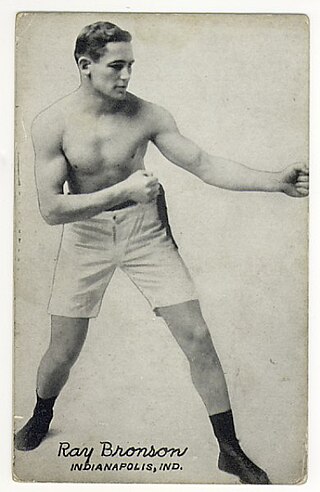
Ray Bronson briefly claimed the World Welterweight Boxing Title between February and December 1912.
Curley Walker was a British boxer who was British bantamweight champion between 1914 and 1915.
Tommy Freeman was an American professional boxer who became a World Welterweight Boxing Champion on September 5, 1930, when he defeated reigning champion Young Jack Thompson. He lost the title to Thompson the following year, on April 14, 1931. Remarkably, the majority of his recorded wins were by knockout, and his losses were few, at under ten percent of his total fights.

Harry Stone, born Harry Seifstein and nicknamed Hop Harry Stone, was an American boxer who competed primarily in Australia. Stone's nickname of "Hop Harry" originated from a fight against Tommy Uren in which he employed a hopping motion that resembled the movement of a kangaroo. He would become known for using this technique in his subsequent fights, as a trademark and in a small part to entertain his audience. He had an effective left jab which became another signature trait.

