Licensure means a restricted practice or a restriction on the use of an occupational title, requiring a license. A license created under a "practice act" requires a license before performing a certain activity, such as driving a car on public roads. A license created under a "title act" restricts the use of a given occupational title to licensees, but anyone can perform the activity itself under a less restricted title. For example, in Oregon, anyone can practice counseling, but only licensees can call themselves "Licensed Professional Counselors." Thus depending on the type of law,
practicing without a license may carry civil or criminal penalties or may be perfectly legal. For some occupations and professions, licensing is often granted through a professional body or a licensing board composed of practitioners who oversee the applications for licenses. This often involves accredited training and examinations, but varies a great deal for different activities and in different countries.
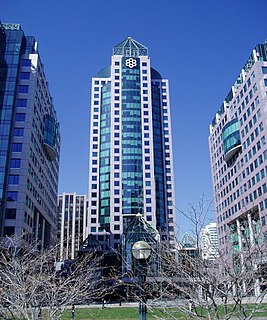
The Municipality of Metropolitan Toronto was an upper tier level of municipal government in Ontario, Canada from 1954 to 1998. It was made up of the old city of Toronto and numerous townships, towns and villages that surrounded Toronto, which were starting to urbanise rapidly after World War II. It was commonly referred to as "Metro Toronto" or "Metro".
The business band is the name used by US radio users who utilize and scanner hobbyists who listen to the Federal Communications Commission (FCC) Industrial/Business pool frequencies. The regulations listing frequencies in this pool are contained in Subpart C of Part 90, Title 47 of the CFR.
Sewage disposal regulation and administration describes the governance of sewage disposal and treatment.
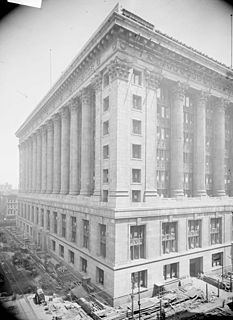
The government of the City of Chicago, Illinois is divided into executive and legislative branches. The Mayor of Chicago is the chief executive, elected by general election for a term of four years, with no term limits. The mayor appoints commissioners and other officials who oversee the various departments. In addition to the mayor, Chicago's two other citywide elected officials are the City Clerk and the treasurer.
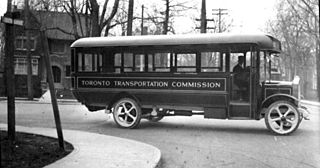
Toronto Transportation Commission (TTC) was the public transit operator in Toronto, Ontario, Canada, which operated buses, streetcars and the island ferries. The system was renamed to the Toronto Transit Commission (TTC) in 1954.
Anthony Perruzza is a politician in Toronto, Ontario, Canada. He was a city councillor in North York from 1988 to 1990, and served in the Legislative Assembly of Ontario from 1990 to 1995 as a member of the New Democratic Party. He is now a Toronto City Councillor for the city's eighth ward, in the eastern section of York West.

The Chairman of the Municipality of Metropolitan Toronto or Metro Chairman was the regional chair of Metropolitan Toronto, Ontario, Canada, and the most senior political figure in the municipality. The Metro Chairman was elected by the members of Metropolitan Toronto Council.

The Oregon Liquor and Cannabis Commission (OLCC) is a government agency of the U.S. state of Oregon. The OLCC was created by an act of the Oregon Legislative Assembly in 1933, days after the repeal of prohibition, as a means of providing control over the distribution, sales and consumption of alcoholic beverages. To this end, the agency was given the authority to regulate and license those who manufacture, sell or serve alcohol. Oregon is one of 18 alcoholic beverage control states that directly control the sales of alcoholic beverages in the United States. In 2014, the passage of Oregon Ballot Measure 91 (2014) legalized the recreational use of marijuana in Oregon and gave regulatory authority to the OLCC.

The City of Toronto Paramedic Services, formerly known as Toronto EMS, is the statutory emergency medical services provider for the city of Toronto, Ontario, Canada. The service is operated directly as a branch of the municipal government as an independent, third-service option provider, which means that the service is funded by the municipal tax base, and operates in much the same manner as any other municipal division, such as the police or fire department, or in some cases like a public utility, but retains its complete independence from all other divisions. While under municipal government control, it is required to comply with legislation and licensing standards provided by the Ontario provincial government. It is not the only service provider in its area; private-for-profit medical transport services also provide routine, non-emergency transports and coverage for special events, but the statutory EMS system is the only provider permitted to service emergency calls.
The City of Toronto Act is the name of a series of different acts of parliament that have governed the organization and political powers of the city since Toronto's original incorporation as a city in 1834.
The Toronto Transportation Services, formerly Metro Roads and Works, is a division of the municipal government of Toronto. It is responsible for all public and non-provincially maintained roadways in Toronto, Ontario, Canada.
The City of Toronto Parks, Forestry and Recreation Division is the largest division of the Toronto municipal government. It is responsible for city-owned parks, forests, and recreation centres. With an gross annual budget in 2018 of C$468 million, the division is responsible for the City's over 3 million trees, 1473 named parks, 839 sports fields, 137 community centres, and about 670 other recreational facilities including: pools, golf courses, ski centres, skating rinks, greenhouses and ferries. Each year, more than 1.2 million Toronto residents participate in over 54,000 recreation and leisure programs offered by the division.
The municipal government of Toronto, corporately known as the City of Toronto, is a public corporation providing services to Toronto, Ontario, Canada. It is administered by 25 elected councillors who, along with the Mayor of Toronto, make up the Toronto City Council. Torontonians elect a new council every four years, in October.

The Michigan Department of Natural Resources (DNR) is the agency of the state of Michigan charged with maintaining natural resources such as state parks, state forests, and recreation areas. It is governed by a director appointed by the Governor and accepted by the Natural Resources Commission. Currently the Director is Keith Creagh. The DNR has about 1,400 permanent employees, and over 1,600 seasonal employees.
Asset management refers to systematic approach to the governance and realization of value from the things that a group or entity is responsible for, over their whole life cycles. It may apply both to tangible assets and to intangible assets. Asset management is a systematic process of developing, operating, maintaining, upgrading, and disposing of assets in the most cost-effective manner.

An executive agency is a part of a government department that is treated as managerially and budgetarily separate, to carry out some part of the executive functions of the United Kingdom government, Scottish Government, Welsh Government or Northern Ireland Executive. Executive agencies are "machinery of government" devices distinct both from non-ministerial government departments and non-departmental public bodies, each of which enjoy a real legal and constitutional separation from ministerial control. The model was also applied in several other countries.

The 2009 City of Toronto inside and outside workers strike was a legal strike action that was undertaken by the Toronto Civic Employees Union and CUPE Local 79, two locals of the Canadian Union of Public Employees in the city of Toronto.
The City of Ottawa's By-law and Regulatory Services Branch (BLRS) is a uniformed municipal law enforcement agency providing regulatory services to the residents and visitors of the City of Ottawa, Ontario, Canada.
Dorothy Thomas, née Mikos was a Canadian politician who served on the Toronto City Council from 1972 to 1976 and from 1980 to 1985.


