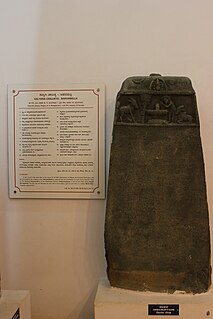
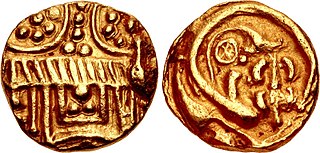
Kirttivarman I was a ruler of the Chalukya dynasty of Vatapi in India. He ruled parts of present-day Karnataka, Goa, Maharashtra and Andhra Pradesh.

The Western Chalukya Empire ruled most of the western Deccan, South India, between the 10th and 12th centuries. This Kannadiga dynasty is sometimes called the Kalyani Chalukya after its regal capital at Kalyani, today's Basavakalyan in the modern Bidar District of Karnataka state, and alternatively the Later Chalukya from its theoretical relationship to the 6th-century Chalukya dynasty of Badami. The dynasty is called Western Chalukyas to differentiate from the contemporaneous Eastern Chalukyas of Vengi, a separate dynasty. Prior to the rise of these Chalukyas, the Rashtrakuta empire of Manyakheta controlled most of Deccan and Central India for over two centuries. In 973, seeing confusion in the Rashtrakuta empire after a successful invasion of their capital by the ruler of the Paramara dynasty of Malwa, Tailapa II, a feudatory of the Rashtrakuta Dynasty ruling from Bijapur region defeated his overlords and made Manyakheta his capital. The dynasty quickly rose to power and grew into an empire under Someshvara I who moved the capital to Kalyani.

The Kalachuris of Kalyani were a 12th-century Indian dynasty, who ruled over parts of present-day northern Karnataka and Maharashtra. This dynasty rose to power in the Deccan region between 1156 and 1181 CE.
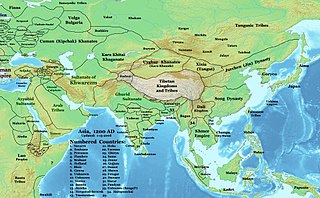
The Seuna, Sevuna or Yadavas of Devagiri was an Indian dynasty, which at its peak ruled a kingdom stretching from the Tungabhadra to the Narmada rivers, including present-day Maharashtra, north Karnataka and parts of Madhya Pradesh, from its capital at Devagiri.
Prithvi-vallabha, or Vallabha-rāja, was a title adopted by several kings that ruled in present-day India, including the Chalukyas of Vatapi, the Rashtrakutas and their successors.
The Chaulukya dynasty, also known as the Chalukyas of Gujarat, ruled parts of what are now Gujarat and Rajasthan in north-western India, between c. 940 CE and c. 1244 CE. Their capital was located at Anahilavada. At times, their rule extended to the Malwa region in present-day Madhya Pradesh. The medieval legends describe them as Agnivanshi Rajputs, and they are also known as the Solanki dynasty in the vernacular literature.
The Kalachuris of Tripuri, also known the Kalachuris of Chedi, ruled parts of central India during 7th to 13th centuries. Their core territory included the historical Chedi region, and their capital was located at Tripuri.
Several dynasties named "Chalukya" ruled in present-day India at various times. The oldest of these were the Chalukyas of Vatapi or Badami. Other Chalukya dynasties include:
Vigraharāja II was an Indian king belonging to the Shakambhari Chahamana dynasty. He ruled the Sapadalaksha country, which included parts of present-day Rajasthan in north-western India.
The Kalachuris were an Indian dynasty that ruled in west-central India between 6th and 7th centuries. They are also known as the Haihayas or as the "early Kalachuris" to distinguish them from their later namesakes.
Yuvarajadeva II was a ruler of the Kalachuri dynasty of Tripuri in central India. His kingdom was centered around the Chedi or Dahala region in present-day Madhya Pradesh. He established matrimonial relations with the Chalukyas of Kalyani, and was defeated by their rival, the Paramara king Munja.
Kokalla II was a ruler of the Kalachuri dynasty of Tripuri in central India. His kingdom was centered around the Chedi or Dahala region in present-day Madhya Pradesh. His Gurgi inscription suggests that he raided the territories of the Gurjara-Pratiharas, the Palas and the Chalukyas of Kalyani.
Gangeyadeva was a ruler of the Kalachuri dynasty of Tripuri in central India. His kingdom was centered around the Chedi or Dahala region in present-day Madhya Pradesh.
Bhillama II was a ruler of the Seuna (Yadava) dynasty of Deccan region in India. He was a vassal of the Kalyani Chalukya ruler Tailapa II, and played an important role in Tailapa's victory against the Paramara king Munja.
Vinayaditya may refer to any of the following kings who ruled in present-day India:
Jayasimha was the first ruler of the Chalukya dynasty of Vatapi in present-day India. He ruled the area around modern Bijapur in the early 6th century, and was the grandfather of the dynasty's first sovereign ruler, Pulakeshin I.
Ranaraga was an early 6th century ruler of the Chalukya dynasty of Vatapi in present-day India. A vassal ruler, he was the father of the dynasty's first sovereign ruler, Pulakeshin I.
Arikesari III was the last known ruler of the Vemulavada Chalukya dynasty of present-day Telangana, India. He was a vassal of the Rashtrakuta king Krishna III.
This page is based on this
Wikipedia article Text is available under the
CC BY-SA 4.0 license; additional terms may apply.
Images, videos and audio are available under their respective licenses.