 | This disambiguation page lists articles associated with the title Transport in Korea. If an internal link led you here, you may wish to change the link to point directly to the intended article. |
Transport in Korea can refer to:
| | This disambiguation page lists articles associated with the title Transport in Korea. If an internal link led you here, you may wish to change the link to point directly to the intended article. |
Transport in Korea can refer to:
This is a list of articles on Korea-related people, places, things, and concepts. For help on how to use this list, see the introduction below.
Korean Air Lines Co., Ltd., operating as Korean Air, is the largest airline and flag carrier of South Korea based on fleet size, international destinations and international flights. The airline's global headquarters are located in Seoul, South Korea. Korean Air was founded as Korean National Airlines in 1946. After several years of service and expansion, the airline was fully privatized in 1969.
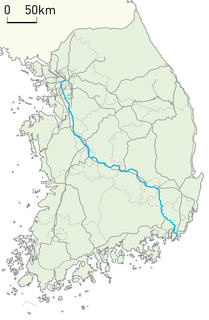
The Gyeongbu Line (Gyeongbuseon) is the most important railway line in South Korea and one of the oldest ones in the country. Gyeongbu line was constructed in 1905, connecting Seoul with Busan, via Suwon, Daejeon, and Daegu. The Gyeongbu Line is by far the most heavily travelled rail line in South Korea.

Air Koryo is the state-owned national flag carrier airline of North Korea, headquartered in Sunan-guyŏk, Pyongyang. Based at Pyongyang International Airport, it operates international scheduled and charter services to points in Asia.
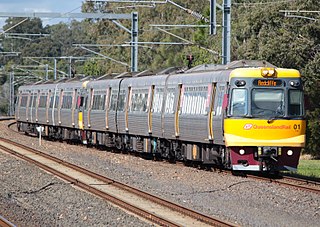
This page provides an index of articles on rail transport by country.

Daegu Metro serves primarily the South Korean city of Daegu.

The Korean People's Army Air and Anti-Air Force is the unified military aviation force of North Korea. It is the second largest branch of the Korean People's Army comprising an estimated 110,000 members. It possesses 940 aircraft of different types, mostly of old Soviet and Chinese origin. Its primary task is to defend North Korean airspace.

Transport Flight (Japan) was a Royal Australian Air Force (RAAF) transport unit that operated in the aftermath of the Korean War. It was formed in March 1955 at Iwakuni, Japan, and equipped with three Douglas C-47 Dakotas and a CAC Wirraway. The flight's main duty was flying a regular courier service between Japan and South Korea in support of Commonwealth military units based on the peninsula. Transport Flight (Japan) ceased operations in June 1956 and disbanded in September that year.
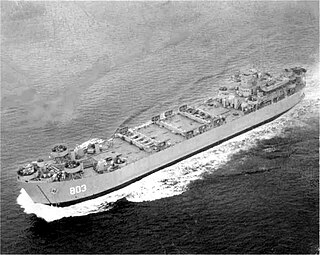
The USS Hampden County (LST-803) was an LST-542-class tank landing ship built for the United States Navy during World War II. Named after Hampden County, Massachusetts, she was the only U.S. Naval vessel to bear the name.

USS Magoffin (APA-199/LPA-199) was a Haskell-class attack transport acquired by the U.S. Navy during World War II for the task of transporting troops to and from combat areas.

The Frederick Funston-class attack transport was a class of two US Navy attack transports. They saw service in World War II and later in the Korean War.

No. 30 Transport Unit was a Royal Australian Air Force (RAAF) unit that operated during the Korean War. It was formed in November 1950 as No. 30 Communications Unit and based at Iwakuni, Japan, as part of No. 91 (Composite) Wing. The unit was initially equipped with four Douglas C–47 Dakotas and two Austers, one of the Dakotas being the personal transport of Lieutenant General Sir Horace Robertson, commander of the British Commonwealth Occupation Force (BCOF). Another four Dakotas were sent to Japan due to operational demands. The unit's role in Korea was to support No. 77 (Fighter) Squadron by transporting supplies and equipment. It also delivered materials and stores to Australian and Commonwealth ground forces, and transported VIPs of the United Nations Command. Return journeys to Japan were often used to evacuate wounded personnel from the theatre. No. 30 Communications Unit was redesignated No. 30 Transport Unit in November 1951, and re-formed as No. 36 (Transport) Squadron in March 1953. The squadron remained in Korea following the armistice, and returned to Australia in June 1955.

Visa requirements for South Korean citizens are administrative entry restrictions by the authorities of other states placed on citizens of South Korea.

Visa requirements for North Korean citizens are administrative entry restrictions imposed on citizens of North Korea by the authorities of other states.

Visitors to North Korea must obtain a visa from one of the North Korean diplomatic missions.

The Ministry of Land, Infrastructure and Transport (MOLIT) is a cabinet-level division of the government of South Korea. Its headquarters is in the Sejong Government Office in Sejong City.
The Battle of Suwon Airfield was the first aerial battle of the Korean War occurring on June 27, 1950 over Kimpo Airfield and Suwon Airfield. The battle, between aircraft of the United States and North Korea, ended in a victory for the US Air Force after nine of its aircraft successfully shot down seven North Korean People's Air Force aircraft. It was the first direct engagement of the Air Battle of South Korea.
The Aviation and Railway Accident Investigation Board is an agency of the South Korean government that investigates aviation and railway accidents, subservient to the Ministry of Land, Infrastructure and Transport (MOLIT) and headquartered in Sejong City.

Hŭngnam is a district of Hamhung, the third largest city in North Korea. It is a port city on the eastern coast on the Sea of Japan. It is only eight miles from the slightly inland city of Hamhung. In 2005 it became a ward of Hamhung.
The Indeogwon–Dongtan Line is a double track subway line opened in 2021.