This page is based on this
Wikipedia article Text is available under the
CC BY-SA 4.0 license; additional terms may apply.
Images, videos and audio are available under their respective licenses.

In anatomy, the atlas (C1) is the most superior (first) cervical vertebra of the spine.

Standard anatomical terms of location deal unambiguously with the anatomy of animals, including humans.

In anatomy, the second cervical vertebra (C2) of the spine is named the axis or epistropheus.
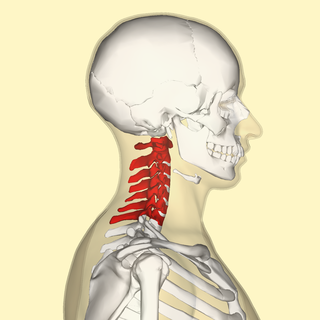
In vertebrates, cervical vertebrae are the vertebrae of the neck, immediately below the skull.
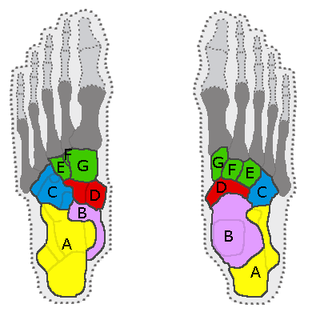
The tarsus is a cluster of seven articulating bones in each foot situated between the lower end of tibia and fibula of the lower leg and the metatarsus. It is made up of the midfoot and hindfoot.
The vertebral arteries are major arteries of the neck. Typically, the vertebral arteries originate from the subclavian arteries. Each vessel courses superiorly along each side of the neck, merging within the skull to form the single, midline basilar artery. As the supplying component of the vertebrobasilar vascular system, the vertebral arteries provide supply blood to the upper spinal cord, brainstem, cerebellum, and posterior part of brain.

A transverse engine is an engine mounted in a vehicle so that the engine's crankshaft axis is perpendicular to the direction of travel. Many modern front wheel drive vehicles use this engine mounting configuration. Most rear wheel drive vehicles use a longitudinal engine configuration, where the engine's crankshaft axis is parallel with the direction of travel, except for some rear-mid engine vehicles, which use a transverse engine and transaxle mounted in the rear instead of the front. Despite typically being used in light vehicles, it is not restricted to light vehicles and has also be used on armored vehicles to save interior space.

The intertransversarii are small muscles placed between the transverse processes of the vertebrae.

A sagittal plane, or longitudinal plane, is an anatomical plane which divides the body into right and left parts. The plane may be in the center of the body and split it into two halves (mid-sagittal) or away from the midline and split it into unequal parts (para-sagittal).

The alar ligaments connect the sides of the dens to tubercles on the medial side of the occipital condyle.
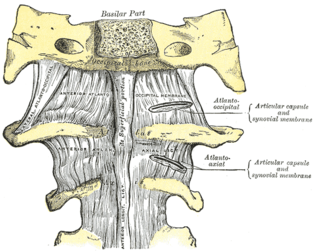
The atlantoaxial joint is a joint in the upper part of the neck between the first and second cervical vertebrae; the atlas and axis. It is a pivot joint.
Ship motions are defined by the six degrees of freedom that a ship, boat or any other craft can experience.

An aircraft in flight is free to rotate in three dimensions: yaw, nose left or right about an axis running up and down; pitch, nose up or down about an axis running from wing to wing; and roll, rotation about an axis running from nose to tail. The axes are alternatively designated as vertical, transverse, and longitudinal respectively. These axes move with the vehicle and rotate relative to the Earth along with the craft. These definitions were analogously applied to spacecraft when the first manned spacecraft were designed in the late 1950s.

In obstetrics, the presentation of a fetus about to be born refers to which anatomical part of the fetus is leading, that is, is closest to the pelvic inlet of the birth canal. According to the leading part, this is identified as a cephalic, breech, or shoulder presentation. A malpresentation is any presentation other than a vertex presentation.

Chromostereopsis is a visual illusion whereby the impression of depth is conveyed in two-dimensional color images, usually of red-blue or red-green colors, but can also be perceived with red-grey or blue-grey images. Such illusions have been reported for over a century and have generally been attributed to some form of chromatic aberration.
An anatomical plane is a hypothetical plane used to transect the human body, in order to describe the location of structures or the direction of movements. In human and animal anatomy, three principal planes are used:

In aviation, the turn and slip indicator and the turn coordinator (TC) variant are essentially two aircraft flight instruments in one device. One indicates the rate of turn, or the rate of change in the aircraft's heading; the other part indicates whether the aircraft is in coordinated flight, showing the slip or skid of the turn. The slip indicator is actually an inclinometer that at rest displays the angle of the aircraft's transverse axis with respect to horizontal, and in motion displays this angle as modified by the acceleration of the aircraft.

The Co-Cathedral of the Most Holy Name of Jesus, also known as the Holy Name of Jesus Concathedral, is the co-cathedral, or technical cathedra, of the Latin Patriarchate of Jerusalem. It is located in the Christian quarter of the Old City of Jerusalem, about halfway between the New Gate and the Jaffa Gate, within the Old City walls.
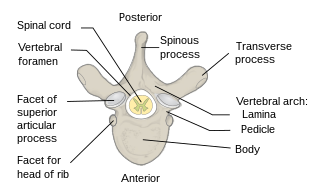
In the vertebrate spinal column, each vertebra is an irregular bone with a complex structure composed of bone and some hyaline cartilage, the proportions of which vary according to the segment of the backbone and the species of vertebrate.
