
Woodwind instruments are a family of musical instruments within the more general category of wind instruments. There are two main types of woodwind instruments: flutes and reed instruments. What differentiates these instruments from other wind instruments is the way in which they produce their sound. All woodwinds produce sound by splitting an exhaled air stream on a sharp edge, such as a reed or a fipple. A woodwind may be made of any material, not just wood. Common examples include brass, silver, cane, as well as other metals such as gold and platinum. Occasionally woodwinds are made out of earthen materials, especially ocarinas. Common examples include flute, oboe, clarinet, bassoon, and saxophone.
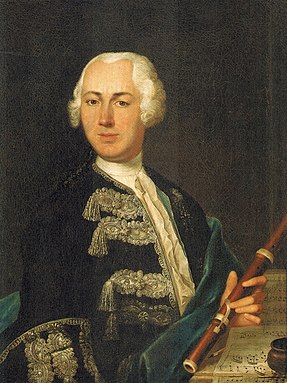
Johann Joachim Quantz was a German flutist, flute maker and Baroque music composer. He composed hundreds of flute sonatas and concertos, and wrote On Playing the Flute, a treatise on flute performance. His works were known and liked by Bach and Mozart.
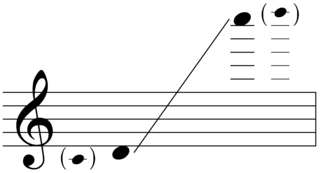
The piccolo is a half-size flute, and a member of the woodwind family of musical instruments. The modern piccolo has most of the same fingerings as its larger sibling, the standard transverse flute, but the sound it produces is an octave higher than written. This gave rise to the name ottavino, which the instrument is called in the scores of Italian composers. It is also called flauto piccolo or flautino.

The ocarina is an ancient wind musical instrument—a type of vessel flute. Variations exist, but a typical ocarina is an enclosed space with four to twelve finger holes and a mouthpiece that projects from the body. It is traditionally made from clay or ceramic, but other materials are also used—such as plastic, wood, glass, metal, or bone. An example of an ocarina made of an animal horn is the medieval German gemshorn.
Matthias Maute is a virtuoso recorder player and composer.

The four orchestral suites, BWV 1066–1069 are four suites by Johann Sebastian Bach. The name ouverture refers only in part to the opening movement in the style of the French overture, in which a majestic opening section in relatively slow dotted-note rhythm in duple meter is followed by a fast fugal section, then rounded off with a short recapitulation of the opening music. More broadly, the term was used in Baroque Germany for a suite of dance-pieces in French Baroque style preceded by such an ouverture. This genre was extremely popular in Germany during Bach's day, and he showed far less interest in it than was usual: Robin Stowell writes that "Telemann's 135 surviving examples [represent] only a fraction of those he is known to have written"; Christoph Graupner left 85; and Johann Friedrich Fasch left almost 100. Bach did write several other ouverture (suites) for solo instruments, notably the Cello Suite no. 5, BWV 1011, which also exists in the autograph Lute Suite in G minor, BWV 995, the Keyboard Partita no. 4 in D, BWV 828, and the Overture in the French style, BWV 831 for keyboard. The two keyboard works are among the few Bach published, and he prepared the lute suite for a "Monsieur Schouster," presumably for a fee, so all three may attest to the form's popularity.
Stephen Preston is an English flautist specialising in period performance of baroque and classical music on original instruments. Additionally he plays modern flute and choreographs historical forms of dance.
Anna Bon was an Italian composer and performer.
Her parents were both involved in music and traveled internationally; her father was the Bolognese artist Girolamo Bon, a librettist and scenographer, and her mother was the singer Rosa Ruvinetti Bon.
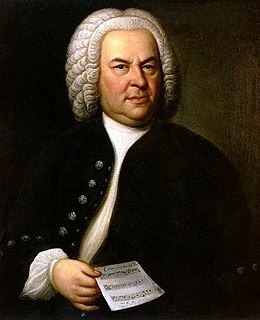
The Sonata in E major for flute and basso continuo is a sonata for transverse flute and figured bass composed by Bach in the 1740s. It was written as the result of a visit in 1741 to the court of Frederick the Great in Potsdam, where Bach's son Carl Philipp Emanuel had been appointed principal harpsichordist to the king the previous year. It was dedicated to Michael Gabriel Fredersdorf, the king's valet and private secretary, who, like the king, was an amateur flautist.

Martha Goldstein was an American harpsichordist and pianist, who gave concerts in the United States, North Africa, the Middle East, and Europe. She performed works by George Frideric Handel, Frédéric Chopin, Georg Philipp Telemann, Franz Liszt, Ferruccio Busoni, Johann Sebastian Bach, and others.
Georg Philipp Telemann's 12 fantaisies à traversière sans basse, 12 Fantasias for Solo Flute, TWV 40:2–13, were published in Hamburg in 1732–33. An extant copy of the publication, conserved in Brussels, has a spurious title page reading Fantasie per il Violino senza Basso. The set is one of Telemann's collections of fantasias for unaccompanied instruments, the others being a set of thirty-six for harpsichord, also published in 1732–33, and two sets published in 1735: twelve for solo violin and twelve for viola da gamba.
The Flute sonata in G major was composed by George Frideric Handel in F major for the oboe, and was transposed by an unknown hand to G major, for flute and keyboard (harpsichord). The work is also referred to as Opus 1 No. 5, as it was first published in 1726 or slightly later by the London publisher Walsh, in an edition falsely attributed to Jeanne Roger of Amsterdam. Other catalogues of Handel's music have referred to the work as HG xxvii,19; and HHA iv/3,28. The sonata was originally composed as an oboe sonata in F major.
Georg Philipp Telemann's XIIX Canons mélodieux ou VI. Sonates en Duo à Flutes Traverses, ou Violons, ou Basses de Viole, TWV 40:118-123, is a set of 18 canons for two equal instruments, forming six sonatas in three movements each, which was published in 1738. These pieces have been arranged for flute and oboe, recorded by European Baroque Soloists on Denon, issued in 1991; catalogue number 81757 96142.
Auser Musici is a period instrument ensemble centered in Pisa that specializes in early music repertory from the Tuscan region of Italy.
Giovanni Antonini is an Italian conductor and soloist on the recorder and baroque transverse flute. He studied in his native Milan, and attended the Civica Scuola di Musica in that city and the Centre de Musique Ancienne in Geneva. In 1985, along with Luca Pianca, he co-founded Il Giardino Armonico, a pioneering Italian early-music ensemble based in Milan.
Passacaille records is a Belgian classical music record label, owned by Musurgia BVBA, based in Halle, Belgium. The company's artistic director is the flautist and flute-maker Jan De Winne.
La tempesta di mare, a flute concerto in F Major, is the first of Six Flute Concertos, Op. 10 by Antonio Vivaldi, published in the late 1720s. La tempesta di mare may also refer to two earlier versions of the same concerto, RV 98, a concerto da camera featuring the flute, from which Vivaldi derived the concerto grosso RV 570.
Johann Sebastian Bach wrote his fifth Brandenburg Concerto, BWV 1050, for harpsichord, flute and violin as soloists, and an orchestral accompaniment consisting of strings and continuo. An early version of the concerto, BWV 1050a, originated in the late 1710s. On 24 March 1721 Bach dedicated the final form of the concerto to Margrave Christian Ludwig of Brandenburg.


