
The Peace of Westphalia was a series of peace treaties signed between May and October 1648 in the Westphalian cities of Osnabrück and Münster, largely ending the European wars of religion, including the Thirty Years' War. The treaties of Westphalia brought to an end a calamitous period of European history which caused the deaths of approximately eight million people. Scholars have identified Westphalia as the beginning of the modern international system, based on the concept of Westphalian sovereignty, though this interpretation has been challenged.
Year 1431 (MCDXXXI) was a common year starting on Monday of the Julian calendar.
Treaty of Paris can refer to one of many treaties signed in Paris, France:

The history of Baden-Württemberg covers the area included in the historical state of Baden, the former Prussian Hohenzollern, and Württemberg, part of the region of Swabia since the 9th century.

The Locarno Treaties were seven agreements negotiated at Locarno, Switzerland, on 5–16 October 1925 and formally signed in London on 1 December, in which the First World War Western European Allied powers and the new states of Central and Eastern Europe sought to secure the post-war territorial settlement, and return normalizing relations with defeated Germany. It also stated that Germany would never go to war with the other countries. Locarno divided borders in Europe into two categories: western, which were guaranteed by Locarno treaties, and eastern borders of Germany with Poland, which were open for revision.

Büsingen am Hochrhein, commonly known as Büsingen, is a German municipality in the south of Baden-Württemberg and an exclave entirely surrounded by Switzerland. It has a population of about 1,450 inhabitants. Since the early 19th century, the village has been separated from the rest of Germany by a narrow strip of land containing the Swiss village of Dörflingen.

A peace treaty is an agreement between two or more hostile parties, usually countries or governments, which formally ends a state of war between the parties. It is different from an armistice, which is an agreement to stop hostilities, or a surrender, in which an army agrees to give up arms, or a ceasefire or truce in which the parties may agree to temporarily or permanently stop fighting.

The War of the Second Coalition (1798–1802) was the second war on revolutionary France by the European monarchies, led by Britain, Austria and Russia, and including the Ottoman Empire, Portugal, Naples, various German monarchies and Sweden. Their goal was to contain the expansion of the French Republic and to restore the monarchy in France. They failed to overthrow the revolutionary regime and French territorial gains since 1793 were confirmed. In the Treaty of Lunéville in 1801, France held all of its previous gains and obtained new lands in Tuscany, Italy, while Austria was granted Venetia and the Dalmatian coast. Britain and France signed the Treaty of Amiens in March 1802, bringing an interval of peace in Europe that lasted for 14 months. By May 1803 Britain and France were again at war and in 1805 Britain assembled the Third Coalition to resume the war against France.

The Duchy of Milan was a state of the Holy Roman Empire in northern Italy. It was created in 1395, when it included twenty-six towns and the wide rural area of the middle Padan Plain east of the hills of Montferrat. During much of its existence, it was wedged between Savoy to the west, Venice to the east, the Swiss Confederacy to the north, and separated from the Mediterranean by Genoa to the south. The Duchy eventually fell to Habsburg Austria with the Treaty of Baden (1714), concluding the War of the Spanish Succession. The Duchy remained an Austrian possession until 1796, when a French army under Napoleon Bonaparte conquered it, and it ceased to exist a year later as a result of the Treaty of Campo Formio, when Austria ceded it to the new Cisalpine Republic.

The Old Swiss Confederacy began as a late medieval alliance between the communities of the valleys in the Central Alps, at the time part of the Holy Roman Empire, to facilitate the management of common interests such as free trade and to ensure the peace along the important trade routes through the mountains. The Hohenstaufen emperors had granted these valleys reichsfrei status in the early 13th century. As reichsfrei regions, the cantons of Uri, Schwyz, and Unterwalden were under the direct authority of the emperor without any intermediate liege lords and thus were largely autonomous.
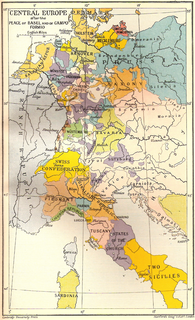
The Peace of Basel of 1795 consists of three peace treaties involving France during the French Revolution.

Upon defeat of Nazi Germany in World War II, the victorious Allies asserted joint authority and sovereignty over 'Germany as a whole', defined as all territories of the former German Reich west of the Oder–Neisse line, having declared the destruction of Nazi Germany at the death of Adolf Hitler. The four powers divided 'Germany as a whole' into four occupation zones for administrative purposes, under the United States, United Kingdom, France and the Soviet Union respectively; creating what became collectively known as Allied-occupied Germany. This division was ratified at the Potsdam Conference. The four zones were as agreed in February 1945 by the United States, United Kingdom and Soviet Union meeting at the Yalta Conference; setting aside an earlier division into three zones proposed by the London Protocol.
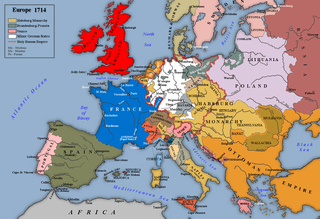
The Treaty of Rastatt was a peace treaty between France and Austria, concluded on 7 March 1714 in the Baden city of Rastatt, to put an end to state of war between them from the War of the Spanish Succession. The treaty followed the earlier Treaty of Utrecht of 11 April 1713, which ended hostilities between France and Spain, on the one hand, and Britain and the Dutch Republic, on the other hand. A third treaty at Baden, Switzerland was required to end the hostilities between France and the Holy Roman Empire.

The Old Swiss Confederacy was a loose confederation of independent small states within the Holy Roman Empire. It is the precursor of the modern state of Switzerland.

Basel Badischer Bahnhof is a railway station situated in the Swiss city of Basel. The station is situated on Swiss soil, but the station is operated by the German railway company Deutsche Bahn. A customs border is situated in the passenger tunnel between the tracks and the station hall. It is the only railway station that is operated as part of the German national rail network yet not located within Germany's state boundaries, and it is listed as a Swiss heritage site of national significance. The station is served by the lines RE, RB, S 6 of the tri-national Regio S-Bahn Basel, and ICE and EC/IC lines to and from Freiburg, Karlsruhe, Mannheim, Frankfurt, Hamburg, Berlin and other cities in Germany.

The Grand Duchy of Baden was an independent state in what is now southwestern Germany until the creation of the German Empire in 1871. It had its own state-owned railway company, the Grand Duchy of Baden State Railways, which was founded in 1840. At the time when it was integrated into the Deutsche Reichsbahn in 1920, its network had an overall length of about 2,000 kilometres (1,200 mi).
Baden is the western part of the German state of Baden-Württemberg, named for Baden-Baden, which was named for its hot springs.
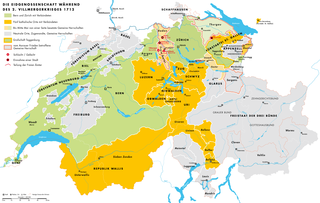
The Toggenburg War, also known as the Second War of Villmergen or the Swiss Civil War of 1712, was a Swiss civil war during the Old Swiss Confederacy, that took place from 12 April until 11 August 1712. On the one hand there were the Catholic "inner cantons" and the Imperial Abbey of Saint Gall, on the other the Protestant cantons of Bern and Zürich as well as the abbatial subjects of Toggenburg. The conflict was simultaneously a religious war, a war for the hegemony within the Confederacy and an uprising of subjects. The war ended in a Protestant victory and toppled the balance of political power within the Confederacy.

