
The history of Baden-Württemberg covers the area included in the historical state of Baden, the former Prussian Hohenzollern, and Württemberg, part of the region of Swabia since the 9th century.
Reutlingen, nicknamed "The Gate to the Swabian Alb", is a Landkreis (district) in the middle of Baden-Württemberg, Germany. The former free imperial city reached the limit of 100,000 residents in 1989. It is the ninth-largest city in Baden-Württemberg. Reutlingen district's neighboring districts are Esslingen, Göppingen, Alb-Donau, Biberach, Sigmaringen, Zollernalbkreis, Tübingen and Böblingen.
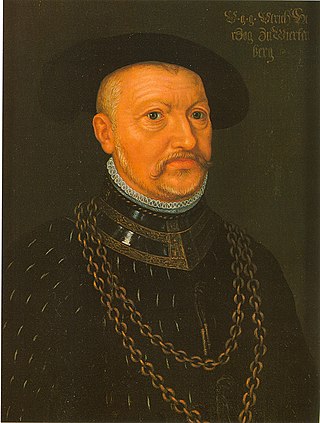
Duke Ulrich of Württemberg succeeded his kinsman Eberhard II as Duke of Württemberg in 1498. He was declared of age in 1503. His volatile personality made him infamous, being called the "Swabian Henry VIII" by historians.

Count Friedrich Wilhelm Alexander Ferdinand of Württemberg, 1st Duke of Urach, was the son of Duke Wilhelm of Württemberg (1761–1830), younger brother of King Frederick I of Württemberg, by his morganatic wife, Baroness Wilhelmine von Tunderfeldt-Rhodis (1777–1822), who had married in 1800. He was the first Head of the House of Urach.

Ulrich V, nicknamed the Much-Loved, was Count of Württemberg from 1419 and then count of Württemberg-Stuttgart until his death in 1480.

Eberhard IV, called the Younger, was Count of Württemberg from 1417 until his death in 1419.

The Duchy of Württemberg was a duchy located in the south-western part of the Holy Roman Empire. It was a state of the Holy Roman Empire from 1495 to 1806. The dukedom's long survival for over three centuries was mainly due to its size, being larger than its immediate neighbors. During the Protestant Reformation, Württemberg faced great pressure from the Catholic emperors to remain loyal. Württemberg resisted repeated French invasions in the 17th and 18th centuries, the duchy being directly in the path of French and Austrian armies who were engaged in the long rivalry between the House of Bourbon and the House of Habsburg. In 1803, Napoleon raised the duchy to be the Electorate of Württemberg. On 1 January 1806, the last elector assumed the title of King of Württemberg. Later that year, on 6 August 1806, the last Emperor, Francis II, abolished the Holy Roman Empire.

Sabina of Bavaria-Munich was Duchess consort of Württemberg by marriage to Ulrich, Duke of Württemberg.
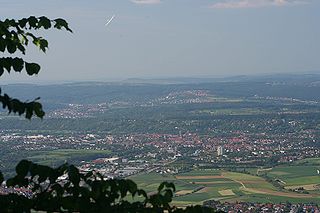
Kirchheim unter Teck is a town in Baden-Württemberg, Germany, in the district of Esslingen. It is located on the small river Lauter, a tributary of the Neckar. It is 10 km near the Teck castle, approximately 35 kilometres southeast of Stuttgart. It is the fourth city in the Esslingen district, forming a district centre for the surrounding communities.

Münsingen is a town in the district of Reutlingen, Baden-Württemberg, Germany. It is situated 23 km southeast of Reutlingen, and 37 km west of Ulm.
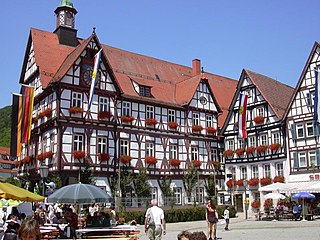
Bad Urach is a town in the district of Reutlingen, Baden-Württemberg, Germany. It is situated 14 km east of Reutlingen, at the foot of the Swabian Jura, and is known for its spa and therapeutic bath.

The House of Württemberg is a German dynasty and former royal family from Württemberg.
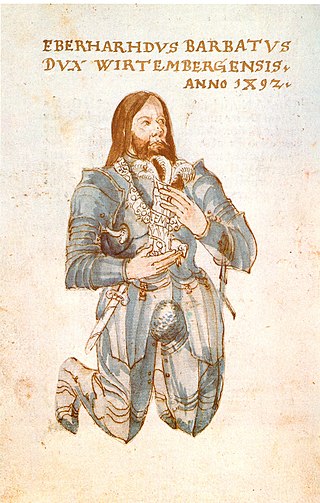
Eberhard I of Württemberg was known as Count Eberhard V from 1459 to 1495, and from July 1495 he was the first Duke of Württemberg. He is also known as Eberhard im Bart.

The Treaty of Münsingen was signed on 14 December 1482. This accord officially reunited the divided County of Württemberg after it was divided by the Treaty of Nürtingen in 1442. The hereditary dispute between the Stuttgart part and the part of Urach were settled after 40 years. Residing in Urach, Count Eberhard V, later Duke Eberhard I of Württemberg, obtained rule and moved the capital to Stuttgart. The succession was laid down for the ruling count in the Stuttgart part of the country, Eberhard VI. With this treaty, that was worked out with collaboration of the council of Württembergian subjects, the indivisibility of Württemberg and the primogeniture became contractual. The treaty prevented the division of Württemberg and thus was an important step to the exaltation to a duchy in 1495. The original document is stored in the main public record office in Stuttgart.

Eberhard VI/II was a German nobleman. He was Count of Württemberg-Stuttgart from 1480 to 1496 as Eberhard VI, then Duke of Württemberg from 1496 to June 1498 as Eberhard II.
Ludwig II was the Count of Württemberg. He was the son of count Ludwig I and Mechthild of the Palatinate. He reigned from 1450 until 1457.

Ludwig I was Count of Württemberg from 1419 and then count of Württemberg-Urach until his death in 1450.

Bempflingen is a municipality in the district Esslingen in the Erms valley in Baden-Württemberg, Germany. It belongs to the Region Stuttgart and the European Metropolitan Region Stuttgart.

Hohenneuffen Castle is a large ruined castle in the northern foothills of the Swabian Alb, above the town of Neuffen in the district of Esslingen in Baden-Württemberg.
The County of Württemberg was a historical territory with origins in the realm of the House of Württemberg, the heart of the old Duchy of Swabia. Its capital was Stuttgart. From the 12th century until 1495, it was a county within the Holy Roman Empire. It later became a duchy and, after the breakup of the Holy Roman Empire, a kingdom.
