 | This article does not cite any sources .(January 2007) (Learn how and when to remove this template message) |
| | This article does not cite any sources .(January 2007) (Learn how and when to remove this template message) |
Tree Solitaire is a form of solitaire in which the cards are laid out as follows:

In botany, a tree is a perennial plant with an elongated stem, or trunk, supporting branches and leaves in most species. In some usages, the definition of a tree may be narrower, including only woody plants with secondary growth, plants that are usable as lumber or plants above a specified height. Trees are not a taxonomic group but include a variety of plant species that have independently evolved a woody trunk and branches as a way to tower above other plants to compete for sunlight. Trees tend to be long-lived, some reaching several thousand years old. In wider definitions, the taller palms, tree ferns, bananas, and bamboos are also trees. Trees have been in existence for 370 million years. It is estimated that there are just over 3 trillion mature trees in the world.
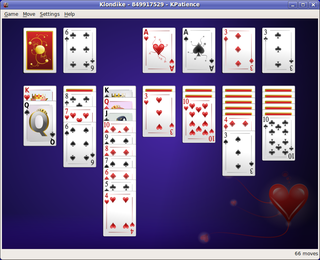
Solitaire is any tabletop game which one can play by oneself. The term "solitaire" is also used for single-player games of concentration and skill using a set layout of tiles, pegs or stones rather than cards. These games include peg solitaire and mahjong solitaire. Most solitaire games function as a puzzle which, due to a different starting position, may be solved in a different fashion each time.
Row one- One card Row two- Two cards Row three- Three cards Row four- Four cards Row five- Five cards Row six- Six Cards Row seven- Seven cards
All rows are laid out in a way that they cover half of the cards in the row immediately above, so that the end result resembles a tree, thus the name.
During play, a player pulls the top three cards from the deck and flips them face up. If less than three cards are left when the end of the deck is reached, then the difference should be ignored and the cards flipped as usual. If two cards are left, then only those cards are flipped. The player may not wrap around to the front of the deck to get a third card. Only the top card can be played, the cards below can be played if the card(s) above them are removed.
The object is to remove all cards from the tree by combining two cards to have a total face value of 13. So, if your third row was: 9 J K; and had no cards on top of it, the king could be removed on its own, the jack would need a two, and the nine would need a 4. Suit is irrelevant, as is color.

The face value is the value of a coin, stamp or paper money, as printed on the coin, stamp or bill itself by the issuing authority. The face value of coins, stamps, or bill is usually its legal value. However, their market value need not bear any relationship to the face value. For example, some rare coins or stamps may be traded at prices considerably above their face value.
The player can only go through the deck three times. If the player is unable to eliminate all cards in the tree and has reached the last card in their deck, then they have lost.
This game is a variant of Pyramid.
Klondike or Canfield (traditional) is a patience game. In the U.S. and Canada, Klondike is the best-known solitaire card game, to the point that the term "solitaire", in the absence of additional qualifiers, typically refers to Klondike. Equally in the UK, it is often just known as "patience". Meanwhile, elsewhere the game is known as American Patience. The game rose to fame in the late 19th century, being named "Klondike" after the Canadian region where a gold rush happened. It is rumored that the game was either created or popularized by the prospectors in Klondike.
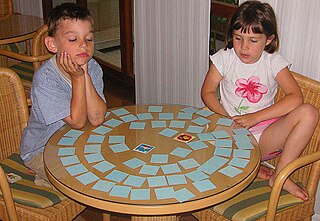
Concentration, also known as Match Match, Match Up, Memory, Pelmanism, Shinkei-suijaku, Pexeso or simply Pairs, is a card game in which all of the cards are laid face down on a surface and two cards are flipped face up over each turn. The object of the game is to turn over pairs of matching cards. Concentration can be played with any number of players or as solitaire. It is a particularly good game for young children, though adults may find it challenging and stimulating as well. The scheme is often used in quiz shows and can be employed as an educational game.

Spider is a type of patience game. It is one of the more popular two-deck solitaire games.

Pyramid is a solitaire game where the object is to get all the cards from the pyramid to the foundation.
Accordion is a solitaire game using one deck of playing cards. The object is to compress the entire deck into one pile like an accordion.
Gargantua is a solitaire card game that is a version of Klondike using two decks. It is also known as Double Klondike and as Jumbo.
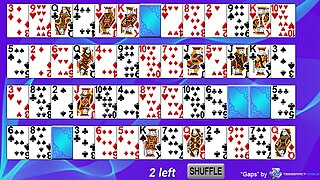
Gaps is a member of the Montana group of Patience games, where the arrangement of cards from Deuce to King is the object. Other games in the group include Spaces, Vacancies, Clown Solitaire, Paganini, Montana itself, Red Moon, and Blue Moon.
Betsy Ross is a solitaire card game using a deck of 52 playing cards. It is similar to another solitaire card game called Calculation except there is no tableau to play in and there is only one wastepile rather than four.
Beleaguered Castle is a solitaire card game played with a deck of 52 playing cards. It is one of the card games touted as "Freecell without cells" because its game play is somewhat akin to the popular solitaire computer game but without extra empty spaces to maneuver. This game is also called Laying Siege and Sham Battle.
Labyrinth is a solitaire card game which uses a deck of 52 playing cards. Just as the words labyrinth and maze are not synonymous, this game and the solitaire game of Maze should not be confused with each other because they are different in the manner of game play and dealing. The rules of the game described below are from the book Card Games for One by Peter Arnold.

Virginia Reel is a solitaire card game which uses two decks of 52 playing cards mixed together. The object of the game is to place all the cards in the 24 foundations.
Royal Cotillion is a solitaire card game which uses two decks of 52 playing cards each. The name probably derives from the fact that since the two kings and two queens of the same suit, the king and queen of each suit dance the cotillion. Authors Sloane Lee and Gabriel Packard gave this game the alternate name of Lords and Ladies because if the game is won, the final layout will show the king and queen of each suit together.
Crescent is a solitaire card game played with two decks of playing cards mixed together. The game is so called because when the cards are dealt properly, the resulting piles should form a large arc or a crescent.
Speed is a game for two players or more of the shedding family of card games, in which each player tries to get rid of all of his or her cards first.
Grand Duchess is a solitaire card game which is played with two decks of playing cards. One unique feature of this game is the building of the reserve, which is not used until the entire stock runs out.
Fortune's Favor is a solitaire card game which is played with a deck of 52 playing cards. It is so-called probably because the chances of winning are completely on the player's side.
Parallels is a solitaire card game which is played with two decks of playing cards. It is so called because the cards are lined up in rows parallel to each other.
Imaginary Thirteen is a solitaire card game which is played with two decks of playing cards. Its gameplay makes it a two-deck version of Calculation and its name is taken from the fact that when a sum is over thirteen, thirteen is subtracted to get the value of the next card, with spot cards worth their face value, jacks eleven, queens twelve, and kings thirteen.

Spider Solitaire, also known as Microsoft Spider Solitaire, is a solitaire card game that is included in Microsoft Windows. It is a version of Spider. As of 2005, it was the most played game on Windows PCs, surpassing the shorter and less challenging Klondike-based Windows Solitaire.

Pyramid or beeramid is a card game that is most commonly used as a drinking game requiring 1 standard deck of playing cards. This game is also referred to as Bullshit Pyramid.