This page is based on this
Wikipedia article Text is available under the
CC BY-SA 4.0 license; additional terms may apply.
Images, videos and audio are available under their respective licenses.
The Ordovician is a geologic period and system, the second of six periods of the Paleozoic Era. The Ordovician spans 41.2 million years from the end of the Cambrian Period 485.4 million years ago (Mya) to the start of the Silurian Period 443.8 Mya.
The Geological Conservation Review (GCR) is produced by the UK's Joint Nature Conservation Committee and is designed to identify those sites of national and international importance needed to show all the key scientific elements of the geological and geomorphological features of Britain. These sites display sediments, rocks, minerals, fossils, and features of the landscape that make a special contribution to an understanding and appreciation of Earth science and the geological history of Britain, which stretches back more than three billion years. The intention of the project, which was devised in 1974 by George Black and William Wimbledon working for the Governmental advisory agency, the Nature Conservancy Council (NCC), was activated in 1977. It aimed to provide the scientific rationale and information base for the conservation of geological SSSIs (Sites of Special Scientific Interest, protected under British law. The NCC and country conservation agencies were established in 1990 when JNCC became established and took over responsibility for managing the GCR site assessment process, and publishing accounts of accepted sites.

The Gorseddau Tramway was a 3 ft narrow gauge railway built in Wales in 1856 to link the slate quarries around Gorseddau with the wharves at Porthmadog. It was an early forerunner of the Gorseddau Junction and Portmadoc Railway and subsequently the Welsh Highland Railway.
The Gorseddau Junction and Portmadoc Railway is a defunct Welsh tramway.
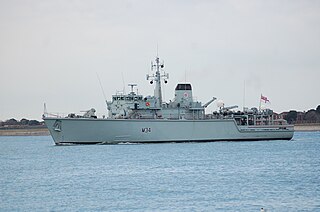
HMS Middleton is a Hunt-class mine countermeasures vessel of the British Royal Navy. She forms part of the Second Mine Countermeasures Squadron based in Portsmouth.
HMS Tremadoc Bay was a Bay-class anti-aircraft frigate of the British Royal Navy, named for Tremadoc Bay in north Wales.

SS Castilian was carrying a cargo of munitions to Lisbon when she struck East Platters Rocks, near The Skerries, Anglesey, Wales and sank on 12 February 1943.

John Owen, also known by his bardic name Owain Alaw Pencerdd, was a Welsh-language poet and also a musician.
Courtessolium is a genus of trilobites in the order Phacopida that existed during the lower Ordovician in what is now France. It was described by Pribyl and Vanek in 1985, and the type species is Courtessolium prepater, which was originally described under the genus Pateraspis by Courtessole and Pillet in 1975, and was later renamed under the genus Pseudosphaerexochus. The new generic name, Courtessolium, honours one of the original authors of the species.
David Charles Brooke-Taylor was an English cricketer who played first-class cricket for Derbyshire from 1947 to 1949.

Llanfairpwllgwyngyll or Llanfair Pwllgwyngyll is a large village and local government community on the island of Anglesey in Wales. It is situated on the Menai Strait next to the Britannia Bridge and across the strait from Bangor. Both shortened and lengthened (Llanfairpwllgwyngyllgogerychwyrndrobwllllantysiliogogogoch) forms of the placename are used in various contexts.
The Kirengellids are a group of problematic Cambrian fossil shells of marine organisms. The shells bear a number of paired muscle scars on the inner surface of the valve.

Sphaeragnostus is an extinct genus from a well-known class of fossil marine arthropods, the trilobites. It can be recognized by having two thorax segments, a totally effaced headshield, while the tailshield although effaced, has a clear furrow parallel to its border, and a short, convex, subcircular axis. It lived during the Ordovician.

Geragnostus is a genus of very small agnostid trilobites whose fossils are found Ordovician-aged marine strata from Eurasia, North America and Argentina.
Prospectatrix is a genus of trilobites of average size, that lived in the Lower Ordovician and is probably ancestral to the other genera of the Cyclopygidae family. Its eyes are only moderately enlarged and it has six or seven thorax segments.
The Rabbitkettle Formation is a geologic formation in Yukon, comprising thin bedded silty and occasionally siliciclastic limestones deposited in deep waters. It preserves fossils dating back to the Ordovician period.
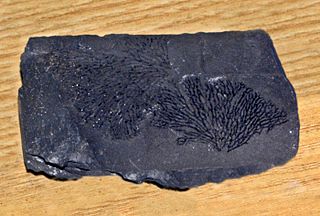
Dictyonema is a genus of dendroid graptolites in the order Dendroidea.
Hugh Maurice was a transcriber of Welsh manuscripts.

The Iscayachi Formation, in older literature also referred to as Guanacuno Formation, is an extensive Tremadocian geologic formation of western and southern Bolivia. The shales and sandstones were deposited in a shallow marine to pro-delta environment. The formation reaches a thickness of 1,000 metres (3,300 ft).

