This page is based on this
Wikipedia article Text is available under the
CC BY-SA 4.0 license; additional terms may apply.
Images, videos and audio are available under their respective licenses.

In naval terminology, a destroyer is a fast, maneuverable long-endurance warship intended to escort larger vessels in a fleet, convoy or battle group and defend them against smaller powerful short-range attackers. They were originally developed in the late 19th century by Fernando Villaamil for the Spanish Navy as a defense against torpedo boats, and by the time of the Russo-Japanese War in 1904, these "torpedo boat destroyers" (TBDs) were "large, swift, and powerfully armed torpedo boats designed to destroy other torpedo boats". Although the term "destroyer" had been used interchangeably with "TBD" and "torpedo boat destroyer" by navies since 1892, the term "torpedo boat destroyer" had been generally shortened to simply "destroyer" by nearly all navies by the First World War.

A frigate is a type of warship, having various sizes and roles over the last few centuries.

A corvette is a small warship. It is traditionally the smallest class of vessel considered to be a proper warship. The warship class above the corvette is that of the frigate, while the class below was historically that of the sloop-of-war. The modern types of ship below a corvette are coastal patrol craft and fast attack craft. In modern terms, a corvette is typically between 500 tons and 2,000 tons although recent designs may approach 3,000 tons, which might instead be considered a small frigate.
The history of the Royal Canadian Navy goes back to 1910, when the naval force was created as the Naval Service of Canada and renamed a year later by King George V. The Royal Canadian Navy (RCN) is one of the three environmental commands of the Canadian Forces. Over the course of its history, the RCN has played a role in the First World War, contributed significantly to the Battle of the Atlantic during the Second World War, and was a part of NATO's force buildup during the Cold War. In 1968, the RCN was amalgamated with the Canadian Army and the Royal Canadian Air Force to form what is today the unified Canadian Armed Forces. The naval force was known as Maritime Command until 2011, when the environmental command was renamed as the Royal Canadian Navy.

The Type 14 Blackwood class were a ship class of minimal "second-rate" anti-submarine warfare frigates. Built for the Royal Navy during the 1950s at a time of increasing threat from the Soviet Union's submarine fleet, they served until the late 1970s. Twelve ships of this class served with the Royal Navy and a further three were built for the Indian Navy.

The Flower-class corvette was a British class of 267 corvettes used during World War II, specifically with the Allied navies as anti-submarine convoy escorts during the Battle of the Atlantic. Royal Navy ships of this class were named after flowers, hence the name of the class.

The Tacoma class of patrol frigates served in the United States Navy during World War II and the Korean War. Originally classified as a gunboat (PG), they were reclassified as a patrol frigate (PF) on 15 April 1943. The class is named for its lead ship, Tacoma, a Maritime Commission (MARCOM) S2-S2-AQ1 design, which in turn was named for the city of Tacoma, Washington. Twenty-one ships were transferred to the British Royal Navy, in which they were known as Colony-class frigates, and twenty-eight ships were transferred under Lend-Lease to the Soviet Navy, where they were designated as a storozhevoi korabl, during World War II. All Tacoma-class ships in US service during World War II were manned by United States Coast Guard crews. Tacoma-class ships were transferred to the United States Coast Guard and various navies post-World War II.
Type 12 frigate refers to several ship classes, most commonly the three ship classes of the Royal Navy designed during the 1950s and constructed during the 1960s.
River class may refer to:

Yarrow Shipbuilders Limited (YSL), often styled as simply Yarrows, was a major shipbuilding firm based in the Scotstoun district of Glasgow on the River Clyde. It is now part of BAE Systems Surface Ships, owned by BAE Systems, which has also operated the nearby Govan shipyard since 1999.

The Type 15 frigate was a class of British anti-submarine frigates of the Royal Navy. They were conversions based on the hulls of World War II-era destroyers built to the standard War Emergency Programme "utility" design.

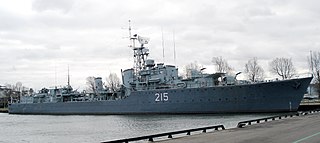
HMCS Micmac was a Tribal-class destroyer which served the Royal Canadian Navy from 1945 to 1964. Micmac was the first modern, high-performance warship built in Canada. She was the first of four Tribal destroyers built at the Halifax Shipyard and one of eight Tribal-class destroyers to serve in the Royal Canadian Navy.
At the start of World War II, the Royal Navy operated a range of destroyer classes. Some of these were legacies of World War I, some were designed during the inter-war years and the rest were the result of wartime experience and conditions. British-built and -designed vessels were also supplied to and built by allied navies, primarily the Australian and Canadian navies.
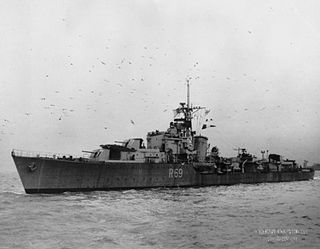
HMS Ulysses was a U-class destroyer of the British Royal Navy that saw service during World War II. She was later converted into a Type 15 fast anti-submarine frigate, with the new pennant number F17.
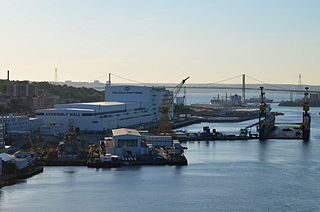
The Halifax Shipyard Limited is a Canadian shipbuilding company located in Halifax, Nova Scotia.

The QF 4 inch Mk XVI gun was the standard British Commonwealth naval anti-aircraft and dual-purpose gun of World War II.
Destroyer escort is the US Navy classification for a smaller, lightly armed warship designed to be used to escort convoys of merchant marine ships.
The Van Amstel-class was a class of 6 frigates that were built during the Second World War in the United States and served as destroyer Escort during that war. After the war the destroyer escorts were loaned to the Dutch navy as part of the MDAP and from 1950 to 1967 served as the Van Amstel-class frigates.