A genus is a taxonomic rank used in the biological classification of living and fossil organisms, as well as viruses, in biology. In the hierarchy of biological classification, genus comes above species and below family. In binomial nomenclature, the genus name forms the first part of the binomial species name for each species within the genus.
Binomial nomenclature, also called binominal nomenclature or binary nomenclature, is a formal system of naming species of living things by giving each a name composed of two parts, both of which use Latin grammatical forms, although they can be based on words from other languages. Such a name is called a binomial name, a binomen, binominal name or a scientific name; more informally it is also called a Latin name. The first part of the name – the generic name – identifies the genus to which the species belongs, while the second part – the specific name or specific epithet – identifies the species within the genus. For example, humans belong to the genus Homo and within this genus to the species Homo sapiens. Tyrannosaurus rex is probably the most widely known binomial. The formal introduction of this system of naming species is credited to Carl Linnaeus, effectively beginning with his work Species Plantarum in 1753. But Gaspard Bauhin, in as early as 1623, had introduced in his book Pinax theatri botanici many names of genera that were later adopted by Linnaeus.
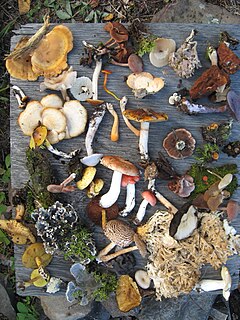
Biodiversity refers to the variety and variability of life on Earth. Biodiversity typically measures variation at the genetic, species, and ecosystem level. Terrestrial biodiversity is usually greater near the equator, which is the result of the warm climate and high primary productivity. Biodiversity is not distributed evenly on Earth, and is richest in the tropics. These tropical forest ecosystems cover less than 10 percent of earth's surface, and contain about 90 percent of the world's species. Marine biodiversity is usually highest along coasts in the Western Pacific, where sea surface temperature is highest, and in the mid-latitudinal band in all oceans. There are latitudinal gradients in species diversity. Biodiversity generally tends to cluster in hotspots, and has been increasing through time, but will be likely to slow in the future.

In biology, extinction is the termination of an organism or of a group of organisms (taxon), usually a species. The moment of extinction is generally considered to be the death of the last individual of the species, although the capacity to breed and recover may have been lost before this point. Because a species' potential range may be very large, determining this moment is difficult, and is usually done retrospectively. This difficulty leads to phenomena such as Lazarus taxa, where a species presumed extinct abruptly "reappears" after a period of apparent absence.
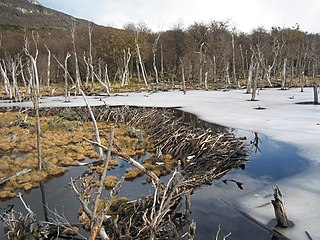
An invasive species is a species that is not native to a specific location, and that has a tendency to spread to a degree believed to cause damage to the environment, human economy or human health.

The IUCN Red List of Threatened Species, founded in 1965, has evolved to become the world's most comprehensive inventory of the global conservation status of biological species. It uses a set of criteria to evaluate the extinction risk of thousands of species and subspecies. These criteria are relevant to all species and all regions of the world, With its strong scientific base, the IUCN Red List is recognized as the most authoritative guide to the status of biological diversity. A series of Regional Red List are produced by countries or organizations, which assess the risk of extinction to species within a political management unit.
The conservation status of a group of organisms indicates whether the group still exists and how likely the group is to become extinct in the near future. Many factors are taken into account when assessing conservation status: not simply the number of individuals remaining, but the overall increase or decrease in the population over time, breeding success rates, and known threats. Various systems of conservation status exist and are in use at international, multi-country, national and local levels as well as for consumer use.
A least concern (LC) species is a species which has been categorized by the International Union for Conservation of Nature (IUCN) as evaluated but not qualified for any other category. They do not qualify as threatened, near threatened, or conservation dependent.

Trapezia is a genus of guard crabs in the family Trapeziidae. Like other members of this family, they live in association with corals, feeding on coral tissue and mucus, and defending the corals from predators, like starfish. It contains the following species:

Earias is a genus of moths in the monotypic subfamily Eariadinae of the family Nolidae. Species are found throughout European, Asian and Australian continents.
An endangered species is a species which has been categorized as very likely to become extinct. Endangered (EN), as categorized by the International Union for Conservation of Nature (IUCN) Red List, is the second most severe conservation status for wild populations in the IUCN's schema after Critically Endangered (CR).
In biology, a species ( ) is the basic unit of classification and a taxonomic rank of an organism, as well as a unit of biodiversity. A species is often defined as the largest group of organisms in which any two individuals of the appropriate sexes or mating types can produce fertile offspring, typically by sexual reproduction. Other ways of defining species include their karyotype, DNA sequence, morphology, behaviour or ecological niche. In addition, paleontologists use the concept of the chronospecies since fossil reproduction cannot be examined. While these definitions may seem adequate, when looked at more closely they represent problematic species concepts. For example, the boundaries between closely related species become unclear with hybridisation, in a species complex of hundreds of similar microspecies, and in a ring species. Also, among organisms that reproduce only asexually, the concept of a reproductive species breaks down, and each clone is potentially a microspecies.
Hastula rufopunctata is a species of sea snail, a marine gastropod mollusk in the family Terebridae, the auger snails.
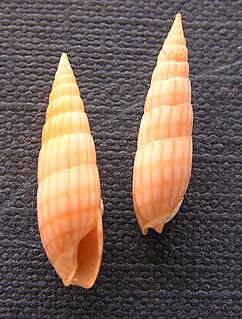
Hastula is a genus of sea snails, marine gastropod mollusks in the family Terebridae, the auger snails.

Pocillopora is a genus of stony corals in the family Pocilloporidae occurring in the Pacific and Indian Oceans. They are commonly called cauliflower corals and brush corals.
Paractaea is a genus of crabs in the family Xanthidae, containing the following species:

Atractomorpha is a genus in the Pyrgomorphidae, a family of grasshoppers, found in Africa, Asia and Australia.

Trapezia rufopunctata is a species of guard crabs in the family Trapeziidae.

Desmiphorini is a tribe of longhorn beetles of the subfamily Lamiinae.
Glenea rufopunctata is a species of beetle in the family Cerambycidae. It was described by Charles Joseph Gahan in 1907. It is known from Sumatra. It contains the varietas Glenea rufopunctata var. semifusca.

