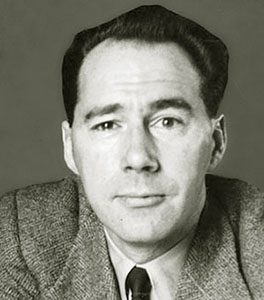
John Wyndham Parkes Lucas Beynon Harris was an English science fiction writer best known for his works written using the pen name John Wyndham, although he also used other combinations of his names, such as John Beynon and Lucas Parkes. Some of his works were set in post-apocalyptic landscapes. His best known works include The Day of the Triffids (1951) and The Midwich Cuckoos (1957), the latter filmed twice as Village of the Damned.

The Day of the Triffids is a 1951 post-apocalyptic novel by the English science fiction author John Wyndham. After most people in the world are blinded by an apparent meteor shower, an aggressive species of plant starts killing people. Although Wyndham had already published other novels using other pen name combinations drawn from his real name, this was the first novel published as "John Wyndham". It established him as an important writer and remains his best-known novel.
The VIC cipher was a pencil and paper cipher used by the Soviet spy Reino Häyhänen, codenamed "VICTOR".
In classical cryptography, the bifid cipher is a cipher which combines the Polybius square with transposition, and uses fractionation to achieve diffusion. It was invented around 1901 by Felix Delastelle.
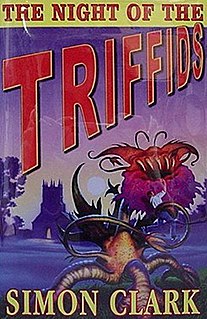
The Night of the Triffids is a science fiction novel by British writer Simon Clark, published in 2001. It is a sequel to John Wyndham's The Day of the Triffids. Clark has been commended for his success at mimicking Wyndham's style, but most reviewers have not rated his creation as highly as the original 1951 work. Clark's book is written in the first person and narrated by David Masen, the son of Wyndham's protagonist.
The FISH stream cipher is a fast software based stream cipher using Lagged Fibonacci generators, plus a concept from the shrinking generator cipher. It was published by Siemens in 1993. FISH is quite fast in software and has a huge key length. However, in the same paper where he proposed Pike, Ross Anderson showed that FISH can be broken with just a few thousand bits of known plaintext.
Félix-Marie Delastelle was a French cryptographer, best known for inventing the bifid cipher, first presented in the Revue du Génie civil in 1895 under the name of "cryptographie nouvelle". This cipher combines fractionation with transposition, and was an early cipher to implement the principles of confusion and diffusion. David Kahn described it as a "system of considerable importance in cryptology."
Encryption software is software that uses cryptography to prevent unauthorized access to digital information. Cryptography is used to protect digital information on computers as well as the digital information that is sent to other computers over the Internet.
The Scream cipher is a word-based stream cipher developed by Shai Halevi, Don Coppersmith and Charanjit Jutla from IBM.
Sosemanuk is a stream cipher developed by Come Berbain, Olivier Billet, Anne Canteaut, Nicolas Courtois, Henri Gilbert, Louis Goubin, Aline Gouget, Louis Granboulan, Cédric Lauradoux, Marine Minier, Thomas Pornin and Hervé Sibert. Along with HC-128, Rabbit, and Salsa20/12, Sosemanuk is one of the final four Profile 1 (software) ciphers selected for the eSTREAM Portfolio.

The Day of the Triffids is a 1962 British science fiction film in CinemaScope and Eastmancolor, produced by George Pitcher and Philip Yordan, and directed by Steve Sekely. It stars Howard Keel and Nicole Maurey, and is based on the 1951 novel of the same name by John Wyndham. The film was released in the U.K. by the Rank Organisation and in the U.S. by Allied Artists.

The Day of the Triffids is a British television series which was first aired by the BBC in 1981. An adaptation by Douglas Livingstone of the 1951 novel by John Wyndham, the six half-hour episodes were produced by David Maloney and directed by Ken Hannam, with original music by Christopher Gunning.
In cryptography, integral cryptanalysis is a cryptanalytic attack that is particularly applicable to block ciphers based on substitution-permutation networks. It was originally designed by Lars Knudsen as a dedicated attack against Square, so it is commonly known as the Square attack. It was also extended to a few other ciphers related to Square: CRYPTON, Rijndael, and SHARK. Stefan Lucks generalized the attack to what he called a saturation attack and used it to attack Twofish, which is not at all similar to Square, having a radically different Feistel network structure. Forms of integral cryptanalysis have since been applied to a variety of ciphers, including Hierocrypt, IDEA, Camellia, Skipjack, MISTY1, MISTY2, SAFER++, KHAZAD, and FOX.
In cryptography, Crab is a block cipher proposed by Burt Kaliski and Matt Robshaw at the first Fast Software Encryption workshop in 1993. Not really intended for use, Crab was developed to demonstrate how ideas from hash functions could be used to create a fast cipher.

The Day of the Triffids is a BBC miniseries adaptation of John Wyndham's novel of the same title. The novel had previously been adapted in 1962 as a theatrical film and by the BBC in a 1981 series.
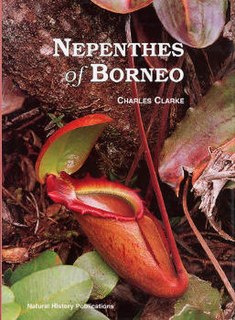
Nepenthes of Borneo is a monograph by Charles Clarke on the tropical pitcher plants of Borneo. It was first published in 1997 by Natural History Publications (Borneo), and reprinted in 2006. Clarke describes it as "primarily an ecological monograph".
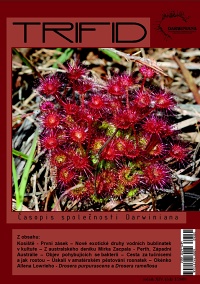
Trifid is a quarterly Czech-language periodical and the official publication of Darwiniana, a carnivorous plant society based in the Czech Republic. Typical articles include matters of horticultural interest, field reports, and scientific studies. The journal was established in 1990 as Amatérské Pěstování Masožravých Rostlin and obtained its current title in 1996. It is published in B5 format, with each issue numbering around 36 pages, of which 24 are in colour.