
The Neva is a river in northwestern Russia flowing from Lake Ladoga through the western part of Leningrad Oblast to the Neva Bay of the Gulf of Finland. Despite its modest length of 74 kilometres (46 mi), it is the fourth-largest river in Europe in terms of average discharge.

Palace Bridge, a road- and foot-traffic bascule bridge, spans the Neva River in Saint Petersburg between Palace Square and Vasilievsky Island. Like every other Neva bridge, it is drawn by night, making foot travel between various parts of the city virtually impossible. The bascule span was designed by an American firm, the Scherzer Rolling Lift Bridge Company, and built by the French firm Société de Construction des Batignolles between 1912 and 1916.
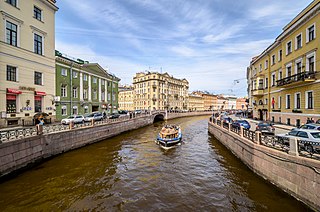
The Moyka is a short river in Saint Petersburg which splits from the Neva River. Along with the Neva, the Fontanka river, and canals including the Griboyedov and Kryukov, the Moyka encircles the central portion of the city, effectively making that area an island or a group of islands. The river derives its name from the Ingrian word Muya for "slush" or "mire", having its original source in former swamp. It is 5 kilometres (3 mi) long and 40 metres (130 ft) wide.

The Alexander Nevsky Bridge in St Petersburg, Russia is named after the legendary Russian military commander and politician Alexander Nevsky. The bridge connects Alexander Nevsky Square and Zanevsky prospect thus linking the southern and the northern parts of the city. Until 2004, when the Big Obukhovsky Bridge was built, the Alexander Nevsky Bridge was the longest bridge across the Neva River in Saint Petersburg. Its length is 906 meters, and it is 35 meters wide. The bridge was built from 1960 to 1965 under the working name of Old Neva Bridge. Designed by the group of architects A. Zhuk, S. Mayofis and Y. Sinitsa, the bridge has complemented the look of adjacent buildings in the surrounding area. The project was led by a team of engineers of the "Lengiprotransmost" institute. Proof-testing was done by means of a column of army tanks. On November 5, 1965, the bridge was open for traffic.
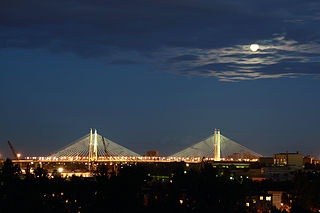
The Great Obukhovo Bridge is the newest bridge across the Neva River in Saint Petersburg, Russia. It is the only bridge across the Neva which is not a drawbridge. One of the longest bridges in Russia, it is the first fixed bridge and largest bridge across the Neva. Of course it is the largest bridge in St. Petersburg by the size of the covered span. It is located in Nevsky District, in the middle stream of the Neva. It connects Obukhovskaya Oborony Avenue with the Oktyabrskaya embankment. It is a cable-stayed bridge; the steel wire ropes are the key element of the supporting construction. But what looks like a bridge is actually two identical twin bridges with opposite directions of movement along them. One is located upstream of the Neva (southern) and is for driving eastward, the other downstream (north) is for driving in a western direction.

The Volodarsky Bridge is a moveable bridge across the Neva River in Saint Petersburg, Russia. The bridge connects Narodnaya and Ivanovskaya streets. It is named after V. Volodarsky, a revolutionary, who was killed near the future bridge in 1918. It is the only bridge in the city with an overpass for trams. The bridge is part of the Central Arc Thoroughfare. In 1932-1936, according to engineer G.P. Peredery's project, a three-span reinforced concrete arch bridge with a metal double-winged drawbridge was built. In 1986-1993, the old bridge was dismantled and replaced with a metal girder. The bridge length is 332 meters, the width is 24–27 meters. Upstream is the Bolshoy Obukhovsky Bridge, and below is the Finland Railway Bridge.

The Annunciation Bridge is the first permanent bridge built across the Neva River in Saint Petersburg, Russia. It connects Vasilievsky Island and the central part of the city. The bridge's length is 331 meters and the width was 24 meters. The original name of the bridge was Nevsky Bridge. It was later renamed Blagoveshchensky Bridge. After the death of Tsar Nicholas I, it was named Nikolaevsky Bridge in his honor, and in 1918 it was renamed for Lieutenant Schmidt.

Bolsheokhtinsky Bridge is a bridge across the Neva River in Saint Petersburg, Russia. The bridge's length is 334 meters, the width is 23 meters. The bridge features three spans; the central one can be drawn.
The Finland Railway Bridge is a pair of parallel rail bridges across the Neva River in Saint Petersburg, Russia. The movable bridges are connecting the Riihimäki–Saint Petersburg Railway and other railway networks in the north of St Petersburg with those in the south of St Petersburg. The same singular name is applied to both of the bridges.

Exchange Bridge is a bascule bridge in Saint Petersburg, opened in 1894. The bridge crosses the Little Neva River close to the Exchange Square and connects the Vasilyevsky and Petrogradsky islands.

Tuchkov Bridge is a bascule bridge across Little Neva in Saint Petersburg, Russia. Its length is 226 meters and its width is 36 meters. Tuchkov bridge connects Vasilievsky Island and Petrogradsky Island.
The appearance of Saint Petersburg includes long, straight boulevards, vast spaces, gardens and parks, decorative wrought-iron fences, monuments and decorative sculptures. The Neva River itself, together with its many canals and their granite embankments and bridges help to give the city its particular ambience.

The Demidov Bridge is a bridge across the Griboyedov Canal in Saint Petersburg, Russia. It connects Kazansky and Spassky islands.

The Hermitage Bridge is a bridge across the Winter Canal along Palace Embankment in Saint Petersburg, Russia. The bridge constitutes part of the Hermitage and Winter Palace ensemble.
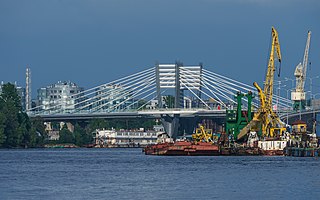
Betancourt Bridge is a non-bascule 6-lane bridge with a cycle path in Saint Petersburg that opened in 2018. The bridge crosses the Little Neva and the Zhdanovka rivers, passing Petrovsky and Sernyy island, and connects the Vasilyevsky and Petrogradsky islands. The bridge is part of the Centre Transport Bypass (CTB), it allows non-stop traffic from Pulkovo Airport to the Krestovsky Stadium. First ideas to construct a bridge across appeared as early as in the 1980s. Since that time the design was changed significantly, instead of the straight lay the bridge became S-shaped in order to avoid the ‘Almaz’ military shipyard that was located on the bank of the Little Neva. However, the production was closed before the actual construction of the bridge even started.

Suvorov Square is a city square in Tsentralny District, Saint Petersburg. It is located between Palace Embankment and the junction of the embankment of the Swan Canal and Millionnaya Street, at the southern end of the Trinity Bridge and the northern end of the Field of Mars. It is bordered to the east by the Saltykov Mansion and to the west by the service wing of the Marble Palace.
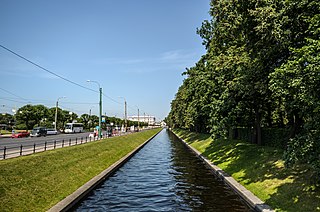
The Swan Canal is a waterway located in Saint Petersburg. Dating from the early years of the foundation of the city, it connects the Moyka and Neva Rivers.

Upper Swan Bridge is a single-span stone bridge in Saint Petersburg. It is one of the oldest stone bridges in the city and carries Palace Embankment across the Swan Canal.

Lower Swan Bridge is a single-span stone bridge in Saint Petersburg crossing the Swan Canal at its junction with the Moyka River.

The First Winter Bridge is a single-span stone bridge in Saint Petersburg, carrying Millionnaya Street across the Winter Canal. The current bridge was originally built in 1768 to cross a different watercourse, and was rebuilt and opened in its present location in 1784.


