
Pharyngealization is a secondary articulation of consonants or vowels by which the pharynx or epiglottis is constricted during the articulation of the sound.
Labialization is a secondary articulatory feature of sounds in some languages. Labialized sounds involve the lips while the remainder of the oral cavity produces another sound. The term is normally restricted to consonants. When vowels involve the lips, they are called rounded.

Lezgins are a Northeast Caucasian ethnic group native predominantly to southern Dagestan, Russia and northeastern Azerbaijan and who speak the Lezgian language.

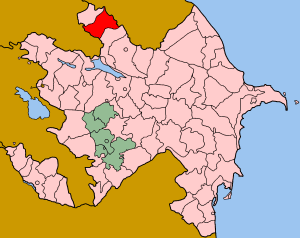
Zaqatala is a rayon of Azerbaijan. The capital and principal town is Zaqatala. The rayon is an appendix of Azerbaijan territory wedged between Kakheti (Georgia) and Dagestan. It is served by the A315 road coming from Mingachevir and leading to the Georgian border at Lagodekhi as well as by a small airfield.
Rutuls, Rutulians are an ethnic group in Dagestan, a republic in the south of Russia, and some parts of Azerbaijan. According to the 2010 Russian Census, there were 35,240 Rutuls in Russia. In 1989 Soviet Census in Azerbaijan there were 336 Rutuls. The Rutul language is a member of the Northeast Caucasian language family; its speakers often have a good command of Azeri and Russian, as Rutul was not a written language until 1990. The Rutul culture is close to that of the Tsakhur and other peoples who inhabit the basin of the upper reaches of the Samur River. Most of the Rutuls are engaged in cattle breeding, farming, and gardening.

The peoples of the Caucasus are diverse comprising more than 50 ethnic groups throughout the Caucasus region.

Zaqatala (Georgian: ზაქათალა; also, Sakataly, Zakatalsk, and Zakataly; Avar: Zakatala) is a city in northwest Azerbaijan. With a municipal population of 31,300 inhabitants, it is located northwest of Sheki, by the Tala River and is the main municipality of the Zaqatala rayon. The municipality consists of the city of Zaqatala and the nearby village of Qazangül. The city is populated by a variety of ethnic groups, each speaking their own languages, including Azerbaijani and Tsakhur. The postal codes are AZ6200-AZ6205.

The Tsakhur or Caxur people are an ethnic group of northern Azerbaijan and southern Dagestan (Russia). The group numbers around 30,000 people and are called yiqy, but are generally known by the name Tsakhur, which derives from the name of a Dagestani village, where they make up the majority.
Tsakhur is a language spoken by the Tsakhurs in northern Azerbaijan and southwestern Dagestan (Russia). It is spoken by about 13,000 people in Azerbaijan and by about 9,770 people in Dagestan. The word Tsakhur derives from the name of a Dagestani village where speakers of this language make up the majority.

Rutul is a language spoken by the Rutuls, an ethnic group living in Dagestan (Russia) and some parts of Azerbaijan. It is spoken by 30,000 people in Dagestan and 17,000 in Azerbaijan. The word Rutul derives from the name of a Dagestani village where speakers of this language make up the majority.
Kusur is a village in the Zaqatala Rayon of Azerbaijan.
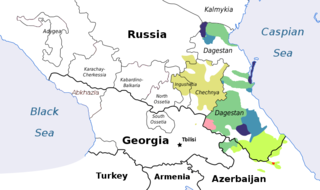
The Lezgic languages are one of seven branches of the Northeast Caucasian language family. Lezgian and Tabasaran are literary languages.
Caspian race is a term used in racial anthropology by some authors to describe a sub-race of the greater Caucasian race. The term is used by M. G. Abdushelishvili (1979) as constituting a branch of the Mediterranean race or Irano-Afghan race. In Soviet-era anthropology, the term was used to include Tats and Azerbaijanis.

Jorabs are multicolored socks with intricate patterns, knitted from the toe-up. They are usually worn in such a way as to display rich decoration.

The Sultanate of Elisu, also known as Elisou or Ilisu, was one of the Khanates of the Caucasus in the 18th and 19th centuries.
The Djaro-Belokani communities (also Char, Chary, rarely Chartalah were a group of self-governing communities in the Caucasus from the 17th to the 19th centuries. They had close ties with the Elisu Sultanate to the southeast.
Sultan Adi Korklu Bey was the first Ruler of the Elisu Sultanate and a Sunni Muslim and reigned over the Tsakhurs. He was a relative and Vassal of Ottoman Suleiman the Magnificent, and was awarded the title Sultan by Suleiman against the Safavid Dynasty.
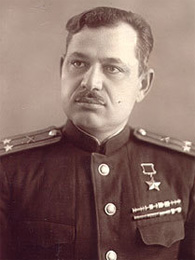
Salahaddin Hasan oglu Kazimov was an Internal Troops Major general and a Hero of the Soviet Union. Kazimov was awarded the title Hero of the Soviet Union on 16 October 1943 for his leadership of an artillery battalion during the Battle of the Dnieper. In a twelve-day period during the battle, his battalion's guns were reported to have killed up to 180 German soldiers and destroyed eleven tanks. Postwar, Kazimov served in the Internal Troops and became Deputy Minister of Internal Affairs of the Azerbaijan SSR. Kazimov and Minister of Internal Affairs Arif Heydarov were shot by an officer of the Shusha prison. Kazimov died on 2 July.

The Rutul Federation or The Rutul Free Society is a Rutul state located in Southern Dagestan and was formed in the 7th century.
This page is based on this
Wikipedia article Text is available under the
CC BY-SA 4.0 license; additional terms may apply.
Images, videos and audio are available under their respective licenses.
