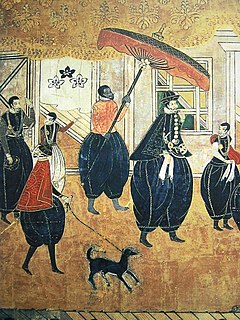
Pottery is the process of forming vessels and other objects with clay and other ceramic materials, which are fired to give them a hard, durable form. Major types include earthenware, stoneware and porcelain. The place where such wares are made by a potter is also called a pottery. The definition of pottery used by the American Society for Testing and Materials (ASTM), is "all fired ceramic wares that contain clay when formed, except technical, structural, and refractory products." In archaeology, especially of ancient and prehistoric periods, "pottery" often means vessels only, and figures etc. of the same material are called "terracottas". Clay as a part of the materials used is required by some definitions of pottery, but this is dubious.

Porcelain is a ceramic material made by heating materials, generally including kaolin, in a kiln to temperatures between 1,200 and 1,400 °C. The toughness, strength, and translucence of porcelain, relative to other types of pottery, arises mainly from vitrification and the formation of the mineral mullite within the body at these high temperatures. Though definitions vary, porcelain can be divided into three main categories: hard-paste, soft-paste and bone china. The category that an object belongs to depends on the composition of the paste used to make the body of the porcelain object and the firing conditions.

The culture of the Philippines is a combination of cultures of the East and West. Filipino identity was created primarily as a result of pre-colonial cultures, colonial influences and Chinese traders intermixing together; gradually evolving into a uniquely Filipino identity. In pre-colonial times, the Philippines was a divided set of nations, islands and tribes being ruled by their own kings, chieftains, lakans, rajahs, datus and sultans. Every nation has its own identity and some are even part of a larger empire outside of what is now the Philippines. Manila, for example, was once part of the Islamic Sultanate of Brunei, while many parts of Mindanao is theorized to be part of the Hindu Majapahit Empire, with its capital being located in East Java in modern-day Indonesia. The advent of colonial rule in the islands marked the beginning of The Philippines as a colony that would later evolved into a country after independence, a collection of Southeast Asian countries united under Spain. Chinese influence has been felt throughout Southeast Asia through trade, even before the colonization of the region; specifically by the Ming dynasty and other earlier dynasties, from as early as the 9th century. But it was during Spanish colonization that Chinese influence truly left their mark on what is now the Philippines. The blending of indigenous, colonial and external influence is very evident in the historic arts and traditions of the Philippines.

Calatagan, officially the Municipality of Calatagan,, is a 2nd class municipality in the province of Batangas, Philippines. According to the 2015 census, it has a population of 56,449 people.
The Pacific Century is a term that has been used to describe the 21st century through analogy with the term American Century. The implicit assumption underlying the usage of the term is that the 21st century will be dominated, especially economically, by the states in the Asia-Pacific region, in particular China, Japan, India, South Korea, Taiwan, the ASEAN members, Australia, Russia, Canada, Mexico, and the United States. This idea can be compared to the historical Eurocentric/Atlantic viewpoint, which has dominated for the past two centuries.

Japanese settlement in the Philippines refers to the branch of the Japanese diaspora having historical contact with and having established themselves in what is now the Philippines. This also refers to Filipino citizens of either pure or mixed Japanese descent currently residing in the country, the latter a result of intermarriages between the Japanese and local populations.

Mangyan is the generic name for the eight indigenous groups found on the island of Mindoro, southwest of the island of Luzon, the Philippines, each with its own tribal name, language, and customs. The total population may be around 280,000, but official statistics are difficult to determine under the conditions of remote areas, reclusive tribal groups and some having little if any outside world contact.

Medieval Islamic pottery occupied a geographical position between Chinese ceramics, then the unchallenged leaders of Eurasian production, and the pottery of the Byzantine Empire and Europe. For most of the period it can fairly be said to have been between the two in terms of aesthetic achievement and influence as well, borrowing from China and exporting to and influencing Byzantium and Europe. The use of drinking and eating vessels in gold and silver, the ideal in ancient Rome and Persia as well as medieval Christian societies, is prohibited by the Hadiths, with the result that pottery and glass were used for tableware by Muslim elites, as pottery also was in China, but was much rarer in Europe and Byzantium. In the same way Islamic restrictions greatly discouraged figurative wall-painting, encouraging the architectural use of schemes of decorative and often geometrically-patterned tiles, which are the most distinctive and original speciality of Islamic ceramics.

Bone china is a type of porcelain that is composed of bone ash, feldspathic material, and kaolin. It has been defined as "ware with a translucent body" containing a minimum of 30% of phosphate derived from animal bone and calculated calcium phosphate. Bone china is the strongest of the porcelain or china ceramics, having very high mechanical and physical strength and chip resistance, and is known for its high levels of whiteness and translucency. Its high strength allows it to be produced in thinner cross-sections than other types of porcelain. Like stoneware it is vitrified, but is translucent due to differing mineral properties.

There are many types of foods in the Philippines because of its residents. Many of the Chinese Filipinos have businesses involving Chinese cuisine. Restaurants are frequently seen where there is a large number of Chinese Filipino residents. The food is usually Cantonese because the chefs are from Hong Kong. Typically the Chinese name of a particular food is given a Filipino name or close equivalent in name to simplify its pronunciation.

The Cebuano people are a subgroup of the Visayan people whose primary language is the Cebuano language. They originated in the province of Cebu in the region of Central Visayas, but then later spread out to other places in the Philippines, such as Siquijor, Bohol, Negros Oriental, southwestern Leyte, western Samar, Masbate, and large parts of Mindanao. It may also refer to the ethnic group who speak the same language as their native tongue in different parts of the archipelago.
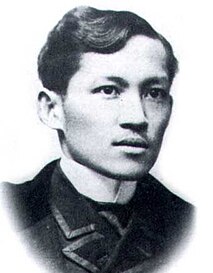
In the Philippines, Filipino mestizo or colloquially tisoy, are people of mixed Filipino and any foreign ancestry. The word mestizo itself is of Spanish origin; it was first used in the Americas to describe only people of mixed Native American and European ancestry.

The art of the Philippines refers to the works of art that have developed and accumulated in the Philippines from the beginning of civilization in the country up to the present era. It reflects to its society and non-Filipinos the wide range of cultural influences on the country's culture and how these influences honed the country's arts. The art of the Philippines can be divided into two distinct branches, namely, traditional arts, and non-traditional arts. Each branch is further divided into various categories with subcategories.

In early Philippine history, the Tagalog settlement at Tondo was a major trade hub located on the northern part of the Pasig River delta, on Luzon island.

Yuchanyan is an early Neolithic cave site in Dao County (Daoxian), Hunan, China. The site yielded sherds of ceramic vessels and other artifacts which were dated by analysis of charcoal and bone collagen, giving a date range of 17,500 to 18,300 years old for the pottery. The pottery specimens may be the oldest known examples of pottery.
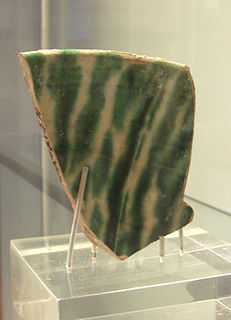
Chinese influences on Islamic pottery cover a period starting from at least the 8th century CE to the 19th century. This influence of Chinese ceramics has to be viewed in the broader context of the considerable importance of Chinese culture on Islamic arts in general.
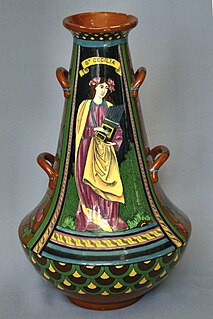
Shelley Potteries, situated in Staffordshire, was earlier known as Wileman & Co. which had also traded as The Foley Potteries. The first Shelley to join the company was Joseph Ball Shelley in 1862 and in 1896 his son Percy Shelley became the sole proprietor, after which it remained a Shelley family business until 1966 when it was taken over by Allied English Potteries. Its china and earthenware products were many and varied although the major output was table ware. In the late Victorian period the Art Nouveau style pottery and Intarsio ranges designed by art director Frederick Alfred Rhead were extremely popular but Shelley is probably best known for its fine bone china “Art Deco” ware of the inter-war years and post-war fashionable tea ware.
Laguna is a province of the Philippines found in Southern Luzon and features a freshwater lake and river valleys surrounded by arable land. This makes Laguna a good site for potential archeological sites. Its lake basin and fertile land makes for the area easily habitable, granting early settlers an accessible source of fish, eels, game and grain to support a thriving community of people. The coasts rivers of Laguna give the region a quick method of transportation and make trade with foreign merchants easier.