
In organic chemistry, a hydrocarbon is an organic compound consisting entirely of hydrogen and carbon. Hydrocarbons are examples of group 14 hydrides. Hydrocarbons from which one hydrogen atom has been removed are functional groups called hydrocarbyls. Because carbon has 4 electrons in its outermost shell carbon has exactly four bonds to make, and is only stable if all 4 of these bonds are used.
Kerosene, also known as paraffin, lamp oil, and coal oil, is a combustible hydrocarbon liquid which is derived from petroleum. It is widely used as a fuel in industry as well as households. Its name derives from Greek: κηρός (keros) meaning wax, and was registered as a trademark by Canadian geologist and inventor Abraham Gesner in 1854 before evolving into a genericized trademark. It is sometimes spelled kerosine in scientific and industrial usage. The term kerosene is common in much of Argentina, Australia, Canada, India, New Zealand, and the United States, while the term paraffin is used in Chile, eastern Africa, South Africa, Norway, and in the United Kingdom. The term lamp oil, or the equivalent in the local languages, is common in the majority of Asia. Liquid paraffin is a more viscous and highly refined product which is used as a laxative. Paraffin wax is a waxy solid extracted from petroleum.

Petroleum is a naturally occurring, yellowish-black liquid found in geological formations beneath the Earth's surface. It is commonly refined into various types of fuels. Components of petroleum are separated using a technique called fractional distillation, i.e. separation of a liquid mixture into fractions differing in boiling point by means of distillation, typically using a fractionating column.

Petroleum engineering is a field of engineering concerned with the activities related to the production of hydrocarbons, which can be either crude oil or natural gas. Exploration and production are deemed to fall within the upstream sector of the oil and gas industry. Exploration, by earth scientists, and petroleum engineering are the oil and gas industry's two main subsurface disciplines, which focus on maximizing economic recovery of hydrocarbons from subsurface reservoirs. Petroleum geology and geophysics focus on provision of a static description of the hydrocarbon reservoir rock, while petroleum engineering focuses on estimation of the recoverable volume of this resource using a detailed understanding of the physical behavior of oil, water and gas within porous rock at very high pressure.
Petroleum geology is the study of origin, occurrence, movement, accumulation, and exploration of hydrocarbon fuels. It refers to the specific set of geological disciplines that are applied to the search for hydrocarbons.
Naphtha is a flammable liquid hydrocarbon mixture.

Petroleum jelly, petrolatum, white petrolatum, soft paraffin, or multi-hydrocarbon, CAS number 8009-03-8, is a semi-solid mixture of hydrocarbons, originally promoted as a topical ointment for its healing properties.
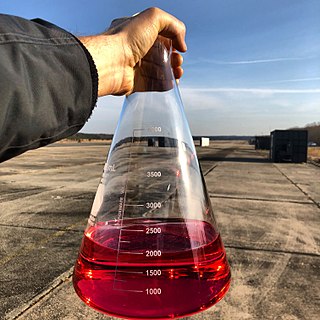
RP-1 (alternately, Rocket Propellant-1 or Refined Petroleum-1) is a highly refined form of kerosene outwardly similar to jet fuel, used as rocket fuel. RP-1 has a lower specific impulse than liquid hydrogen (LH2), but is cheaper, stable at room temperature, far less of an explosion hazard, and far denser. RP-1 is significantly more powerful than LH2 by volume. RP-1 also has a fraction of the toxicity and carcinogenic hazards of hydrazine, another room-temperature liquid fuel.

In petrochemistry, petroleum geology and organic chemistry, cracking is the process whereby complex organic molecules such as kerogens or long-chain hydrocarbons are broken down into simpler molecules such as light hydrocarbons, by the breaking of carbon-carbon bonds in the precursors. The rate of cracking and the end products are strongly dependent on the temperature and presence of catalysts. Cracking is the breakdown of a large alkane into smaller, more useful alkenes. Simply put, hydrocarbon cracking is the process of breaking a long-chain of hydrocarbons into short ones. This process requires high temperatures and high pressure.
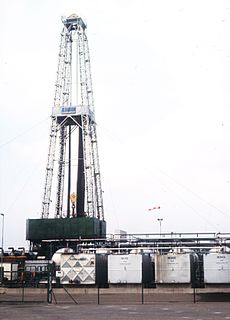
Hydrocarbon exploration is the search by petroleum geologists and geophysicists for hydrocarbon deposits beneath the Earth's surface, such as oil and natural gas. Oil and gas exploration are grouped under the science of petroleum geology.
Abiogenic petroleum origin is a body of hypotheses which propose that petroleum and natural gas deposits are mostly formed by inorganic means, rather than by the decomposition of organisms. Thomas Gold's deep gas hypothesis states that the origin of some natural gas deposits were formed out of hydrocarbons deep in the earth's mantle. Theories explaining the origin of petroleum as abiotic, however, are generally not well accepted by the scientific community.
Petroleum ether is the petroleum fraction consisting of aliphatic hydrocarbons and boiling in the range 35‒60 °C; commonly used as a laboratory solvent. Despite the name, petroleum ether is not classified as an ether; the term is used only figuratively, signifying extreme lightness and volatility.
The oil and gas industry is usually divided into three major sectors: upstream, midstream, and downstream. The downstream sector is the refining of petroleum crude oil and the processing and purifying of raw natural gas, as well as the marketing and distribution of products derived from crude oil and natural gas. The downstream sector reaches consumers through products such as gasoline or petrol, kerosene, jet fuel, diesel oil, heating oil, fuel oils, lubricants, waxes, asphalt, natural gas, and liquefied petroleum gas (LPG) as well as hundreds of petrochemicals.
A petroleum reservoir or oil and gas reservoir is a subsurface pool of hydrocarbons contained in porous or fractured rock formations. Petroleum reservoirs are broadly classified as conventional and unconventional reservoirs. In case of conventional reservoirs, the naturally occurring hydrocarbons, such as crude oil or natural gas, are trapped by overlying rock formations with lower permeability. While in unconventional reservoirs the rocks have high porosity and low permeability which keeps the hydrocarbons trapped in place, therefore not requiring a cap rock. Reservoirs are found using hydrocarbon exploration methods.
A coker or coker unit is an oil refinery processing unit that converts the residual oil from the vacuum distillation column into low molecular weight hydrocarbon gases, naphtha, light and heavy gas oils, and petroleum coke. The process thermally cracks the long chain hydrocarbon molecules in the residual oil feed into shorter chain molecules leaving behind the excess carbon in the form of petroleum coke.
A petroleum geologist is an earth scientist who works in the field of petroleum geology, which involves all aspects of oil discovery and production. Petroleum geologists are usually linked to the actual discovery of oil and the identification of possible oil deposits or leads. It can be a very labor-intensive task involving several different fields of science and elaborate equipment. Petroleum geologists look at the structural and sedimentary aspects of the stratum/strata to identify possible oil traps.
Total petroleum hydrocarbons (TPH) is a term used for any mixture of hydrocarbons that are found in crude oil. There are several hundred of these compounds, but not all occur in any one sample. Crude oil is used to make petroleum products which can contaminate the environment. Because there are so many different chemicals in crude oil and in other petroleum products, it is not practical to measure each one separately. However, it is useful to measure the total amount of TPH at a site. Chemicals that occur in TPH include hexane, benzene, toluene, xylenes, naphthalene, and fluorene, other constituents of gasoline, of jet fuels, of mineral oils, and of other petroleum products. Petroleum Hydrocarbon Ranges are monitored at various levels depending on the state and testing site.
In petroleum geology, a structural trap is a type of geological trap that forms as a result of changes in the structure of the subsurface, due to tectonic, diapiric, gravitational and compactional processes. These changes block the upward migration of hydrocarbons and can lead to the formation of a petroleum reservoir.
In petroleum geology, source rock refers to rocks from which hydrocarbons have been generated or are capable of being generated. They form one of the necessary elements of a working petroleum system. They are organic-rich sediments that may have been deposited in a variety of environments including deep water marine, lacustrine and deltaic. Oil shale can be regarded as an organic-rich but immature source rock from which little or no oil has been generated and expelled. Subsurface source rock mapping methodologies make it possible to identify likely zones of petroleum occurrence in sedimentary basins as well as shale gas plays.
Zhao Wenzhi is a Chinese petroleum geologist and explorer who has made contributions to the theories and discoveries of lithology-related hydrocarbon accumulations with large scale, natural gas relaying generation in high to over mature geothermal evolutional stage, Jurassic coal measure-derived hydrocarbon reservoirs, and sag-wide oil-bearing distribution, etc. He is an academician of the Chinese Academy of Engineering. He is the President of PetroChina Research Institute of Petroleum Exploration and Development (RIPED), and Deputy General Manager of PetroChina Exploration & Production Company. Zhao was voted one of China's top 35 scientists in 2007 and ranked 14.
