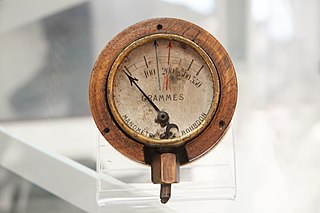
Pressure measurement is the analysis of an applied force by a fluid on a surface. Pressure is typically measured in units of force per unit of surface area. Many techniques have been developed for the measurement of pressure and vacuum. Instruments used to measure and display pressure in an integral unit are called pressure gauges or vacuum gauges. A manometer is a good example, as it uses a column of liquid to both measure and indicate pressure. Likewise the widely used Bourdon gauge is a mechanical device, which both measures and indicates and is probably the best known type of gauge.

Magnetic tape is a medium for magnetic recording, made of a thin, magnetizable coating on a long, narrow strip of plastic film. It was developed in Germany in 1928, based on magnetic wire recording. Devices that record and play back audio and video using magnetic tape are tape recorders and video tape recorders respectively. A device that stores computer data on magnetic tape is known as a tape drive.

The UNIVAC I was the first commercial computer produced in the United States. It was designed principally by J. Presper Eckert and John Mauchly, the inventors of the ENIAC. Design work was started by their company, Eckert–Mauchly Computer Corporation (EMCC), and was completed after the company had been acquired by Remington Rand. In the years before successor models of the UNIVAC I appeared, the machine was simply known as "the UNIVAC".
UNIVAC is a line of electronic digital stored-program computers starting with the products of the Eckert–Mauchly Computer Corporation. Later the name was applied to a division of the Remington Rand company and successor organizations.

The IBM 729 Magnetic Tape Unit was IBM's iconic tape mass storage system from the late 1950s through the mid-1960s. Part of the IBM 7 track family of tape units, it was used on late 700, most 7000 and many 1400 series computers. Like its predecessor, the IBM 727 and many successors, the 729 used 1/2 inch (12.7 mm) magnetic tape up to 2400 feet long wound on reels up to 10½ inch (267 mm) diameter. To allow rapid tape acceleration, long vacuum columns were placed between the tape reels and the read/write heads to absorb sudden increases in tape tension which would otherwise break the tape. Write protection was provided by a removable plastic ring in the back of the tape reel.
The UNISERVO tape drive was the primary I/O device on the UNIVAC I computer. Its place in history is assured as it was the first tape drive for a commercially sold computer.

The Bendix G-15 computer was introduced in 1956 by the Bendix Corporation, Computer Division, Los Angeles, California. It is about 5 by 3 by 3 ft and weighs about 966 pounds (438 kg).
The base system, without peripherals, cost $49,500. A working model cost around $60,000. It could also be rented for $1,485 per month. It was meant for scientific and industrial markets. The series was gradually discontinued when Control Data Corporation took over the Bendix computer division in 1963.

The UNIVAC II was an improvement to the UNIVAC I that UNIVAC first delivered in 1958. The improvements included core memory of 2,000 to 10,000 words, UNISERVO II tape drives which could use either the old UNIVAC I metal tapes or the new PET tapes, and some of the circuits were transistorized although it was still a vacuum tube computer. It was fully compatible with existing UNIVAC I programs for both code and data. It weighed about 16,000 pounds.
Inch of mercury is a unit of measurement for pressure. It is still used for barometric pressure in weather reports, refrigeration and aviation in the United States.

Solid-state electronics means semiconductor electronics; electronic equipment using semiconductor devices such as semiconductor diodes, transistors, and integrated circuits (ICs). The term is also used for devices in which semiconductor electronics which have no moving parts replace devices with moving parts, such as the solid-state relay in which transistor switches are used in place of a moving-arm electromechanical relay, or the solid-state drive (SSD) a type of semiconductor memory used in computers to replace hard disk drives, which store data on a rotating disk.

The IBM 727 Magnetic Tape Unit was announced for the IBM 701 and IBM 702 on September 25, 1953. It became IBM's standard tape drive for their early vacuum tube era computer systems. Later vacuum tube machines and first-generation transistor computers used the IBM 729-series tape drive. The 727 was withdrawn on May 12, 1971.
IBM's first magnetic tape data storage devices, introduced in 1952, use what is now generally known as 7 track tape. The magnetic tape is 1/2" wide and there are six data tracks plus one parity track for a total of seven parallel tracks that span the length of the tape. Data is stored as six-bit characters, with each bit of the character and the additional parity bit stored in a different track.

The IBM System/360, released in 1964, introduced what is now generally known as 9 track tape. The ½ inch (12.7 mm) wide magnetic tape media and reels are the same size as the earlier IBM 7 track format it replaced, but the new format has eight data tracks and one parity track for a total of nine parallel tracks. Data is stored as 8-bit characters, spanning the full width of the tape. Various recording methods were employed during its lifetime as tape speed and data density increased, including PE, GCR and NRZI. Tapes came in various sizes up to 3,600 feet (1,100 m) in length.
Magnetic tape data storage is a system for storing digital information on magnetic tape using digital recording. Modern magnetic tape is most commonly packaged in cartridges and cassettes. The device that performs writing or reading of data is a tape drive. Autoloaders and tape libraries automate cartridge handling. For example, a common cassette-based format is Linear Tape-Open, which comes in a variety of densities and is manufactured by several companies.
This article covers the peripherals available for Atari's 8-bit computer family, which includes the 400/800, XL, XE, the and XEGS.
The IBM 3570 is a series of tape drives and corresponding magnetic tape data storage media formats developed by IBM. The storage technology and media were introduced using the name Magstar MP, combining the IBM storage brand name Magstar with MP for MultiPurpose. The IBM product number 3570 was associated with the tape drives and libraries that used the Magstar MP media.

The IBM Naval Ordnance Research Calculator (NORC) was a one-of-a-kind first-generation computer built by IBM for the United States Navy's Bureau of Ordnance. It went into service in December 1954 and was likely the most powerful computer at the time. The Naval Ordnance Research Calculator (NORC), was built at the Watson Scientific Computing Laboratory under the direction of Wallace Eckert.


