
Ratha Jatra is a Hindu festival associated with Lord Jagannath held at Puri in the state of Odisha, India. It is the oldest Ratha Yatra taking place in India and the World, whose descriptions can be found in Brahma Purana, Padma Purana, and Skanda Purana and Kapila Samhita.

Puri is a city and a Municipality in the state of Odisha in eastern India. It is the district headquarters of Puri district and is situated on the Bay of Bengal, 60 kilometres (37 mi) south of the state capital of Bhubaneswar. It is also known as Sri Jagannatha Dhama after the 12th-century Jagannatha Temple located in the city. It is one of the original Char Dham pilgrimage sites for Hindus.
Kalpathi (Kalpathy) Ratholsavam is an annual Hindu Temple festival in the Kalpathi village of Palakkad district in Kerala state, south India. The festival is at the Sri Visalakshi Sametha Sri Viswanatha Swamy temple where the deities are Lord Siva and his consort Visalakshi, another name for Parvati.

The Shree Jagannath Temple of Puri is an important Hindu temple dedicated to Lord Jagannath, a form of lord Maha Vishnu, located on the eastern coast of India, at Puri in the state of Odisha. The temple is an important pilgrimage destination. The present temple was rebuilt from the 10th century onwards, on the site of an earlier temple, and begun by King Anantavarman Chodaganga Deva, first of the Eastern Ganga dynasty.

The Rathayatra of Mahesh is the biggest rathayatra in the world after Puri's Trio Rath Yatra and the most popular in Bengal, having been celebrated since 1396. It is held in Mahesh, a historical locality within Serampore City in the Indian state of West Bengal. It is a week-long festival and a grand fair is held at that time. People throng to have a share in pulling the long ropes (Rosshi) attached to the chariots of Lord Jagannath, Balarama and Subhadra on the journey from the temple to Mahesh Gundicha Bari and back within 8th day.

Udupi Sri Krishna Matha is a famous Hindu temple dedicated to god Krishna and Dvaita Matha located in the city of Udupi in Karnataka, India.
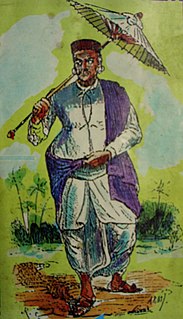
The Daivadnya Brahmins are a Hindu Brahmin caste, predominantly residing in the states of Goa, coastal Karnataka, and coastal Maharashtra.

Ratha Saptami or Rathasapthami is a Hindu festival that falls on the seventh day (Saptami) in the bright half of the Hindu month Maagha. It is symbolically represented in the form of the Sun God Surya turning his Ratha (Chariot) drawn by seven horses towards the northern hemisphere, in a north-easterly direction. It also marks the birth of Surya and hence celebrated as Surya Jayanti.
Agrashala is a pilgrimage resthouse specially meant for devotees in Goan temples. Goan temples are usually seen surrounded by Agrashalas. The Agrashala provides following facilities for the temple patrons or the Mahajanas:
Mahamaya Kalika Saunsthan is a temple complex in Kansarpal village of Bicholim taluka in the state of Goa, India. The presiding deity of the temple is Kali worshipped in the form of Mahamaya. The goddess Kali, the terrible and cruel to the demons and evil doers, is worshiped with blood sacrifice in most parts of India, in Goa however the fierce invocation of the deity was never popular. As per the regional myths after killing the demons Sumbha and Nisumbha, the deity's anger was soothed and the deity manifested herself in a peaceful (Shanta), gentle (Soumya) form, which is very popular in Goa.

Gundicha Temple, is a Hindu temple, situated in the temple town of Puri in the state of Odisha, India. It is significant for being the destination of the celebrated annual Rath Yatra of Puri. While it remains vacant most of the year, the temple is occupied by images of the deities of Jagannath, his brother Balabhadra and sister Subhadra for seven complete days every year during the annual Rath Yatra festival.

Sri Jagannath Temple is a famous Hindu temple located in Baripada, Mayurbhanj district, in the state of Odisha, India. The name Jagannath is a combination of the Sanskrit words Jagat (Universe) and Nath.
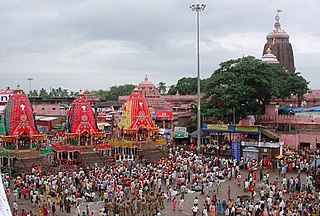
Ratha Jatra, also referred to as Rathayatra or Chariot festival is any public procession in a chariot. The term particularly refers to the annual Rathajatra in Odisha, Jharkhand, West Bengal and other East Indian states, particularly the Odia festival that involve a public procession with a chariot with deities Jagannath, Balabhadra, Subhadra and Sudarshana Chakra on a ratha, a wooden deula-shaped chariot. It attracts over a million Hindu pilgrims who join the procession each year.

The Draupadi Ratha is a monument in the Pancha Rathas complex at Mahabalipuram, previously called Mamallapuram, on the Coromandel Coast of the Bay of Bengal, in the Kancheepuram district of the state of Tamil Nadu, India. It is an example of monolithic Indian rock-cut architecture. Dating from the late 7th century, it is attributed to the reign of King Mahendravarman I and his son Narasimhavarman I of the Pallava Kingdom. The entire complex is under the auspices of the Archaeological Survey of India (ASI), and is one of the Group of Monuments at Mahabalipuram designated as a UNESCO World Heritage Site since 1984.

The Guptipara Rathayatra is being celebrated in Guptipara in Hooghly District of West Bengal since the 1730s. The chariot is a nabaratna-style wooden temple, where the presiding deity in the chariot is that of Radharaman Jiu. The Guptipara Rathayatra is second only to the Puri Rathayatra in terms of the distance covered. One of the unique events of Guptipara Rathayatra is the bhandara loot, which is held a day before the purnayatra or the ulto rath. A month long fair is held in Guptipara on the occasion of the festival. Every year thousands of devotees take part in the festival.
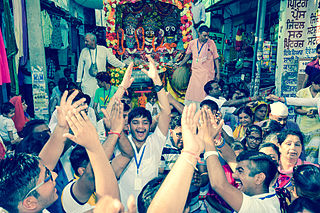
Ratha Yatra is a Hindu festival associated with the god Jagannath held at Mandir Thakur Shri Saty Narayan Ji in the Nabha City, state of Punjab, India. This annual festival is celebrated in the month of August or September. The festival commemorates Jagannath's annual visit to Nabha city.


