
Autism is a developmental disorder characterized by difficulties with social interaction and communication and by restricted and repetitive behavior. Parents usually notice signs during the first three years of their child's life. These signs often develop gradually, though some children with autism reach their developmental milestones at a normal pace before worsening.

Married... with Children is an American television sitcom that aired on Fox, created by Michael G. Moye and Ron Leavitt. Originally broadcast from April 5, 1987 to June 9, 1997, it is the longest-lasting live-action sitcom on Fox and the first to be broadcast in the network's primetime programming slot.

Asperger syndrome (AS), also known as Asperger's, is a developmental disorder characterized by significant difficulties in social interaction and nonverbal communication, along with restricted and repetitive patterns of behavior and interests. As a milder autism spectrum disorder (ASD), it differs from other ASDs by relatively normal language and intelligence. Although not required for diagnosis, physical clumsiness and unusual use of language are common. Signs usually begin before two years of age and typically last for a person's entire life.

The British royal family comprises Queen Elizabeth II and her close relations. There is no strict legal or formal definition of who is or is not a member of the British royal family.

Sesame Street is an American educational children's television series that combines live action, sketch comedy, animation and puppetry. It is produced by Sesame Workshop and was created by Joan Ganz Cooney and Lloyd Morrisett. The program is known for its images communicated through the use of Jim Henson's Muppets, and includes short films, with humor and cultural references. The series premiered on November 10, 1969, to positive reviews, some controversy, and high viewership; it has aired on the U.S.'s national public television provider PBS since its debut, with its first run moving to premium channel HBO on January 16, 2016.

Pneumonia is an inflammatory condition of the lung affecting primarily the small air sacs known as alveoli. Typically symptoms include some combination of productive or dry cough, chest pain, fever, and trouble breathing. Severity is variable.
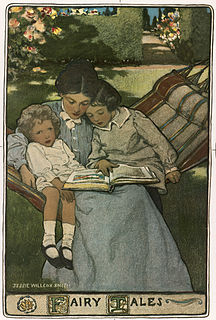
Children's literature or juvenile literature includes stories, books, magazines, and poems that are enjoyed by children. Modern children's literature is classified in two different ways: genre or the intended age of the reader.

Roald Dahl was a British novelist, short story writer, poet, screenwriter, and fighter pilot. His books have sold more than 250 million copies worldwide.
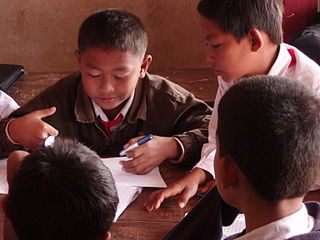
Attention deficit hyperactivity disorder (ADHD) is a mental disorder of the neurodevelopmental type. It is characterized by difficulty paying attention, excessive activity, and behavior without regards to consequences which is not appropriate for a person's age. There are also often problems with regulation of emotions. The symptoms appear before a person is twelve years old, are present for more than six months, and cause problems in at least two settings. In children, problems paying attention may result in poor school performance. Additionally there is an association with other mental disorders and substance misuse. Although it causes impairment, particularly in modern society, many people with ADHD can have sustained attention for tasks they find interesting or rewarding.

Child labour refers to the exploitation of children through any form of work that deprives children of their childhood, interferes with their ability to attend regular school, and is mentally, physically, socially or morally harmful. Such exploitation is prohibited by legislation worldwide, although these laws do not consider all work by children as child labour; exceptions include work by child artists, family duties, supervised training, and some forms of child work practiced by Amish children, as well as by Indigenous children in the Americas.
Biologically, a child is a human being between the stages of birth and puberty, or between the developmental period of infancy and puberty. The legal definition of child generally refers to a minor, otherwise known as a person younger than the age of majority.
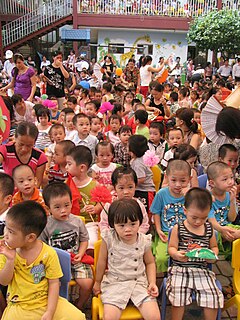
Kindergarten is a preschool educational approach based on playing, singing, practical activities such as drawing, and social interaction as part of the transition from home to school. Such institutions were originally created in the late 18th century in Bavaria and Strasbourg to serve children whose parents both worked outside home. The term was coined by the German Friedrich Fröbel, whose approach globally influenced early-years education. Today, the term is used in many countries to describe a variety of educational institutions and learning spaces for children ranging from two to seven years of age, based on a variety of teaching methods.

The Montessori Method of Education, developed by Maria Montessori, is a child-centered educational approach based on scientific observations of children. Montessori's method has been used for over 100 years in many parts of the world.

International Children's Day is a day recognized to celebrate children. The day is celebrated on various dates in different countries.
Children's rights are the human rights of children with particular attention to the rights of special protection and care afforded to minors. The 1989 Convention on the Rights of the Child (CRC) defines a child as "any human being below the age of eighteen years, unless under the law applicable to the child, majority is attained earlier." Children's rights includes their right to association with both parents, human identity as well as the basic needs for physical protection, food, universal state-paid education, health care, and criminal laws appropriate for the age and development of the child, equal protection of the child's civil rights, and freedom from discrimination on the basis of the child's race, gender, sexual orientation, gender identity, national origin, religion, disability, color, ethnicity, or other characteristics. Interpretations of children's rights range from allowing children the capacity for autonomous action to the enforcement of children being physically, mentally and emotionally free from abuse, though what constitutes "abuse" is a matter of debate. Other definitions include the rights to care and nurturing. There are no definitions of other terms used to describe young people such as "adolescents", "teenagers", or "youth" in international law, but the children's rights movement is considered distinct from the youth rights movement. The field of children's rights spans the fields of law, politics, religion, and morality.

Child abuse or child maltreatment is physical, sexual, and/or psychological maltreatment or neglect of a child or children, especially by a parent or a caregiver. Child abuse may include any act or failure to act by a parent or a caregiver that results in actual or potential harm to a child, and can occur in a child's home, or in the organizations, schools or communities the child interacts with.

Mary Poppins is a series of eight children's books written by Australian-British writer P. L. Travers and published over the period 1934 to 1988. Mary Shepard was the illustrator throughout the series.

In the context of human society, a family is a group of people related either by consanguinity, affinity, or co-residence or some combination of these. Members of the immediate family may include spouses, parents, brothers, sisters, sons, and daughters. Members of the extended family may include grandparents, aunts, uncles, cousins, nephews, nieces, and siblings-in-law. Sometimes these are also considered members of the immediate family, depending on an individual's specific relationship with them.
Child sexual abuse, also called child molestation, is a form of child abuse in which an adult or older adolescent uses a child for sexual stimulation. Forms of child sexual abuse include engaging in sexual activities with a child, indecent exposure, child grooming, child sexual exploitation or using a child to produce child pornography.

The United Nations Children's Fund (UNICEF), originally known as the United Nations International Children's Emergency Fund, was created by the United Nations General Assembly on 11 December 1946, to provide emergency food and healthcare to children and mothers in countries that had been devastated by World War II. The Polish physician Ludwik Rajchman is widely regarded as the founder of UNICEF and served as its first chairman from 1946. On Rajchman's suggestion, the American Maurice Pate was appointed its first executive director, serving from 1947 until his death in 1965. In 1950, UNICEF's mandate was extended to address the long-term needs of children and women in developing countries everywhere. In 1953 it became a permanent part of the United Nations System, and the words "international" and "emergency" were dropped from the organization's name, though it retained the original acronym, "UNICEF".


