
An equal temperament is a musical temperament, or a system of tuning, in which the frequency interval between every pair of adjacent notes has the same ratio. In other words, the ratios of the frequencies of any adjacent pair of notes is the same, and, as pitch is perceived roughly as the logarithm of frequency, equal perceived "distance" from every note to its nearest neighbor.

In music, there are two common meanings for tuning:

Meantone temperament is a musical temperament, that is a tuning system, obtained by slightly compromising the fifths in order to improve the thirds. Meantone temperaments are constructed the same way as Pythagorean tuning, as a stack of equal fifths, but in meantone each fifth is narrow compared to the perfect fifth of ratio 3:2.
Well temperament is a type of tempered tuning described in 20th-century music theory. The term is modeled on the German word wohltemperiert. This word also appears in the title of J.S. Bach's famous composition "Das wohltemperierte Klavier", The Well-Tempered Clavier.
In psychology, temperament broadly refers to consistent individual differences in behavior that are biologically based and are relatively independent of learning, system of values and attitudes. Some researchers point to association of temperament with formal dynamical features of behavior, such as energetic aspects, plasticity, sensitivity to specific reinforcers and emotionality. Temperament traits remain its distinct patterns in behavior throughout adulthood but they are most noticeable and most studied in children. Babies are typically described by temperament, but longitudinal research in the 1920s began to establish temperament as something which is stable across the lifespan.
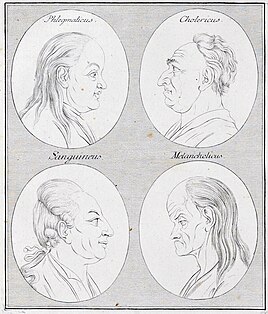
The four temperament theory is a proto-psychological theory which suggests that there are four fundamental personality types: sanguine, choleric, melancholic, and phlegmatic. Most formulations include the possibility of mixtures among the types where an individual's personality types overlap and they share two or more temperaments. Greek physician Hippocrates described the four temperaments as part of the ancient medical concept of humorism, that four bodily fluids affect human personality traits and behaviors. Modern medical science does not define a fixed relationship between internal secretions and personality, although some psychological personality type systems use categories similar to the Greek temperaments.

In music, a ditone is the interval of a major third. The size of a ditone varies according to the sizes of the two tones of which it is compounded. The largest is the Pythagorean ditone, with a ratio of 81:64, also called a comma-redundant major third; the smallest is the interval with a ratio of 100:81, also called a comma-deficient major third.
The Keirsey Temperament Sorter (KTS) is a self-assessed personality questionnaire designed to help people better understand themselves and others. It was first introduced in the book Please Understand Me. It is one of the most widely used personality assessments in the world, and its user base consists of major employers including Bank of America, Allstate, the U.S. Air Force, IBM, 7-Eleven, Safeco, AT&T, and Coca-Cola. The KTS is closely associated with the Myers-Briggs Type Indicator (MBTI); however, there are significant practical and theoretical differences between the two personality questionnaires and their associated different descriptions.
The year 1697 in music involved some significant events.
Five temperaments is a theory in psychology, that expands upon the four temperaments proposed in ancient medical theory.
Mark Lindley is a noted musicologist and, more recently, a historian of modern India, and a teacher of economics.

Music theory has no axiomatic foundation in modern mathematics, yet the basis of musical sound can be described mathematically and exhibits "a remarkable array of number properties". Elements of music such as its form, rhythm and metre, the pitches of its notes and the tempo of its pulse can be related to the measurement of time and frequency, offering ready analogies in geometry.

In musical tuning, a temperament is a tuning system that slightly compromises the pure intervals of just intonation to meet other requirements. Most modern Western musical instruments are tuned in the equal temperament system. "Tempering is the process of altering the size of an interval by making it narrower or wider than pure. A temperament is any plan that describes the adjustments to the sizes of some or all of the twelve fifth intervals in the circle of fifths so that they accommodate pure octaves and produce certain sizes of major thirds." Temperament is especially important for keyboard instruments, which typically allow a player to play only the pitches assigned to the various keys, and lack any way to alter pitch of a note in performance. Historically, the use of just intonation, Pythagorean tuning and meantone temperament meant that such instruments could sound "in tune" in one key, or some keys, but would then have more dissonance in other keys.
"Young temperament" may refer to either of a pair of circulating temperaments described by Thomas Young in a letter dated July 9, 1799, to the Royal Society of London. The letter was read at the Society's meeting of January 16, 1800, and included in its Philosophical Transactions for that year. The temperaments are referred to individually as "Young's first temperament" and "Young's second temperament", more briefly as "Young's No. 1" and "Young's No. 2", or with some other variations of these expressions.

The Church of Saint Mary Help of Christians in Via Tuscolana is a parish and titular church, minor basilica of Rome.
Claudio Di Veroli is an Italian-Argentinian harpsichordist who has written several books and papers on baroque performance practice. Born in Buenos Aires, Argentina, he was raised in an Italian family and attended Italian primary and secondary school. He studied privately in Buenos Aires under Ernesto Epstein, Erwin Leuchter (harmony) and Ljerko Spiller, obtained a degree in Mathematics from the University of Buenos Aires and a PhD in Statistics from Imperial College, London, under the supervision of Prof. Sir David Cox (statistician). Living in Europe in the early 70's he studied harpsichord with Colin Tilney in London and Hubert Bédard in Paris.

