This page is based on this
Wikipedia article Text is available under the
CC BY-SA 4.0 license; additional terms may apply.
Images, videos and audio are available under their respective licenses.
English usually refers to:

Persian, also known by its endonym Farsi, is one of the Western Iranian languages within the Indo-Iranian branch of the Indo-European language family. It is primarily spoken in Iran, Afghanistan, and Tajikistan, Uzbekistan and some other regions which historically were Persianate societies and considered part of Greater Iran. It is written right to left in the Persian alphabet, a modified variant of the Arabic script.

The Indo-Iranian languages, Indo-Iranic languages, or Aryan languages constitute the largest and southeasternmost extant branch of the Indo-European language family. It has more than 1.5 billion speakers, stretching from Europe (Romani), Turkey and the Caucasus (Ossetian) eastward to Xinjiang (Sarikoli) and Assam (Assamese), and south to Sri Lanka (Sinhalese) and the Maldives (Maldivian). Furthermore, there are large communities of Indo-Iranian speakers in northwestern Europe, North America and Australia.
The Persians are an Iranian ethnic group that make up over half the population of Iran. They share a common cultural system and are native speakers of the Persian language, as well as closely related languages.

Shah is a title given to the emperors, kings, princes and lords of Iran. It was also adopted by the kings of Shirvan namely the Shirvanshahs. It was also used by Persianate societies such as the rulers and offspring of the Ottoman Empire, Mughal emperors of the Indian Subcontinent, the Bengal Sultanate, as well as in Afghanistan. In Iran the title was continuously used; rather than King in the European sense, each Persian ruler regarded himself as the Shahanshah or Padishah of the Persian Empire.
AS, As, A/S or similar may refer to:
The Media of Iran are privately and publicly owned but is subject to censorship. As of 2016, Iran had 178 newspapers, 83 magazines, 15,000 information sites and 2 million blogs. A special court has authority to monitor the print media and may suspend publication or revoke the licenses of papers or journals that a jury finds guilty of publishing anti-religious material, slander, or information detrimental to the national interest. The Iranian media is prohibited from criticizing the Islamic doctrines.
The Torricelli languages are a family of about fifty languages of the northern Papua New Guinea coast, spoken by only about 80,000 people. They are named after the Torricelli Mountains. The most populous and best known Torricelli language is the Arapesh, with about 30,000 speakers.
Iran System encoding was an 8-bit character encoding scheme and was created by Iran System corporation for Persian language support. This encoding was in use in Iran in DOS-based programs and after the introduction of Microsoft code page 1256 this encoding became obsolete. However, some Windows and DOS programs using this encoding are still in use and some Windows fonts with this encoding exist. Now most programs use code page 1256, code page 1259, or Unicode.
Cloob.com is a Persian-language social networking website, mainly popular in Iran. After the locally popular social networking website Orkut was blocked by the Iranian government, a series of local sites and networks, including Cloob, emerged to fill the gap. Its main page contains the title Iranian Virtual Society and states that all content is controlled in accordance with Iranian law, a policy intended to lower the risk of government censorship.
The website claims to have around 1 million members and over 100 million page views per month. Users have access to features like: internal email, communities and community discussions (clubs), personal and community photo albums, article archive for communities, live messaging and chat rooms for communities, weblog, job and resume database, virtual money, income/expense book keeping for individual members, online shops for offering goods and services, classifieds, questions and answers, link and content sharing, news, member updates and extensive permission setting capabilities.
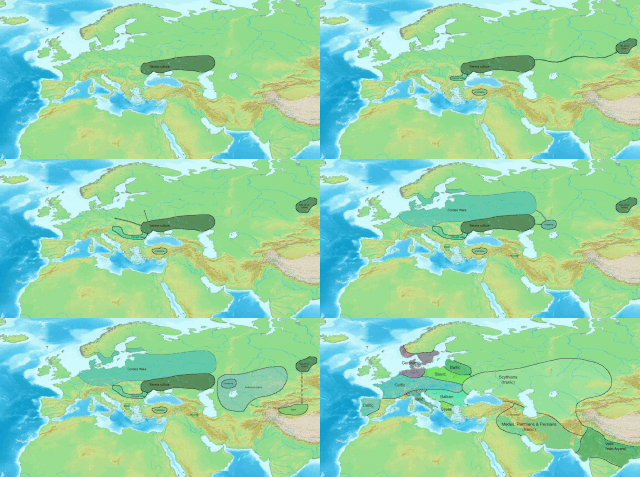
"Aryan" is a term that was used as a self-designation by Indo-Iranian people. The word was used by the Indic people of the Vedic period in India as an ethnic label for themselves and to refer to the noble class as well as the geographic region known as Āryāvarta, where Indo-Aryan culture is based. The closely related Iranian people also used the term as an ethnic label for themselves in the Avesta scriptures, and the word forms the etymological source of the country name Iran. It was believed in the 19th century that Aryan was also a self-designation used by all Proto-Indo-Europeans, a theory that has now been abandoned. Scholars point out that, even in ancient times, the idea of being an "Aryan" was religious, cultural and linguistic, not racial.
Morghdari-ye Iran Valman is a village in Kuhpayeh-e Gharbi Rural District, in the Central District of Abyek County, Qazvin Province, Iran. At the 2006 census, its existence was noted, but its population was not reported. The name means Iran Valman Poultry.
Shit is an English-language vulgarism, literally referring to feces, but having many metaphoric uses.

