This page is based on this
Wikipedia article Text is available under the
CC BY-SA 4.0 license; additional terms may apply.
Images, videos and audio are available under their respective licenses.

Aortic stenosis is the narrowing of the exit of the left ventricle of the heart, such that problems result. It may occur at the aortic valve as well as above and below this level. It typically gets worse over time. Symptoms often come on gradually with a decreased ability to exercise often occurring first. If heart failure, loss of consciousness, or heart related chest pain occurs due to AS the outcomes are worse. Loss of consciousness typically occurs with standing or exercise. Signs of heart failure include shortness of breath especially when lying down, at night, or with exercise, and swelling of the legs. Thickening of the valve without narrowing is known as aortic sclerosis.

A heart valve normally allows blood to flow in only one direction through the heart. The four valves are commonly represented in a mammalian heart that determines the pathway of blood flow through the heart. A heart valve opens or closes incumbent on differential blood pressure on each side.

Heart sounds are the noises generated by the beating heart and the resultant flow of blood through it. Specifically, the sounds reflect the turbulence created when the heart valves snap shut. In cardiac auscultation, an examiner may use a stethoscope to listen for these unique and distinct sounds that provide important auditory data regarding the condition of the heart.
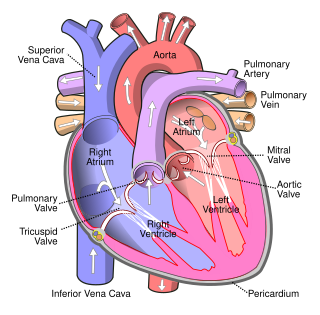
The aortic valve is a valve in the human heart between the left ventricle and the aorta. It is one of the two semilunar valves of the heart, the other being the pulmonary valve. The heart has four valves and the other two are the mitral and the tricuspid valves. The aortic valve normally has three cusps or leaflets, although in 1–2% of the population it is found to congenitally have two leaflets. The aortic valve is the last structure in the heart the blood travels through before flowing through the systemic circulation.

Heart murmurs are heart sounds produced when blood flows across one of the heart valves that are loud enough to be heard with a stethoscope.
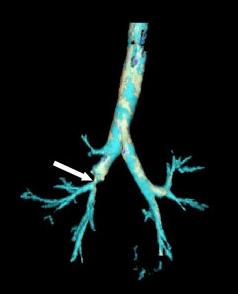
A stenosis is an abnormal narrowing in a blood vessel or other tubular organ or structure. It is also sometimes called a stricture.
Aortic valve replacement is a procedure in which a patient's failing aortic valve is replaced with an artificial heart valve. The aortic valve can be affected by a range of diseases; the valve can either become leaky or partially blocked. Current aortic valve replacement approaches include open heart surgery via a sternotomy, minimally invasive cardiac surgery (MICS) and transcatheter aortic valve replacement (TAVR).
The Rastelli procedure is an open heart surgical procedure developed by Italian physician and cardiac surgery researcher, Giancarlo Rastelli in 1967 at the Mayo Clinic and involves using a pulmonary or aortic homograft conduit to relieve pulmonary
obstruction in double outlet right ventricle with pulmonary stenosis.
A transthoracic echocardiogram (TTE) is the most common type of echocardiogram, which is a still or moving image of the internal parts of the heart using ultrasound. In this case, the probe is placed on the chest or abdomen of the subject to get various views of the heart. It is used as a non-invasive assessment of the overall health of the heart, including a patient's heart valves and degree of heart muscle contraction. The images are displayed on a monitor for real-time viewing and then recorded.
Valvular heart disease is any cardiovascular disease process involving one or more of the four valves of the heart. These conditions occur largely as a consequence of aging, but may also be the result of congenital (inborn) abnormalities or specific disease or physiologic processes including rheumatic heart disease and pregnancy.
ICD-10 is an international statistical classification used in health care and related industries.
Tricuspid Valve Stenosis is a valvular heart disease that narrows the opening of the heart's tricuspid valve. It is a relatively rare condition that causes stenosis-increased restriction of blood flow through the valve.
Percutaneous aortic valve replacement (PAVR), also known as transcatheter aortic valve implantation (TAVI) or transcatheter aortic valve replacement (TAVR), is the replacement of the aortic valve of the heart through the blood vessels. The replacement valve is delivered via one of several access methods: transfemoral, transapical, subclavian, direct aortic, and transcaval, among others.
Aortic valve area calculation is an indirect method of determining the area of the aortic valve. The calculated aortic valve orifice area is currently one of the measures for evaluating the severity of aortic stenosis. A valve area of less than 0.8 cm² is considered to be severe aortic stenosis.
Diastolic heart murmurs are heart murmurs heard during diastole.
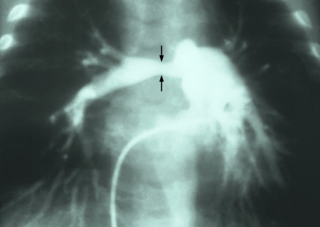
Stenosis of the pulmonary artery is a condition where the pulmonary artery is subject to an abnormal constriction. Peripheral pulmonary artery stenosis may occur as an isolated event or in association with Alagille syndrome, Berardinelli-Seip congenital lipodystrophy type 1, Costello syndrome, Keutel syndrome, nasodigitoacoustic syndrome, Noonan syndrome or Williams syndrome.
With the advent of newer, non-invasive imaging techniques, the origin of other, so-called adventitial sounds or heart clicks has been appreciated. These are short, high-pitched sounds.
Commissurotomy of heart valves is called valvulotomy, valvotomy, valvuloplasty, or valvoplasty and consists of making one or more incisions at the edges of the commissure formed between the two or three valve leaflets, which relieves the constriction of valvular stenosis.


