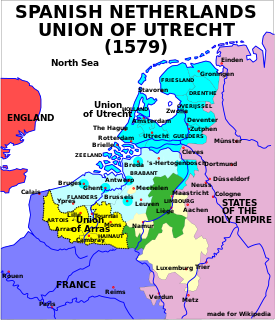
The Union of Utrecht was a treaty signed on 23 January 1579 in Utrecht, the Netherlands, unifying the northern provinces of the Netherlands, until then under the control of Habsburg Spain.

The Siege of Antwerp was an engagement between the German and the Belgian, British and French armies around the fortified city of Antwerp during World War I. German troops besieged a garrison of Belgian fortress troops, the Belgian field army and the British Royal Naval Division in the Antwerp area, after the German invasion of Belgium in August 1914. The city, which was ringed by forts known as the National Redoubt, was besieged to the south and east by German forces. The Belgian forces in Antwerp conducted three sorties in late September and early October, which interrupted German plans to send troops to France, where reinforcements were needed to counter the French armies and the British Expeditionary Force (BEF).

The Eighty Years' War or Dutch War of Independence (1568–1648) was a revolt of the Seventeen Provinces of what are today the Netherlands, Belgium, and Luxembourg against Philip II of Spain, the sovereign of the Habsburg Netherlands. After the initial stages, Philip II deployed his armies and regained control over most of the rebelling provinces. Under the leadership of the exiled William the Silent, the northern provinces continued their resistance. They eventually were able to oust the Habsburg armies, and in 1581 they established the Republic of the Seven United Netherlands. The war continued in other areas, although the heartland of the republic was no longer threatened; this included the beginnings of the Dutch Colonial Empire, which at the time were conceived as carrying overseas the war with Spain. The Dutch Republic was recognized by Spain and the major European powers in 1609 at the start of the Twelve Years' Truce. Hostilities broke out again around 1619, as part of the broader Thirty Years' War. An end was reached in 1648 with the Peace of Münster, when the Dutch Republic was definitively recognised as an independent country no longer part of the Holy Roman Empire. The Peace of Münster is sometimes considered the beginning of the Dutch Golden Age.

The Sack of Antwerp, often known as the Spanish Fury at Antwerp, was an episode of the Eighty Years' War. It is the greatest massacre in Belgian history.

The United Belgian States, also known as the United States of Belgium, was a confederal republic in the Southern Netherlands which was established after the Brabant Revolution. It existed from January to December 1790 as part of the unsuccessful revolt against the Habsburg Emperor, Joseph II.

Hoboken is a southern district of the arrondissement and city of Antwerp, in the Flemish Region of Belgium. It is located at the Scheldt river. The name of the district has its origins in Middle Dutch.
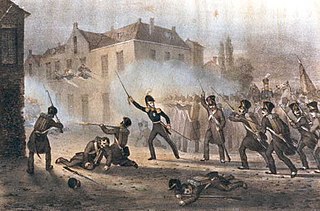
The Ten Days' Campaign was a failed military expedition by the United Kingdom of the Netherlands against the secessionist Kingdom of Belgium between 2 and 12 August 1831. The campaign was an attempt by the Dutch King William I to halt the course of the Belgian Revolution which had broken out in August 1830.
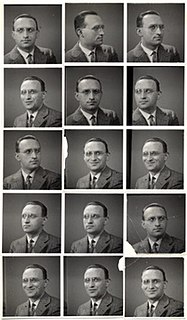
Marnix Gijsen was a Belgian writer. His real name was Joannes Alphonsius Albertus Goris; his pseudonym relates to Marnix van Sint Aldegonde and the surname of his mother (Gijsen).

Lieutenant-general BEM Victor Jean Clement, Baron van Strydonck de Burkel was a general of the Belgian Army and the primary architect of the formation of the Free Belgian Forces after Belgium's official surrender on May 28, 1940 in World War II.

Lieutenant General Robert L. Van Antwerp Jr. M.Sc. M.B.A. PE was the Chief of Engineers of the United States Army and Commanding General of the U.S. Army Corps of Engineers.

The Dutch Republic Lion was the badge of the Union of Utrecht, the Republic of the Seven United Netherlands and is a precursor of the current coat of arms of the Kingdom the Netherlands.

Antwerp is a city in Belgium, and is the capital of Antwerp province in Flanders. With a population of 520,504, it is the most populous city proper in Belgium, and with 1,200,000 the second largest metropolitan region after Brussels.

John Van Antwerp MacMurray was an American attorney, author and diplomat best known as one of the leading China experts in the U.S. government. He served as Assistant Secretary of State from November 1924 to May 1925, and was subsequently appointed Minister to China in 1925. Although MacMurray had coveted the China post, he soon fell into disagreement with the State Department over U.S. policy towards the ruling Kuomintang government. He resigned the position in 1929 and briefly left the foreign service. Following several years in academia, MacMurray returned to the State Department to become Minister to Estonia, Latvia and Lithuania from 1933 to 1936. He later served as ambassador to Turkey from 1936 to 1941, and then was made a special assistant to the Secretary of State until his retirement in 1944.

The Siege of Lingen of 1605 took place between 10 August and 19 August 1605, at Lingen, District of Emsland, Lower Saxony, between Spain and the United Provinces, during the Eighty Years' War. Prince Maurice of Nassau tried to preserve Lingen at all costs. The Dutch garrison led by Captain Maerten Cobben, expecting to be aided by Maurice's army, held out for nine days, but were finally forced to surrender. The siege was part of Spinola's successful campaign of 1605-1606.

The Siege of Eindhoven, also known as the Capture of Eindhoven of 1583, took place between 7 February and 23 April 1583 at Eindhoven, Duchy of Brabant, Spanish Netherlands during the Eighty Years' War and the Anglo-Spanish War (1585–1604). On 7 February 1583 a Spanish force sent by Don Alexander Farnese, Governor-General of the Spanish Netherlands, commanded by Karl von Mansfeld and Claude de Berlaymont laid siege to Eindhoven, an important and strategic city of Brabant held by Dutch, Scottish and French soldiers under the States' commander Hendrik van Bonnivet. After three months of siege, and the failed attempts by the States-General to assist Bonnivet's forces, the defenders surrendered to the Spaniards on 23 April.

The Battle of Borgerhout was a battle during the Eighty Years' War, of the Spanish Army of Flanders led by Alexander Farnese, Prince of Parma, upon a fortified camp at the village of Borgerhout, near Antwerp, where several thousand French, English, Scottish and Walloon soldiers in service of the recently created Union of Utrecht were stationed. It took place during the reconquest by the armies of Philip II of Spain of the Burgundian Netherlands, whose different provinces had united in 1576 under the Pacification of Ghent to drive out the foreign troops out and to grant religious liberty to Protestants.


