
Printing is a process for reproducing text and images using a master form or template. The earliest non-paper products involving printing include cylinder seals and objects such as the Cyrus Cylinder and the Cylinders of Nabonidus. The earliest known form of printing as applied to paper was woodblock printing, which appeared in China before 220 AD. Later developments in printing technology include the movable type invented by Bi Sheng around 1040 AD and the printing press invented by Johannes Gutenberg in the 15th century. The technology of printing played a key role in the development of the Renaissance and the scientific revolution, and laid the material basis for the modern knowledge-based economy and the spread of learning to the masses.

Woodcut is a relief printing technique in printmaking. An artist carves an image into the surface of a block of wood—typically with gouges—leaving the printing parts level with the surface while removing the non-printing parts. Areas that the artist cuts away carry no ink, while characters or images at surface level carry the ink to produce the print. The block is cut along the wood grain. The surface is covered with ink by rolling over the surface with an ink-covered roller (brayer), leaving ink upon the flat surface but not in the non-printing areas.

The Tripiṭaka Koreana or Palman Daejanggyeong is a Korean collection of the Tripiṭaka, carved onto 81,258 wooden printing blocks in the 13th century. It is the world's most comprehensive and oldest intact version of Buddhist canon in Hanja script, with no known errors or errata in the 52,330,152 characters which are organized in over 1496 titles and 6568 volumes. Each wood block measures 24 centimeters in height and 70 centimeters in length. The thickness of the blocks ranges from 2.6 to 4 centimeters and each weighs about three to four kilograms. The woodblocks are almost as tall as Mount Baekdu at 2.74 km when stacked, measure 60 km long when lined up, and weigh 280 tons in total. The woodblocks are in pristine condition without warping or deformation despite being created more than 750 years ago. The Tripiṭaka Koreana is stored in Haeinsa, a Buddhist temple in South Gyeongsang Province, in South Korea.
Baren (馬連、馬楝) listen (help·info) is a disk-like hand tool with a flat bottom and a knotted handle used in Japanese woodblock printing. It is used to burnish the back of a sheet of paper, lifting ink from the block.
Hiroshi Yoshida was a 20th-century Japanese painter and woodblock printmaker. He is regarded as one of the greatest artists of the shin-hanga style, and is noted especially for his excellent landscape prints. Yoshida travelled widely, and was particularly known for his images of non-Japanese subjects done in traditional Japanese woodblock style, including the Taj Mahal, the Swiss Alps, the Grand Canyon, and other National Parks in the United States.
Printing in East Asia evolved from ink rubbings made on paper or cloth from texts on stone tables in China during the Han dynasty. Mechanical woodblock printing on paper started in China during the Tang dynasty before the 8th century CE. The use of woodblock printing quickly spread to other East Asian countries. While the Chinese used only clay and wood movable type at first, use of metal movable type was pioneered in Korea by the 13th century. The Western-style printing press became known in East Asia by the 16th century but was not fully adopted until centuries later.
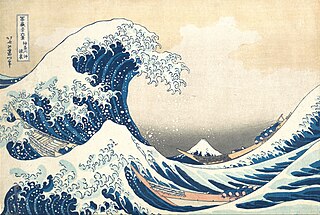
Woodblock printing in Japan is a technique best known for its use in the ukiyo-e artistic genre of single sheets, but it was also used for printing books in the same period. Woodblock printing had been used in China for centuries to print books, long before the advent of movable type, but was widely adopted in Japan during the Edo period (1603–1868). Although similar to woodcut in Western printmaking in some regards, the mokuhanga technique differs in that it uses water-based inks—as opposed to western woodcut, which often uses oil-based inks. The Japanese water-based inks provide a wide range of vivid colors, glazes, and transparency.

The history of printing starts as early as 3500 BC, when the Persian and Mesopotamian civilizations used cylinder seals to certify documents written in clay. Other early forms include block seals, pottery imprints and cloth printing. Woodblock printing on paper originated in China around 200 AD. It led to the development of movable type in the eleventh century and the spread of book production in East Asia. Woodblock printing was also used in Europe, but it was in the fifteenth century that European printers developed a process for mass-producing metal type to support an economical book publishing industry. This industry enabled the communication of ideas and sharing of knowledge on an unprecedented scale. Alongside the development of text printing, new and lower-cost methods of image reproduction were developed, including lithography, screen printing and photocopying.
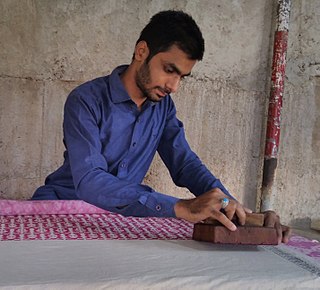
Woodblock printing on textiles is the process of printing patterns on textiles, usually of linen, cotton or silk, by means of incised wooden blocks. It is the earliest, simplest and slowest of all methods of textile printing. Block printing by hand is a slow process. It is, however, capable of yielding highly artistic results, some of which are unobtainable by any other method.
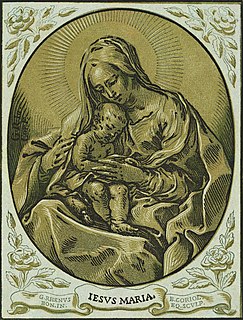
Bartolommeo Coriolano was an Italian engraver during the Baroque period. His father, Cristoforo Coriolano, and brother, Giovanni Battista Coriolano were also woodblock printers, although there is some doubt over the actual relationship between Cristoforo and Bartolommeo Coriolano. Coriolano had a daughter, Teresa Maria Coriolano, who later became a painter and engraver.

Edmund Evans was an English wood-engraver and colour printer during the Victorian era. Evans specialized in full-colour printing, which, in part because of his work, became popular in the mid-19th century. He employed and collaborated with illustrators such as Walter Crane, Randolph Caldecott, Kate Greenaway and Richard Doyle to produce what are now considered to be classic children's books. Although little is known about his life, he wrote a short autobiography before his death in 1905 in which he described his life as a printer in Victorian London.
Buddhist influences on print technology in East Asia are far-reaching. The history of writing in Asia dates back to the 13th century BC. China used bones and shells for religious inscriptions in the form of divinations. From these beginnings, numerous forms of writing and printing were developed. In many instances, as in Europe, it was religion that played a major role in the development of writing and printing techniques or which was the reason behind the usage of these techniques. Of the religions in East Asia, it was Buddhism that played the strongest role in influencing writing and, in particular, printing. There were other factors that influenced the creation of manuscript and print culture, but Buddhism had the largest influence in spreading the usage of print technology, which in turn led to an increase in the dissemination of secular printing and literacy as well as wielding an important influence on economics, government, and competing religions/philosophies.

Bokashi is a technique used in Japanese woodblock printmaking. It achieves a variation in lightness and darkness (value) of a single color or multiple colors by hand applying a gradation of ink to a moistened wooden printing block, rather than inking the block uniformly. This hand-application had to be repeated for each sheet of paper that was printed.

Chromoxylography was a colour woodblock printing process, popular from the mid-19th to the early-20th century, commonly used to produce illustrations in children's books, serial pulp magazines, and cover art for yellow-back and penny dreadfuls. The art of relief engraving and chromoxylography was perfected by engravers and printers in the 19th century, most notably in Victorian London by engraver and printer Edmund Evans who was particularly good with the process, producing a wide range of hues and tones through color mixing. Chromoxylography was a complicated technique, requiring intricate engraving and printing for the best results. Less expensive products, such as covers for pulp magazines, had to be produced with few colours, often only two or three, whereas more intricate and expensive books and reproductions of paintings used as many as a dozen or more colors. For each colour used, a separate woodblock had to be carved of the image being reproduced.
Dennis Ichiyama is an artist focusing on woodblock prints and former professor of Visual Communications Design at Purdue University in West Lafayette, Indiana..

The woodblock fragment Bois Protat is a fragmentary woodblock for printing, and the images on it are the oldest surviving woodcut images from the Western world. It is cut on both sides, with a scene from Christ's crucifixion on the recto, and a kneeling angel from a presumed Annunciation scene on the verso. The crucifixion scene likely consisted of three or more blocks; the surviving block fragment features Longinus the Roman centurion at the Crucifixion, shown speaking with a banderole, a mediaeval precursor to the modern speech balloon containing his words.

The conservation and restoration of woodblock prints, is the process of caring for and repairing images made from a specific printing process involving using wooden reliefs to stamp or imprint an image onto paper. The process of creating woodblock prints as Asian examples are known, or woodcuts as Western examples are called, has been known for many centuries, and many older prints have experienced aging and deterioration of the paper and colorants used.


