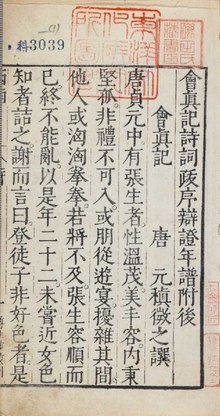
The Biography of Ying-ying (traditional Chinese:鶯鶯傳;simplified Chinese:莺莺传;pinyin:Yīngyīng zhuàn),also translated as The Tale of Yingying or The Story of Yingying,by Yuan Zhen,is a Tang dynastychuanqi tale.[1] It tells the story of a relationship conflicted between love and duty between a 16-year-old girl and a 21-year-old student. It is considered to be one of the most well-known works of fiction in Chinese literature.
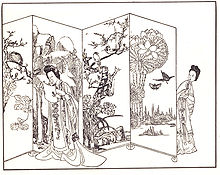
Scene from Romance of the Western Chamber,an opera inspired by the story of Yingying
Yuan Zhen pioneered psychological exploration and possibilities of plot development. His tale mixed narration,poetry and letters from one character to another to demonstrate emotion rather than describe it,making it in one sense an epistolary novel. The work was also innovative because its characters,in the terms suggested by E.M. Forster,are "round" rather than "flat",that is,unlike the characters in the earlier zhiguai or zhiren tales,are not built around a single idea or quality,but have the power to surprise readers. Recent critic Gu Mingdong suggests that with this tale,Chinese fiction "came of age",and the story provided themes for later plays,stories,and novels.[2]
Yingying's Biography was one of three Tang dynasty works particularly influential in the development of the caizi-jiaren (scholar and beauty novels).[1]
The young man,known only as "the student Zhang",is living in a rented dwelling in a Buddhist compound in the countryside some distance from a small city when a recently widowed woman,her daughter and son with an entourage befitting their wealth move into another rented dwelling in that compound. The father of the family died while stationed in some remote part of China,so the widow Cui (pronounced "tswei") is returning the family to Chang'an. They pause in their journey to recuperate from their long trek. Troops in the nearby city mutiny,so the student Zhang uses his friendly connections with influential men in that city to get a guard posted over the compound. The widow Cui and her group are made much more secure as a result of the student Zhang's pulling of strings. She gives a banquet to express her gratitude for Zhang's actions.
The widow Cui instructs her daughter to attend the banquet and to say "thank you" to the student Zhang. However,the daughter only appears because she is under duress and behaves in a most petulant and churlish manner. Nevertheless,she appears gloriously beautiful to Zhang despite her deliberately unkempt state. He has hitherto experienced no intimacy with anyone,and his companions have teased him about his lack of experience. There is no indication whatsoever that he has loving parents,siblings,or anyone in his life who is more to him than a mere acquaintance. He is immediately infatuated with this young woman who is so different from the young women who entertained his companions in the capital.
Zhang could not properly contact the daughter,Cui Yingying,directly. He arranges an indirect conduit through which he sends two "vernal" poems that the author of the story indicates would have conveyed no indecent propositions. Yingying responds with a poem that indicates romantic interest in "my lover",and invites him to come to her apartment after midnight. The student Zhang thinks that "his salvation [is] at hand",i.e.,that he will at last find an end to the long dearth of affection in his life. However,when he keeps the appointment Yingying calls him a virtual rapist. He is totally crushed. Several nights later,Yingying comes to his apartment without prior arrangement and initiates intercourse with him. She says not a single word to him from the time she enters his apartment to the time she leaves at dawn the next day. Before long they establish a pattern in which Zhang would sneak into her dwelling each night,and sneak back out again the following dawn. Despite her daughter entertaining a virile man every night,the widow Cui does not intervene. When her daughter asks for her reaction she says,essentially,that her daughter has got herself into the current situation and should get herself out of it in any way she may choose.
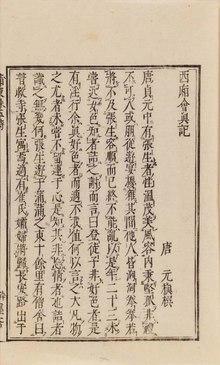
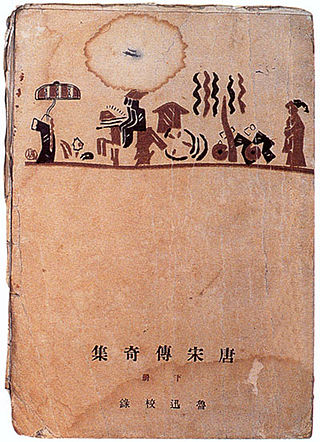
Another later printed edition
After some months of the functional equivalent of young married life,the student Zhang has to go to the capital to take the yearly civil service examination that will determine whether he will be able to get a good job in the government. Yingying feels that Zhang is abandoning her. She blames him for attending to education and job seeking rather than staying with her. Zhang does not pass the examination and returns to the Buddhist compound. Yingying could use this juncture to renegotiate their relationship. Instead,everything continues as before. Every time Zhang does anything to try to get to know her better,she rebuffs him. When the time of the next examinations comes,Zhang again prepares to leave for the capital. Yingying is once more convinced that he is abandoning her. She eventually becomes very emotional about her "abandonment." Zhang leaves anyway.
When he arrives in the capital,he writes to Yingying and attempts to set out his true feelings for her. She responds with a letter that implies that Zhang has been untrue to her,is interested only in his own future as an official,etc. Zhang does not react to this letter by feeling guilty. Instead,he decides that the relationship is bad for him. He may also have realized that the relationship was bad for Yingying. The story is not clear at this point and only says that Zhang decides to end things,and that he makes certain rationalizations to his companions who thought he should let things go on as before.
After some time passed,the widow Cui manages to arrange a reasonably good marriage for Yingying. Zhang,too,finds a wife. When his official duties take him near to Yingying's new home,he attempts to visit her. She refuses to see him,but sends him a poem that indicates that she is thoroughly miserable,and that this sorrowful state of affairs is all Zhang's fault. Some days later she sends him a poem of farewell,saying that he should direct his energies toward making a good relationship with his wife. Afterwards Zhang hears no more about her.
Arthur Waley, "The Story of Ts'ui Yingying", More Translations From Chinese (1919) Sacred Texts (also in the Anthology of Chinese Literature by Cyril Birch, vol. I. ( ISBN0-8021-5038-1);[4]
↑ Nienhauser, William H. "Introduction." In: Nienhauser, William H. (editor). Tang Dynasty Tales: A Guided Reader. World Scientific, 2010. ISBN9814287288, 9789814287289. p. xv.
External links
Wikisource has original text related to this article:
Li Yu, before 961 known as Li Congjia (李從嘉), also known as Li Houzhu or Last Lord of Southern Tang (南唐後主), was the third ruler of the Southern Tang dynasty of China during the Five Dynasties and Ten Kingdoms period. He reigned from 961 until 976, when he was captured by the invading Northern Song dynasty armies which annexed his state.
King Ling of Zhou, personal name Ji Xiexin, was a king of the Chinese Zhou dynasty. He died in 545 BC.
Chang'e, originally known as Heng'e (姮娥), is the goddess of the Moon and wife of Hou Yi, the great archer. Renowned by her beauty, Chang'e is also known for her ascending to the Moon with her pet Yu Tu, the Moon Rabbit and living in the Moon Palace (廣寒宮). She is one of the major goddesses in Chinese mythology, Chinese folk religion, Chinese Buddhism, Confucianism, and Taoism. In modern times, Chang'e is the namesake of the Chinese Lunar Exploration Program.
Meng Haoran was a Chinese poet and a major literary figure of the Tang dynasty. He was somewhat an older contemporary of Wang Wei, Li Bai and Du Fu. Despite his brief pursuit of an official career, Meng Haoran spent most of his life in and around his hometown Xiangyang of the Hubei Province living like a hermit, while creating poems inspired by its landscapes and milieu.
Emperor Xuanzong of Tang, personal name Li Longji, was an emperor of the Tang dynasty of China, reigning from 712 to 756 CE. His reign of 44 years was the longest during the Tang dynasty. Through two palace coups, he seized the throne and inherited an empire still in its golden age. He was initially assisted by capable chancellors like Yao Chong, Song Jing and Zhang Yue who were already serving as government officials before Xuanzong ascended the throne. However, under Emperor Xuanzong, the empire reached its turning point and went into sharp decline and near collapse, due to numerous political missteps throughout his long reign, such as over-trusting Li Linfu, Yang Guozhong and An Lushan, with Tang's golden age ending in the An Lushan Rebellion.
Arthur David Waley was an English orientalist and sinologist who achieved both popular and scholarly acclaim for his translations of Chinese and Japanese poetry. Among his honours were appointment as Commander of the Order of the British Empire in 1952, receiving the Queen's Gold Medal for Poetry in 1953, and being invested as a Member of the Order of the Companions of Honour in 1956.
Romance of the Western Chamber, also translated as The Story of the Western Wing, The West Chamber, Romance of the Western Bower and similar titles, is one of the most famous Chinese dramatic works. It was written by the Yuan dynasty playwright Wang Shifu (王實甫), and set during the Tang dynasty. Known as "China's most popular love comedy," it is the story of a young couple consummating their love without parental approval, and has been seen both as a "lover's bible" and "potentially lethal," as readers were in danger of pining away under its influence.
The Chu Ci, variously translated as Verses of Chu, Songs of Chu, or Elegies of Chu, is an ancient anthology of Chinese poetry including works traditionally attributed mainly to Qu Yuan and Song Yu from the Warring States period, as well as a large number of works composed during the Han dynasty several centuries later. The traditional version of the Chu Ci contains 17 major sections, anthologized with its current contents by Wang Yi, a 2nd-century AD librarian who served under Emperor Shun of Han. Classical Chinese poetry prior to the Qin dynasty is largely known through the Chu Ci and the Classic of Poetry.
Yuan Zhen, courtesy name Weizhi (微之), was a Chinese novelist, poet, and politician of the middle Tang dynasty. In prose literature, Yuan Zhen is particularly known for his work Yingying's Biography, which has often been adapted for other treatments, including operatic and musical ones. In poetry, he is remembered for the inclusion of some of his poems by popular anthologies, his verses on exotic topics, and for being part of the group of "New Yuefu" poets, which often used poetry as a form of expression and protest, but one potentially subtle enough to avoid the likely repercussions of more direct criticism. The poetic circle in which Yuan Zhen was involved included Bai Juyi, among others. Politically Yuan Zhen was briefly chancellor, during the reign of Emperor Muzong.
The Tale of King Mu, Son of Heaven is a fantasy version of the travels of King Mu of Zhou, historical fifth sovereign of the Zhou dynasty of China, r. 976–922 BCE or 956–918 BCE.
Da Tang Fu Rong Yuan is a Chinese television series based on a novel by Nangong Bo (南宫博) about the romance between Emperor Xuanzong of the Tang dynasty and his consort Yang Yuhuan. The series was directed by Zhou Xiaowen and starred Fan Bingbing and Winston Chao. It was first broadcast on CCTV-8 in mainland China in 2007.
The Tale of Li Wa is a short novella by Chinese writer Bai Xingjian during the Tang dynasty.
Lu Zhaolin, courtesy name Shengzhi, was a Tang dynasty Chinese poet, traditionally grouped together with Luo Binwang, Wang Bo, and Yang Jiong as the Four Paragons of the Early Tang.
Zhang Ruoxu was a Chinese poet of the early Tang dynasty from Yangzhou in modern Jiangsu province. He is best known for "Spring River in the Flower Moon Night", one of the most unique and influential Tang poems, which has inspired numerous later artworks.
The Cui clan of Qinghe (清河崔氏) was an eminent Chinese family of high-ranking government officials and Confucian scholars. The clan's ancestral home was in Qinghe Commandery (清河郡), which covered parts of present-day Shandong and Hebei provinces.
Di Ying is a Taiwanese actress best known for her roles in Dou hua nu (1992) and Gatao 2: The New King (2018).
Chuanqi is a form of fictional short story in Classical Chinese first formed in the Tang dynasty. The term often refers specifically to fictions written in the Tang dynasty, in which case the fictions are also called Tang chuanqi or chuanqi wen. Chuanqi originated from the Zhiguai xiaoshuo of the Six Dynasties, was first formed in Early Tang dynasty, became popular in Middle Tang and dwindled in the Song dynasty. Chuanqi has four main themes: love, gods and demons, xiayi and history. Well known works of chuanqi include The World Inside a Pillow and Renshi zhuan by Shen Jiji, Yingying's Biography by Yuan Zhen, The Tale of Huo Xiaoyu by Jiang Fang, The Tale of Li Wa by Bai Xingjian, The Governor of Nanke by Li Gongzuo, Chang hen ge zhuan by Chen Hong, Hongxian zhuan by Yuan Jiao and The Tale of the Curly-Bearded Guest by Du Guangting. Unlike general Biji xiaoshuo and Zhiguai xiaoshuo, most chuanqi stories have a complicated plot with twists and detailed descriptions and are meaningful literary creations instead of mere recordings of factual events. They are some of the earliest Chinese literature written in the form of short stories and have provided valuable inspiration plot-wise and in other ways for fiction and drama in later eras. Many were preserved in the 10th-century anthology, Taiping Guangji.
"Hongxian" or "The Tale of Hongxian" (紅線傳) is a Chinese short story dating back to the Tang dynasty, believed to have been written by either Yuan Jiao (袁郊) or Yang Juyuan (杨巨源). "Hongxian" revolves around a general's maid who strikes fear into the heart of a rival general by infiltrating his bedroom and stealing a golden box.
"Du Zichun" is a short story first published in the Tang dynasty. It revolves around the eponymous protagonist and a Taoist priest, who enlists his help in producing the elixir of life.
"The Tale of the Supernatural Marriage at Dongting", better known as "The Story of Liu Yi", is a Chinese chuanqi (fantasy) short story from the Tang dynasty, written by Li Chaowei (李朝威) in the second half of the 8th century. It is about a young man named Liu Yi who, out of sympathy, agrees to deliver a letter from a distressed dragon to her father, the Dragon King of Lake Dongting; following her rescue and the death of her abusive husband, the Dragon Girl transforms into a beautiful woman and marries Liu Yi.
This page is based on this Wikipedia article Text is available under the CC BY-SA 4.0 license; additional terms may apply. Images, videos and audio are available under their respective licenses.