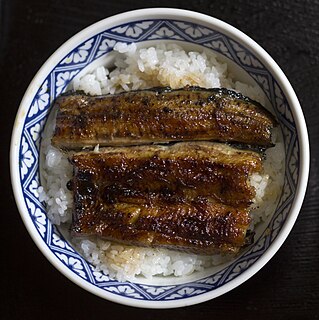
Donburi is a Japanese "rice bowl dish" consisting of fish, meat, vegetables or other ingredients simmered together and served over rice. Donburi meals are served in oversized rice bowls also called donburi. Donburi are sometimes called sweetened or savory stews on rice.

Nasi lemak is a Malay fragrant rice dish cooked in coconut milk and pandan leaf. It is commonly found in Malaysia, where it is considered the national dish; it is also the native dish in neighbouring areas with significant Malay populations such as Singapore; Brunei, and Southern Thailand. In Indonesia it can be found in several parts of Sumatra; especially Malay realm of Riau, Riau Islands and Medan. Nasi lemak can also be found in the Bangsamoro region of Mindanao prepared by Filipino Moro. It is considered one of the most famous dishes for a Malay-style breakfast. It is not to be confused with nasi dagang, sold in the Malaysian east coast states of Terengganu and Kelantan, although both dishes are often served for breakfast. However, because nasi lemak can be served in a variety of ways, it is often eaten throughout the day.

Caviar is a delicacy consisting of salt-cured roe of the Acipenseridae family. The roe can be "fresh" (non-pasteurized) or pasteurized, with pasteurization reducing its culinary and economic value.

Hokkien mee is a Malaysian and Singaporean dish that has its origins in the cuisine of China's Fujian (Hokkien) province. In its most common form, the dish consists of egg noodles and rice noodles stir-fried with egg, slices of pork, prawns and squid, and served and garnished with vegetables, small pieces of lard, sambal sauce and lime.

Singaporean cuisine is diverse and contains elements derived from several ethnic groups, as a result of its history as a seaport with a large immigrant population. Influences include the cuisines of the native Malays, the largest ethnic group, the Chinese and the third largest ethnic group, the Indians as well as Indonesian, Peranakan and Western traditions. Influences from other regions such as Sri Lanka, Thailand and the Middle East are also present.

Fish balls are a common food in southern China, Hong Kong, Macau, Southeast Asia and overseas Chinese communities. They are made with fish paste and boiled in a soupy broth, or deep fried. They are also common in Nordic countries.

Malaysian Chinese cuisine is derived from the culinary traditions of Chinese Malaysian immigrants and their descendants, who have adapted or modified their culinary traditions under the influence of Malaysian culture as well as immigration patterns of Chinese to Malaysia. Because the vast majority of Chinese Malaysians are descendants of immigrants from southern China, Malaysian Chinese cuisine is predominantly based on an eclectic repertoire of dishes with roots from Fujian, Cantonese, Hakka and Teochew cuisines.

Banmian (板麵) is a popular Chinese noodle dish, consisting of handmade noodles served in soup.

Penang cuisine is the cuisine of the multicultural society of Penang, Malaysia. Most of these cuisine are sold at road-side stalls, known as "hawker food" and colloquially as 'muckan carts'. Local Penangites typically find these hawker fares cheaper and easier to eat out at due to the ubiquitousness of the hawker stalls and that they are open for much of the day and night. Penang island. On February 22, 2013, Penang was ranked by CNN Travel as one of the top ten street food cities in Asia. Penang has also been voted by Lonely Planet as the top culinary destination in 2014.

Noodle soup refers to a variety of soups with noodles and other ingredients served in a light broth. Noodle soup is common dish across East and Southeast Asia. Various types of noodles are used, such as rice noodles, wheat noodles and egg noodles.
Chinese Indonesian cuisine is characterized by the mixture of Chinese with local Indonesian style. Chinese Indonesians brought their legacy of Chinese cuisine, and modified some of the dishes with the addition of Indonesian ingredients, such as kecap manis, palm sugar, peanut sauce, chili, santan and local spices to form a hybrid Chinese-Indonesian cuisine. Some of the dishes and cakes share the same style as in Malaysia and Singapore which are known as the Nonya cuisine by the Peranakan.
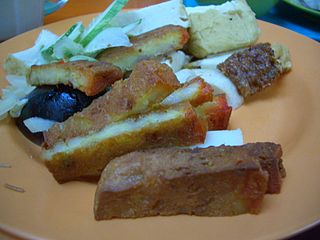
Ngo hiang, also known as heh gerng or lor bak is a unique Hokkien and Teochew dish widely adopted in Indonesia, Malaysia, the Philippines, Singapore, and Thailand; in addition to its place of origin in eastern China.

Lor mee is a Chinese-inspired noodle dish served in a thick starchy gravy and thick flat yellow noodles. The dish is eaten by Hokkiens in Singapore, Malaysia and Indonesia. The thick gravy is made of corn starch, spices and eggs. The ingredients added into the noodles are usually ngo hiang, fish cake, fish, round and flat meat dumplings, half a boiled egg, and other items depending on the stall and the price paid. Vinegar and garlic can be added as an optional item. The dish is also eaten with red chili. Traditional versions also include bits of fried fish as topping though few stalls serve this version anymore.

Siomay, is an Indonesian steamed fish dumpling with vegetables served in peanut sauce. It is derived from Chinese Shumai. It is considered a light meal that is similar to the Chinese Dim Sum, but is cone shaped. It is traditionally made from tenggiri (wahoo) fish meat. Sometimes other types of seafood such as tuna, mackerel, and prawn also can be used to make siomay. Other complements to siomay are steamed cabbage, potatoes, bitter gourd, boiled egg, and tofu. Siomay is cut into bite size pieces and topped with peanut sauce, sweet soy sauce, chili sauce and a dash of lime juice.
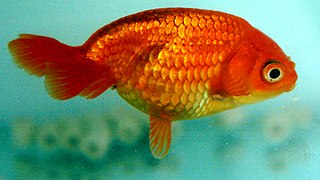
The egg fish goldfish is a fancy goldfish breed which lacks a dorsal fin and has a pronounced egg-shaped body.
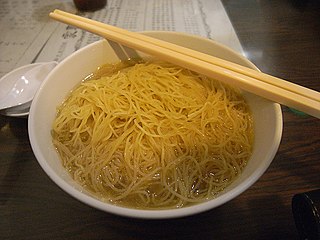
Youmian are a variety of Chinese noodle widely used in Southern China, especially in the cuisines of Hong Kong and Guangdong. It has also been selectively used in the cuisines of Shanghai, Malaysia, and Singapore. Youmian is also used in some dishes in the overseas Chinese communities.
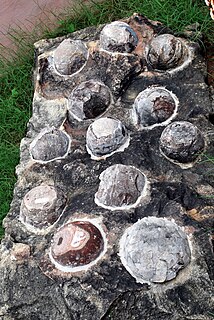
Egg fossils are the fossilized remains of eggs laid by ancient animals. As evidence of the physiological processes of an animal, egg fossils are considered a type of trace fossil. Under rare circumstances a fossil egg may preserve the remains of the once-developing embryo inside, in which case it also contains body fossils. A wide variety of different animal groups laid eggs that are now preserved in the fossil record beginning in the Paleozoic era. Examples include invertebrates like ammonoids as well as vertebrates like fishes, possible amphibians, and reptiles. The latter group includes the many dinosaur eggs that have been recovered from Mesozoic strata. Since the organism responsible for laying any given egg fossil is frequently unknown, scientists classify eggs using a parallel system of taxonomy separate from but modeled after the Linnaean system. This "parataxonomy" is called veterovata.
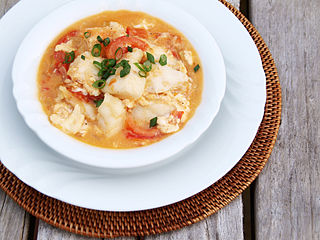
Sarsiado is a fish dish from the Philippines which features tomatoes and eggs.
The name sarsiado in the Tagalog language means "cooked with a thick sauce". The name is derived from the Filipino word sarsa which in turn is from the Spanish word "salsa", which means "sauce".

