Year 639 (DCXXXIX) was a common year starting on Friday of the Julian calendar. The denomination 639 for this year has been used since the early medieval period, when the Anno Domini calendar era became the prevalent method in Europe for naming years.

Piedras Negras is the modern name for a ruined city of the pre-Columbian Maya civilization located on the north bank of the Usumacinta River in the Petén department of northeastern Guatemala. Piedras Negras is one of the most powerful of the Usumacinta ancient Maya urban centers. Occupation at Piedras Negras is known from the Late Preclassic period onward, based on dates retrieved from epigraphic information found on multiple stelae and altars at the site. Piedras Negras is an archaeological site known for its large sculptural output when compared to other ancient Maya sites. The wealth of sculpture, in conjunction with the precise chronological information associated with the lives of elites of Piedras Negras, has allowed archaeologists to reconstruct the political history of the Piedras Negras polity and its geopolitical footprint.

K'inich Ahkal Mo' Nahb III also known as Chaacal III and Akul Anab III,, was an ajaw of the Maya city of Palenque. He took the throne on 30 December 721, reigning until c.736.
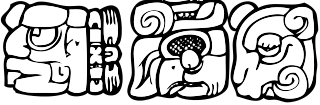
Itzam K'an Ahk I, also known as Ruler 2, was an ajaw of Piedras Negras, an ancient Maya settlement in Guatemala. He ruled during the Late Classic Period, from AD 639-686. The son of K'inich Yo'nal Ahk I, Itzam K'an Ahk I took the throne when he was only 12 years old. His reign was marked by several wars, and he seems to have had a special connection with Calakmul. Itzam K'an Ahk I died just a few days before the marriage of his son, who succeeded him as ajaw of Piedras Negras and took on the name K'inich Yo'nal Ahk II. Itzam K'an Ahk I left behind several monuments, including eight stelae stelae, three panels, a throne, and a short stela-like column; this made him the most active of Piedras Negras's leaders in regards to erecting monuments.

K'ahk' Pulaj Chan Chaahk, also known as Lord Chac before the decipherment of his corresponding name glyphs, is currently the only archaeologically identified ruler of the pre-Columbian Maya polity at Uxmal, who ruled in the early 10th century.
Only a handful of details are known from this king, as hieroglyphic inscriptions, while very prominent in the Southern Maya Lowlands, are scarce in the north. What is known is that Lord Chac acceded to the throne somewhere at the end of the 9th century. During his rule, between 890-910 AD, some of the largest and most impressive buildings in Uxmal, such as the so-called Nunnery Quadrangle and the Governor's Palace, were built. An inscription at a large ballcourt in Uxmal, for playing the Mesoamerican ballgame, informs us it was dedicated in 901 during the reign of this king.

Yat Ahk I was the third king of Mayan city-state Piedras Negras in Guatemala. He is also known as Ah Cauac Ah K'in, and by the English translation of his name, Turtle Tooth.
Piedras Negras Ruler C was a king of that Maya city-state. He was the fourth ruler of Piedras Negras, successor of Turtle Tooth, who could be his father.

Itzam K'an Ahk II, also known as Ruler 4, was an ajaw of Piedras Negras, an ancient Maya settlement in Guatemala. He ruled during the Late Classic Period, from 729–757 AD. Itzam K'an Ahk II ascended to the throne following the death of K'inich Yo'nal Ahk II. Itzam K'an Ahk II may have fathered the following three kings of Piedras Negras: Yo'nal Ahk III, Ha' K'in Xook, and K'inich Yat Ahk II. Following Itzam K'an Ahk II's demise, he was succeeded by Yo'nal Ahk III in 757 AD. Itzam K'an Ahk II left behind several monuments, including stelae at Piedras Negras and a large mortuary temple now known as Pyramid O-13. In addition, the details of his life and his K'atun-jubilee were commemorated on Panel 3, raised by K'inich Yat Ahk II several years following Itzam K'an Ahk II's death.

K'ahk' Ujol K'inich I was a king of Maya city of Caracol in Belize, named after the Sun deity called Kinich Ahau. He is also known as Ruler I and Smoking Skull I. He reigned c. AD 470.
Yajaw Te' K'inich I was a Mayan king (ajaw) of Caracol in Belize.
K'an I was a Maya king of Caracol in Belize. He reigned AD 531-534.

Yajaw Te' K'inich II was a king of the Mayan state Caracol in Belize. He was also known as Ruler III, Lord Water and Lord Muluc and reigned AD 553-593>.
K'ahk' Ujol K'inich II was a king of Caracol, Mayan city-state in Belize. He is also known as Ruler VI and Smoking Skull II. He reigned AD 658–680.
Yuknoom Yich'aak K'ahk' ) or Yuknoom Ixquiac was a Maya king of the Kaan kingdom, which had its capital at Calakmul during the Classic Period of Mesoamerican chronology.
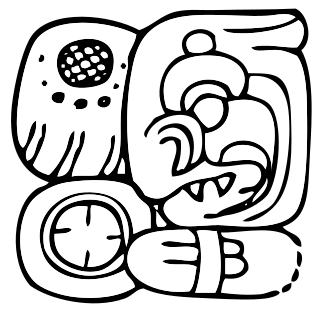
Ha' K'in Xook, also known as Ruler 6, was an ajaw of Piedras Negras, an ancient Maya settlement in Guatemala. He ruled during the Late Classic Period, from 767–780 AD. Ha' K'in Xook was a son of Itzam K'an Ahk II, and he ascended the throne following the death of his brother, Yo'nal Ahk III. Ha' K'in Xook's reign ended with either his death or his abdication in favor of his brother K'inich Yat Ahk II; archaeologists and Mayanists have not arrived at a clear consensus. Ha' K'in Xook left behind several monuments, including stelae at Piedras Negras and a stone fragment from El Porvenir. In addition, a stone seat known as Throne 1 and erected by K'inich Yat Ahk II records either the death or abdication of Ha' K'in Xook.

K'inich Yat Ahk II, also known as Ruler 7, was the last ajaw of Piedras Negras, an ancient Maya settlement in Guatemala. He ruled during the Late Classic Period, from 781 to roughly 808 AD. Possibly a descendant of Itzam K'an Ahk II, K'inich Yat Ahk II ascended the throne upon the death of his brother, the sixth ajaw of the site, Ha' K'in Xook. While K'inich Yat Ahk II presided over the destruction of the rival Maya site Pomona, his reign likely ended with K'inich Tatbu Skull IV of Yaxchilan capturing and subjugating Piedras Negras. Itzam K'an Ahk II left behind several monuments, including stelae at Piedras Negras, a stone seat known as Throne 1 which records either the death or abdication of Ha' K'in Xook, and Panel 3 which recounts the exploits of Itzam K'an Ahk II.
Lady K'atun Ajaw of Namaan, was the queen and consort of K'inich Yo'nal Ahk II, the king of Piedras Negras, Maya city in Guatemala.
Coming from the city of Namaan, Lady K'atun Ajaw married K'inich Yo'nal Ahk on November 19, 686 CE, when she was just 12 years old. She would go on to have a child with him, Lady Juntaan Ahk, who was born on March 19, 708 CE, and the trio celebrated the closing of the 14th K'atun together on December 3, 711 CE.