Yongchon

Last updated

Yongchon may refer to several places in Korea. Because of North–South differences and various systems for the romanization of Korean, each of these place names has several possible English spellings.

The Korean language has changed between North and South Korea due to the length of time that the two states have been separated. Underlying dialect differences have been extended, in part by government policies and in part by the isolation of North Korea from the outside world.

Romanization of Korean

Romanization of Korean refers to systems for representing the Korean language in the Latin script. Korea's alphabetic script, called Hangul, has historically been used in conjunction with Hanja, though such practice has become infrequent.

Yeongcheon Municipal City in Yeongnam, South Korea

Yeongcheon is a city in North Gyeongsang Province, South Korea.

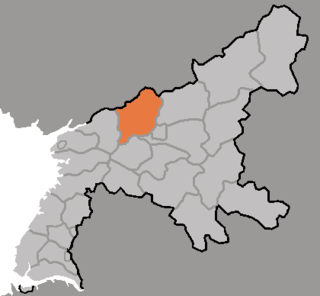
Ryongchon County County in North Pyŏngan, North Korea

Ryongch'ŏn County is a kun (county) in North P'yǒngan province, North Korea, at the mouth of the Yalu River. The county seat is Ryongch'ŏn-ŭp, about 20 kilometres (12 mi) from the border with China. The area has a reported population of 27,000 and is a centre of chemical and metalworking production.

Administrative divisions of North Korea

The administrative divisions of North Korea are organized into three hierarchical levels. These divisions were discovered in 2002. Many of the units have equivalents in the system of South Korea. At the highest level are nine provinces, two directly governed cities, and three special administrative divisions. The second-level divisions are cities, counties, wards, and districts. These are further subdivided into third-level entities: towns, neighborhoods, villages, and workers' districts.

Related Research Articles

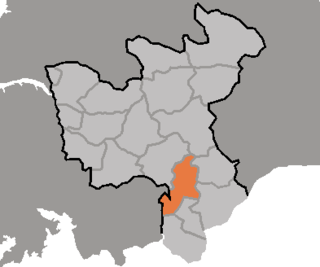
Tokchon Municipal City in South Pyŏngan, North Korea

Tŏkch'ŏn is a si, or city, in northern South P'yŏngan province, North Korea. It is bordered by Nyŏngwŏn and Maengsan to the east, Kujang county in North P'yŏngan province to the north, Kaech'ŏn to the west and Pukch'ang to the south. It was known as "Tokugawa" during Japanese rule.

Sunchon Municipal City in South Pyŏngan, North Korea

Sunch'ŏn is a city in South Pyongan province, North Korea. It has an estimated population of 437,000, and is home to various manufacturing plants.

Kaechon Municipal City in South Pyŏngan, North Korea

Kaech'ŏn is a city in South P'yŏngan province, North Korea.

Kilju County County in North Hamgyong Province, North Korea

Kilju, sometimes romanized as Kilchu, is a county in North Hamgyong province, North Korea. The county seat is Kilju Town.

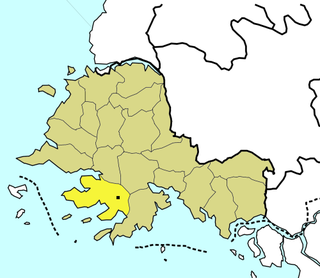
Ongjin County, South Hwanghae County in South Hwanghae Province, North Korea

Ongjin County is a county in southern South Hwanghae Province, North Korea. It is located on the Ongjin Peninsula, which projects into the Yellow Sea.

Uiju County County in North Pyŏngan, North Korea

Ŭiju County is a kun, or county, in North Pyongan Province, North Korea. The county has an area of 420 km², and a population of 110,018.

Tanchon Municipal City in South Hamgyong Province, North Korea

Tanch'ŏn is a port city in northeastern South Hamgyŏng province, North Korea. It has a population of approximately 360,000. Tanch'ŏn borders the Sea of Japan, into which the Namdae River flows.

Anbyon County County in Kangwon Province, North Korea

Anbyŏn is a kun, or county, in Kangwŏn province, North Korea. Originally included in South Hamgyŏng province, it was transferred to Kangwŏn province in a September 1946 reshuffling of local government.

Ryongrim County County in Chagang Province, North Korea

Ryongrim County is a kun, or county, in southeastern Chagang Province, North Korea. It borders Rangrim, Changjin, Chŏnch'ŏn, Tongsin, Taehŭng, and Sŏnggan counties. The county is mainly alpine territory. It contains many mountain peaks, such as Wagalbong (2,260m), Ch'ŏnŭimulsan (2,032m), Rangrimsan (2,186m), Milpuldŏksan (1,577m), Ungŏsusan (2,020m), Tomabong (1,525m), Paktalsan (1,817m), Taedasan (1,463m), and Sonamsan (1,178m).

Yomju County County in North Pyŏngan, North Korea

Yŏmju County is a kun, or county, in northwestern North P'yŏngan province, North Korea, on the coast of the Yellow Sea. It is bordered by Ryongch'ŏn and P'ihyŏn to the north, Tongrim to the east, and Ch'ŏlsan to the south; to the west lies the ocean. The county was created in 1952 from portions of Ch'ŏlsan and Ryongch'ŏn.

Pakchon County County in North Pyŏngan, North Korea

Pakch'ŏn County is a kun, or county, in southern North P'yŏngan province, North Korea. It is bordered to the north by T'aech'ŏn, to the east and southeast by Nyŏngbyŏn, and to the west by Unjŏn counties. To the south, it looks across the Ch'ŏngch'ŏn River at Anju city and Mundŏk county in South P'yŏngan province. In 1952, 4 myŏn of Pakch'ŏn were split off to join Unjŏn county; since then, the county's administrative divisions have been revised in 1954, 1956, 1958, 1978, 1980, and 1982.

Sindo County County in North Pyŏngan, North Korea

Sindo County is a kun (county) in the North P'yŏngan province of North Korea. Most of the county consists of Pidansŏm, an island in the estuary of the Yalu River. Sindo was established as a separate county in 1991; previously, it had been part of Ryongch'ŏn, although it had enjoyed a brief existence as a separate county in 1967.

Ryongju Station is a railway station in Inhŭng-ri, Ryongch'ŏn County, North P'yŏngan Province, North Korea. It is on located on the P'yŏngŭi Line of the Korean State Railway.

Ryongchon Station

Ryongch'ŏn Station is a railway station in Ryongch'ŏn-ŭp, Ryongch'ŏn County, North P'yŏngan Province, North Korea. It is the junction point of the P'yŏngŭi and Tasado lines of the Korean State Railway.

Kumchon County County in North Hwanghae Province, North Korea

Kŭmch'ŏn County is a county in the North Hwanghae province of North Korea. It has a population of 68,216.

Sinchon County County in South Hwanghae Province, North Korea

Sinch'ŏn County is a county in South Hwanghae province, North Korea.

Hambuk Line trunk line of the North Korean State Railway

The Hambuk Line is an electrified standard-gauge trunk line of the Korean State Railway in North Korea, running from Ch'ŏngjin) on the P'yŏngra Line to Rajin, likewise on the P'yŏngra line.