Related Research Articles

The I Corps is a corps of the United States Army headquartered in Joint Base Lewis-McChord, Washington. It is a major formation of United States Army Pacific (USARPAC) and its current mission involves administrative oversight of army units in the Asia-Pacific region, including the Pacific Pathways program.

The Seventh Air Force (Air Forces Korea) (7 AF) is a Numbered Air Force of the United States Pacific Air Forces (PACAF). It is headquartered at Osan Air Base, South Korea.

John William "Jack" Vessey Jr. was a career officer in the United States Army. He attained the rank of general, and was most notable for his service as the tenth chairman of the Joint Chiefs of Staff.

The Kempeitai was the military police of the Imperial Japanese Army (IJA). The organization also shared civilian secret police that specialized clandestine and covert operation, counterinsurgency, counterintelligence, HUMINT, interrogate suspects who may be allied soldiers, spies or resistance movement, maintain security of prisoner of war camps, raiding to capture high-value targets, and providing security at important government and military locations at risk of being sabotaged roles within Japan and its occupied territories, and was notorious for its brutality and role in suppressing dissent. The broad duties of the Kempeitai included maintaining military discipline, enforcing conscription laws, protecting vital military zones, and investigating crimes among soldiers. In occupied areas, it also issued travel permits, recruited labor, arrested resistance, requisitioned food and supplies, spread propaganda, and suppressed anti-Japanese sentiment. At its peak at the end of World War II, the Kempeitai was an extensive corps with about 35,000 personnel.

The 31st Infantry Division ("Dixie") was an infantry division of the United States Army National Guard, active almost continuously from 1917 to 1968. Composed of men from Alabama, Florida, Georgia, Louisiana, Michigan, Illinois, and Mississippi at various points in its existence, the division saw service in both World War I and World War II, and was mobilized during the Korean War, although it was not sent overseas in the latter.

Lieutenant General Edward Mallory Almond was a senior United States Army officer who fought in World War I, World War II, where he commanded the 92nd Infantry Division, and the Korean War, where he commanded the U.S. X Corps.

South West Pacific Area (SWPA) was the name given to the Allied supreme military command in the South West Pacific Theatre of World War II. It was one of four major Allied commands in the Pacific War. SWPA included the Philippines, Borneo, the Dutch East Indies, East Timor, Australia, the Territories of Papua and New Guinea, and the western part of the Solomon Islands. It primarily consisted of United States and Australian forces, although Dutch, Filipino, British, and other Allied forces also served in the SWPA.

Masakazu Kawabe was a general in the Imperial Japanese Army. He held important commands in the Imperial Japanese Army during the Second Sino-Japanese War, and during World War II in the Burma Campaign and defense of the Japanese homeland late in the war. He was also the elder brother of General Torashirō Kawabe.

Lieutenant General Sir Horace Clement Hugh Robertson, was a senior officer in the Australian Army who served in the First World War, the Second World War and the Korean War. He was one of the first graduates of the Royal Military College, Duntroon, to reach the ranks of major general and lieutenant general.

Gen. Antoni Chruściel was a Polish military officer and a general of the Polish Army. He is best known as the de facto commander of all the armed forces of the Warsaw Uprising of 1944, as well as Home Army's chief of staff.
Yukio Kasahara was a leading general in the Imperial Japanese Army in the Second Sino-Japanese War.
The United States Air Force became a separate military service on 18 September 1947 with the implementation of the National Security Act of 1947. The Act created the National Military Establishment, later renamed the United States Department of Defense, which was composed of four of the five branches, the Army, Marine Corps, Navy, and a newly created Air Force. Prior to 1947, the responsibility for military aviation was divided between the Army for land-based operations and the Navy and Marine Corps for sea-based operations from aircraft carrier and amphibious aircraft. The Army created the first antecedent of the Air Force on 1 August 1907, which through a succession of changes of organization, titles, and missions advanced toward eventual separation 40 years later. The predecessor organizations leading up to today's U.S. Air Force are:

Lieutenant General Frank William Milburn was a senior United States Army officer who served during World War II and the Korean War. From December 1943, through the end of World War II, Milburn commanded the XXI Corps.

Lieutenant General George Edward Stratemeyer was a senior commander in the United States Air Force. He held senior command appointments in the China Burma India Theater of World War II and was Far East Air Forces commander during the first year of the Korean War.
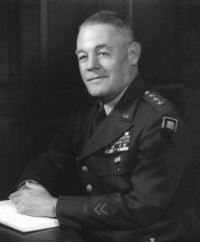
Thomas Wade Herren was a United States Army officer and combat commander whose career spanned from World War I to the post-Korean War era.

This is the service summary of Douglas MacArthur, a General in the United States Army, who began his career in 1903 as a second lieutenant and served in three major military conflicts, going on to hold the highest military offices of both the United States and the Philippines.
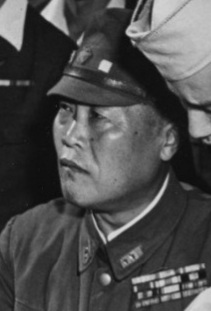
Yoshio Tachibana was a lieutenant general in the Japanese Imperial Army during World War II. He was commander of the Japanese garrison in Chichijima, Ogasawara Islands, and was later tried and executed for the Chichijima incident, a war crime involving torture, extrajudicial execution and cannibalism of American prisoners of war.

William Kelly Harrison Jr. was a highly decorated officer in the United States Army with the rank of Lieutenant General. A graduate of the United States Military Academy, he rose through the ranks to brigadier general during World War II and distinguished himself in combat several times, while serving as the assistant division commander of the 30th Infantry Division during the Normandy Campaign and the Battle of the Bulge. Harrison was decorated with the Distinguished Service Cross, the second highest decoration of the United States military for bravery in combat, for his actions during Operation Cobra.

Mikhail Mikhailovich Meshcheryakov was a Red Army major general and Hero of the Soviet Union.

Far East Command (FECOM) was a unified combatant command of the United States Department of Defense, active from 1947 until 1957, functionally organised to undertake the occupation of Japan and Korea. The 1st and 6th Marine Divisions, who from 1945 to 1948 assisted the Chinese government in occupying northern China, disarming the Japanese, and helping the Kuomintang Chinese without fully getting involved in the Chinese Civil War, were not part of Far East Command and reported to Pacific Command and the U.S. Navy.